


A web-based psychoeducational program for informal caregivers of patients with Alzheimer's disease: a pilot randomized controlled trial
- PMID: 25967983
- PMCID: PMC4468784
- DOI: 10.2196/jmir.3717
A web-based psychoeducational program for informal caregivers of patients with Alzheimer's disease: a pilot randomized controlled trial
Abstract
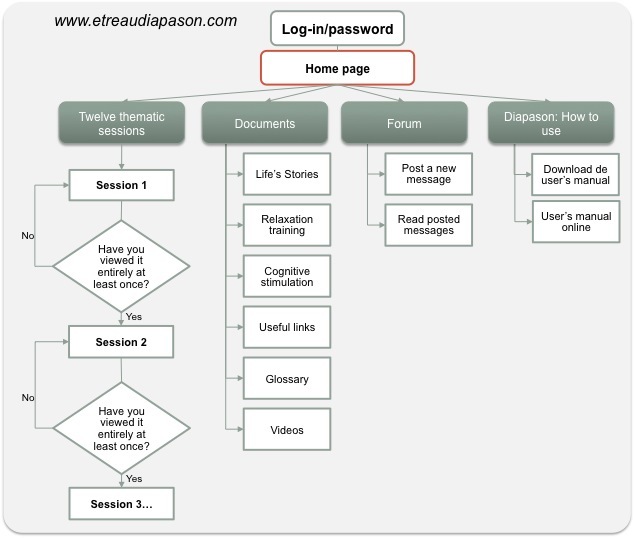
Background: Although several face-to-face programs are dedicated to informal caregivers of persons with dementia, they are not always accessible to overburdened or isolated caregivers. Based on a face-to-face intervention program, we adapted and designed a Web-based fully automated psychoeducational program (called Diapason) inspired by a cognitive approach.
Objective: This study aimed to evaluate through a pilot unblinded randomized controlled trial the efficacy and acceptability of a Web-based psychoeducational program for informal caregivers of persons with Alzheimer's disease (PWAD) based on a mixed methods research design.
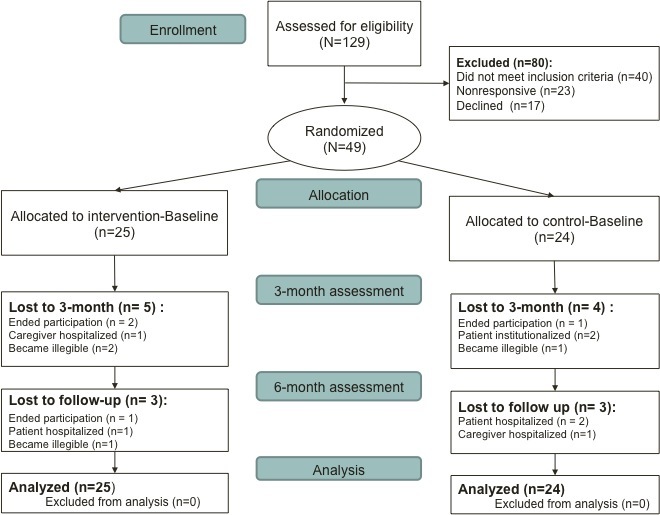
Methods: We recruited and randomized offline 49 informal caregivers of a PWAD in a day care center in Paris, France. They either received the Web-based intervention and usual care for 3 months (experimental group, n=25) or only usual care (control group, n=24). Caregivers' perceived stress (PSS-14, primary outcome), self-efficacy, burden, perceived health status, and depression (secondary outcomes) were measured during 3 face-to-face on-site visits: at baseline, at the end of the program (month 3), and after follow-up (month 6). Additionally, semistructured interviews were conducted with experimental group caregivers at month 6 and examined with thematic analysis.
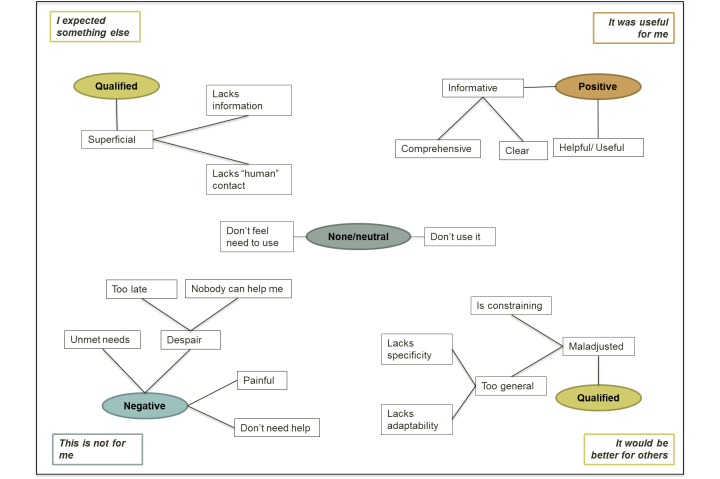
Results: Intention-to-treat analysis did not show significant differences in self-perceived stress between the experimental and control groups (P=.98). The experimental group significantly improved their knowledge of the illness (d=.79, P=.008) from baseline to month 3. Of the 25 participants allocated to the experimental group, 17 (71%) finished the protocol and entirely viewed at least 10 of 12 online sessions. On average, participants used the website 19.72 times (SD 12.88) and were connected for 262.20 minutes (SD 270.74). The results of the satisfaction questionnaire showed that most participants considered the program to be useful (95%, 19/20), clear (100%, 20/20), and comprehensive (85%, 17/20). Significant correlations were found between relationship and caregivers' program opinion (P=.01). Thus, positive opinions were provided by husbands and sons (3/3), whereas qualified opinions were primarily reported by daughters (8/11). Female spouses expressed negative (2/3) or neutral opinions (1/3). Caregivers expected more dynamic content and further interaction with staff and peers.
Conclusions: In this study, quantitative results were inconclusive owing to small sample size. Qualitative results indicated/showed little acceptance of the program and high expectations from caregivers. Caregivers did not rule out their interest in this kind of intervention provided that it met their needs. More dynamic, personalized, and social interventions are desirable. Our recruitment issues pointed out the necessity of in-depth studies about caregivers' help-seeking behaviors and readiness factors.
Trial registration: Clinicaltrials.gov NCT01430286; http://clinicaltrials.gov/ct2/show/NCT01430286 (Archived by WebCite at http://www.webcitation/6KxHaRspL).
Keywords: Alzheimer disease; Internet; eHealth; emotional stress; family caregivers; psychological education; qualitative research; randomized controlled trials.
Conflict of interest statement
Conflicts of Interest: Some authors and researchers (VCL, JW, IC, and ASR) were also involved in the development of the Diapason program.
Figures
References
-
- World Health Organization . Dementia: a public health priority. Geneva: World Health Organization; 2012. [2014-10-03]. http://apps.who.int/iris/bitstream/10665/75263/1/9789241564458_eng.pdf?ua=1.
-
- Alzheimer's Association 2013 Alzheimer's disease facts and figures. Alzheimers Dement. 2013 Mar;9(2):208–45. doi: 10.1016/j.jalz.2013.02.003. http://www.alz.org/downloads/facts_figures_2013.pdf - DOI - PubMed
-
- Blom MM, Bosmans JE, Cuijpers P, Zarit SH, Pot AM. Effectiveness and cost-effectiveness of an internet intervention for family caregivers of people with dementia: design of a randomized controlled trial. BMC Psychiatry. 2013;13:17. doi: 10.1186/1471-244X-13-17. http://www.pubmedcentral.nih.gov/articlerender.fcgi?artid=3557221&tool=p... - DOI - PMC - PubMed
-
- Schulz R, Martire LM. Family caregiving of persons with dementia: prevalence, health effects, and support strategies. Am J Geriatr Psychiatry. 2004;12(3):240–9. http://www.sciencedirect.com/science/article/pii/S1064748112617746 - PubMed
Publication types
MeSH terms
Associated data
LinkOut - more resources
Full Text Sources
Other Literature Sources
Medical
Miscellaneous
