Review
. 2016 Aug;23(4):979-90.
doi: 10.3758/s13423-015-0842-3.

GRAPES-Grounding representations in action, perception, and emotion systems: How object properties and categories are represented in the human brain

Affiliations
Review

GRAPES-Grounding representations in action, perception, and emotion systems: How object properties and categories are represented in the human brain

Alex Martin. Psychon Bull Rev. 2016 Aug.

Abstract

In this article, I discuss some of the latest functional neuroimaging findings on the organization of object concepts in the human brain. I argue that these data provide strong support for viewing concepts as the products of highly interactive neural circuits grounded in the action, perception, and emotion systems. The nodes of these circuits are defined by regions representing specific object properties (e.g., form, color, and motion) and thus are property-specific, rather than strictly modality-specific. How these circuits are modified by external and internal environmental demands, the distinction between representational content and format, and the grounding of abstract social concepts are also discussed.

Trial registration: ClinicalTrials.gov NCT01031407.

Keywords: Cognitive neuroscience of memory; Concepts and categories; Embodied cognition; Neuroimaging and memory.


Figures
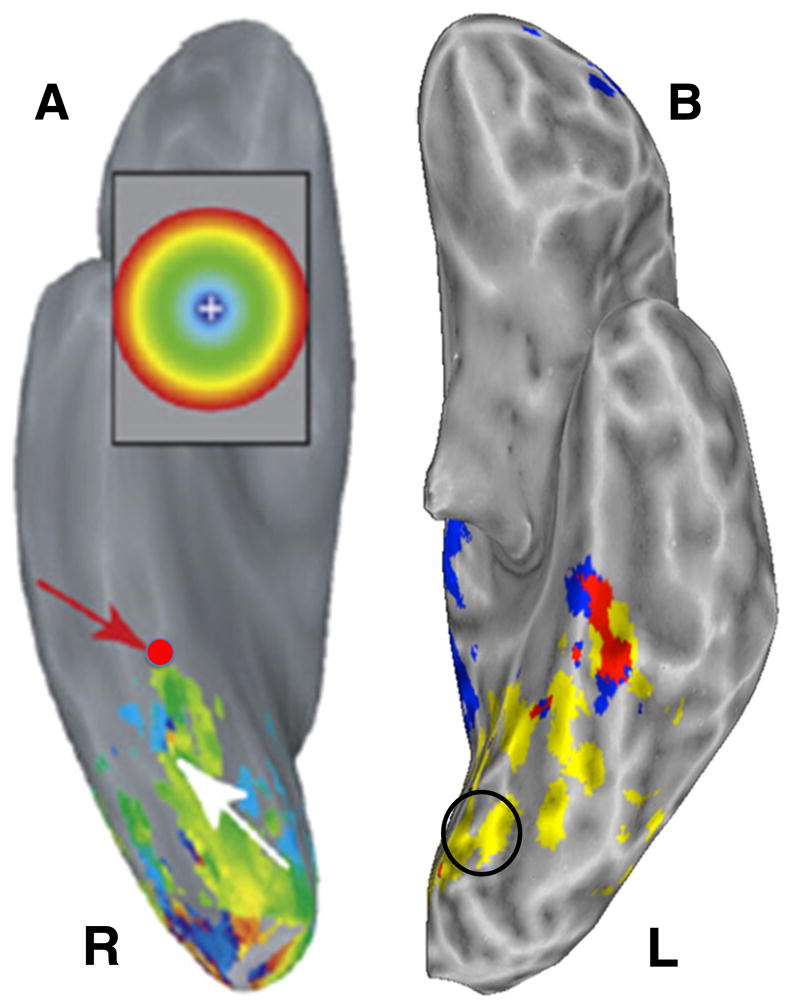
Fig. 1
Fig. 1
Regions of ventral occipitotemporal cortex responsive to perceiving and knowing about color. (A) Ventral view of the right hemisphere of a single patient. The red dot shows the location of the electrode that responded most strongly to blue-purple color and that produced blue-purple visual imagery when stimulated (reprinted with permission; see Murphey et al., 2008, for details). (B) Ventral view of the left hemisphere from the group study on perceiving and knowing about color (Simmons et al., 2007). Regions active when distinguishing subtle differences in hue are shown in yellow. The black circle indicates the approximate location of the lingual gyrus region active when passively viewing colors. The region responding to both perceiving and retrieving information about color is shown in red. Note the close correspondence between that region and the location of the electrode in panel A
Fig. 2
Fig. 2
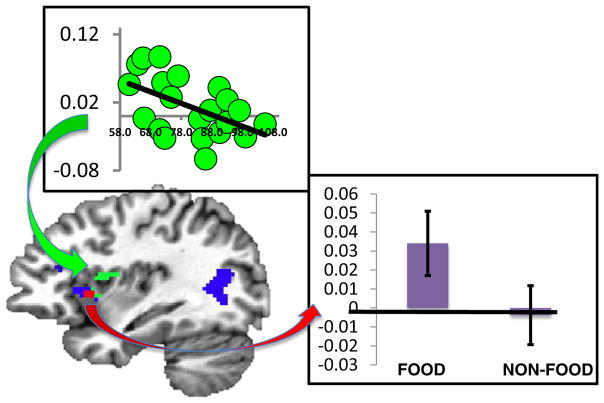
Regions of insular cortex responsive to perceived and inferred taste: Sagittal view of the left hemisphere showing regions in the insular cortex responsive to a pleasant taste (green) and viewing pictures of appetizing foods (blue). The histogram shows activation levels for food and nonfood objects in the anterior insula responsive to taste (red area). The graph shows the level of each subject’s response in primary gustatory cortex (mid-dorsal insula, green) as a function of peripheral blood glucose level. The correlation between glucose and the mid-dorsal insula response was significant (r = –.51) and significantly stronger than the response in this region to nonfood objects (r = –.04; see Simmons et al., 2013, for details)
Fig. 3
Fig. 3
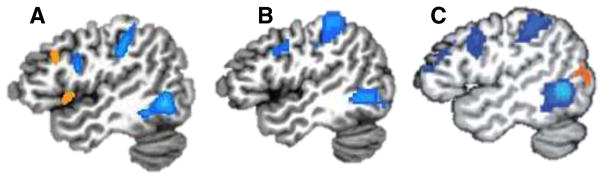
Intrinsic circuitry for perceiving and knowing about “tools.” (A) Task-dependent activations: Sagittal view of the left hemisphere showing regions in posterior middle temporal gyrus, posterior parietal cortex, and premotor cortex that are more active when viewing tools than when viewing animals (blue regions, N = 34) (Stevens et al., in press). (B) Task-independent data: Covariation of slowly fluctuating neural activity recorded at “rest” in a single subject (blue regions). Seeds were in the medial region of the left fusiform gyrus and in the right lateral fusiform gyrus (not shown), identified by the comparison of tools versus animals, respectively (independent localizer). Resting-state time series in the color regions were significantly more correlated with fluctuations in the left medial fusiform gyrus than with those in the right lateral fusiform gyrus (for details, see Stevens et al., in press). (C) Covariation of slowly fluctuating neural activity recorded at “rest” in a group study (blue regions, N = 25). Seeds were in the left posterior middle temporal gyrus and the right posterior superior temporal sulcus, identified by independent localizer scans (see Simmons & Martin, 2012, for details)

References

    1. Adolphs R. The social brain: Neural basis of social knowledge. Annual Review of Psychology. 2009;60:693–716. doi: 10.1146/annurev.psych.60.110707. - DOI - PMC - PubMed
    1. Allport DA. Distributed memory, modular subsystems and dysphasia. In: Newman SP, Epstein R, editors. Current perspectives in dysphasia. New York, NY: Churchill Livingstone; 1985. pp. 32–60.
    1. Amedi A, Malach R, Hendler T, Peled S, Zohary E. Visuohaptic object-related activation in the ventral visual pathway. Nature Neuroscience. 2001;4:687–689. - PubMed
    1. Amedi A, Jacobson G, Hendler T, Malach R, Zohary E. Convergence of visual and tactile shape processing in the human lateral occipital complex. Cerebral Cortex. 2002;12:1202–1212. - PubMed
    1. Amedi A, Stern WM, Camprodon JA, Bermpohl F, Merabet L, Rotman S, … Pascual-Leone A. Shape conveyed by visual-to-auditory sensory substitution activates the lateral occipital complex. Nature Neuroscience. 2007;10:324–330. - PubMed

Associated data