. 2015 May 12;6(3):e00074-15.
doi: 10.1128/mBio.00074-15.

Bacterial swarms recruit cargo bacteria to pave the way in toxic environments

Affiliations

Bacterial swarms recruit cargo bacteria to pave the way in toxic environments

Alin Finkelshtein et al. mBio. .

Abstract

Swarming bacteria are challenged by the need to invade hostile environments. Swarms of the flagellated bacterium Paenibacillus vortex can collectively transport other microorganisms. Here we show that P. vortex can invade toxic environments by carrying antibiotic-degrading bacteria; this transport is mediated by a specialized, phenotypic subpopulation utilizing a process not dependent on cargo motility. Swarms of beta-lactam antibiotic (BLA)-sensitive P. vortex used beta-lactamase-producing, resistant, cargo bacteria to detoxify BLAs in their path. In the presence of BLAs, both transporter and cargo bacteria gained from this temporary cooperation; there was a positive correlation between BLA resistance and dispersal. P. vortex transported only the most beneficial antibiotic-resistant cargo (including environmental and clinical isolates) in a sustained way. P. vortex displayed a bet-hedging strategy that promoted the colonization of nontoxic niches by P. vortex alone; when detoxifying cargo bacteria were not needed, they were lost. This work has relevance for the dispersal of antibiotic-resistant microorganisms and for strategies for asymmetric cooperation with agricultural and medical implications.

Importance: Antibiotic resistance is a major health threat. We show a novel mechanism for the local spread of antibiotic resistance. This involves interactions between different bacteria: one species provides an enzyme that detoxifies the antibiotic (a sessile cargo bacterium carrying a resistance gene), while the other (Paenibacillus vortex) moves itself and transports the cargo. P. vortex used a bet-hedging strategy, colonizing new environments alone when the cargo added no benefit, but cooperating when the cargo was needed. This work is of interest in an evolutionary context and sheds light on fundamental questions, such as how environmental antibiotic resistance may lead to clinical resistance and also microbial social organization, as well as the costs, benefits, and risks of dispersal in the environment.


Figures

FIG 1
FIG 1
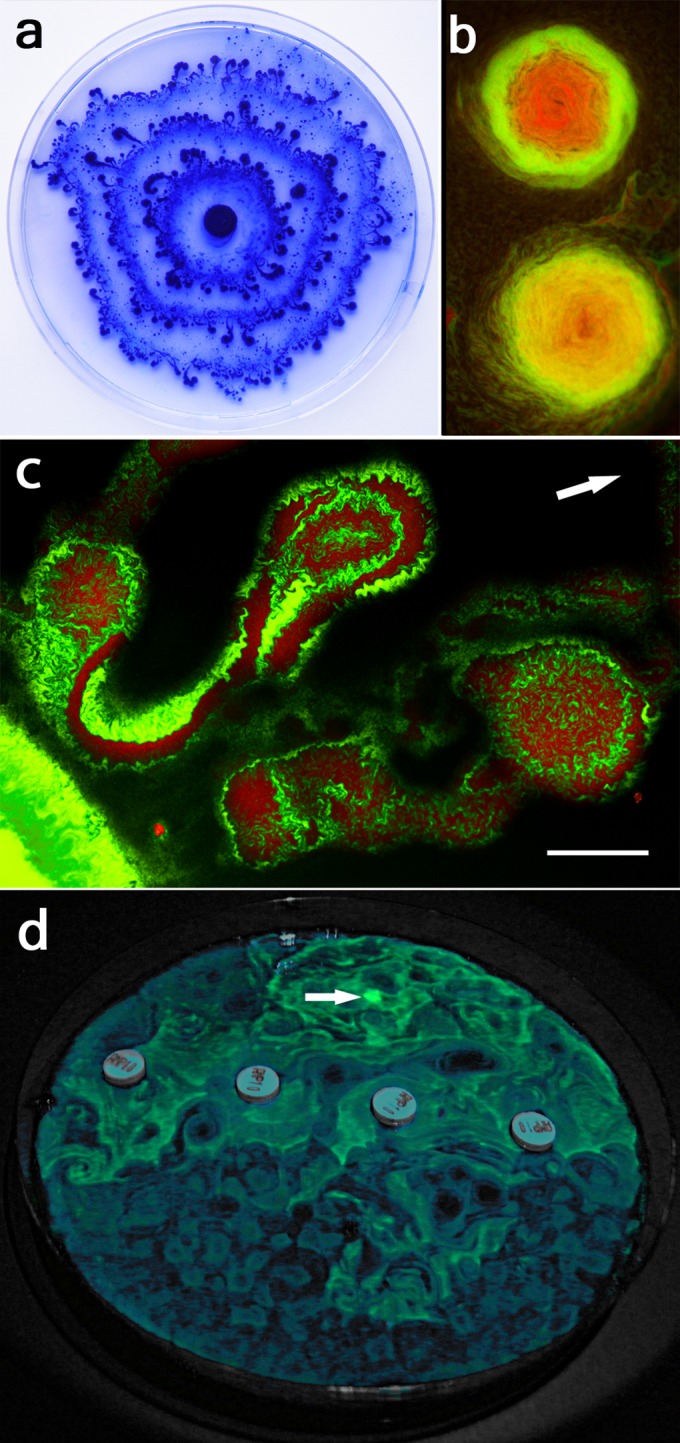
Colony and microcolony imaging of cargo transport. (a) A periodically expanding colony composed of swarming P. vortex and Ampr E. coli cargo imaged after incubation for 72 h at 37°C on a 14-cm-diameter MH agar plate with 200 µg ml−1 Amp. The plate was stained with Coomassie blue to enhance contrast. (b) Imaging by fluorescence microscopy of two moving peripheral colonies (rotating and moving progressively outwards from the inoculation point, in an experiment identical to that shown in panel a), using hexidium iodide to identify P. vortex (red) and GFP expression for E. coli (green). (c) Imaging by fluorescence microscopy of microcolony transport of a Ctxr strain of Enterobacter aerogenes GA2 (stained by Syto 9 [green]) by P. vortex (stained by hexidium iodide [red]) over agar containing 3 µg ml−1 Ctx. The arrow shows the overall direction of transport at a rate of ~3 mm h−1. (d) Transport of a consortium of P. vortex and Ampr E. coli over an MH agar plate with a barrier of Amp created by four Neosensitabs (see Fig. S2 in the supplemental material). Imaging is of E. coli via a blue light LED to visualize GFP expressed by the cargo strain. The scale bar in panel c (300 μm) corresponds to 3.8 cm (panel a), 200 µm (panel b images), and 1.9 cm for the cell in panel d.
FIG 2
FIG 2
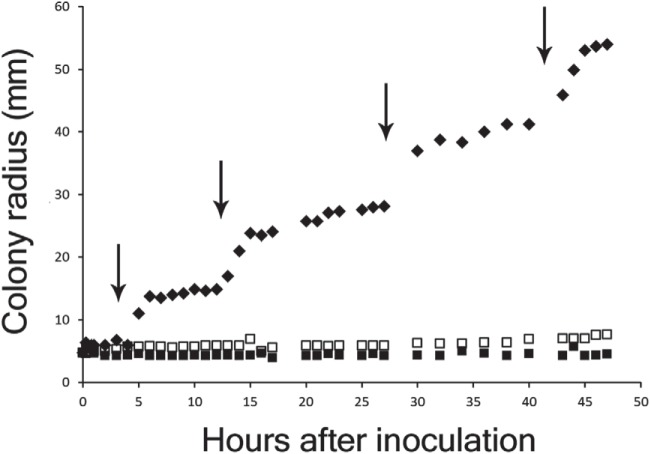
Periodicity of P. vortex swarming with Ampr E. coli cargo in the presence of Amp. One or both strains were inoculated in the center of MH agar plates containing 200 µg ml−1 Amp, followed by incubation at 37°C and tracking the expansion of the resulting colony by automated imaging. White squares, E. coli inoculated alone; black squares, P. vortex alone; black diamonds, both strains. Coinoculation of P. vortex and E. coli allowed a colony to form with a concentric ring architecture (Fig. 1a). At the expanding edge of such a colony, periods of rapid advancement (indicated by arrows) alternated with phases of less active progress (plateaus).
FIG 3
FIG 3
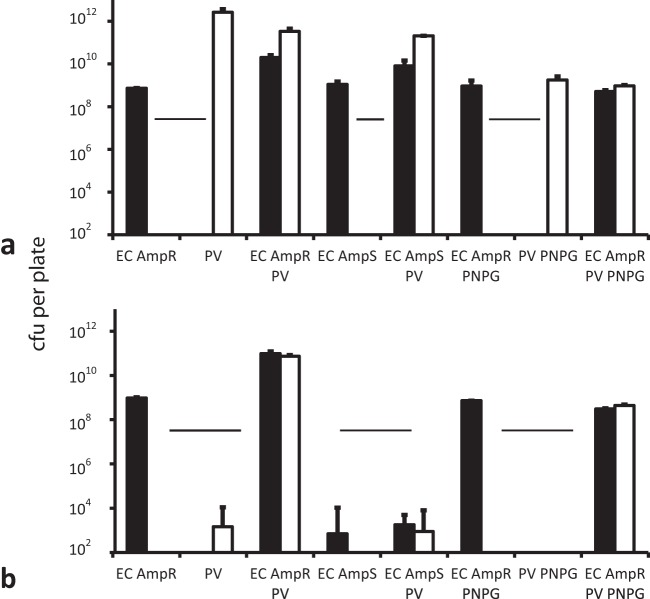
Quantification of the effects of transport on population changes in both transport and cargo strains in the presence and absence of Amp. Selective viable counts (black bars, E. coli; white, P. vortex) were used to determine transporter and cargo CFU after inoculation on 14-cm-diameter MH agar plates with transporter (P. vortex [PV]) and/or cargo (E. coli [EC]) bacteria, with the change in viable count assessed by selective plating after 72 h at 37°C. PNPG, addition of the swarming inhibitor p-nitrophenylglycerol (0.5 mM). The broken horizontal line indicates the inoculum level (5 × 10⁷ CFU) for each species. (a) Plates without antibiotic; (b) plates with 200 µg ml−1 Amp.
FIG 4
FIG 4
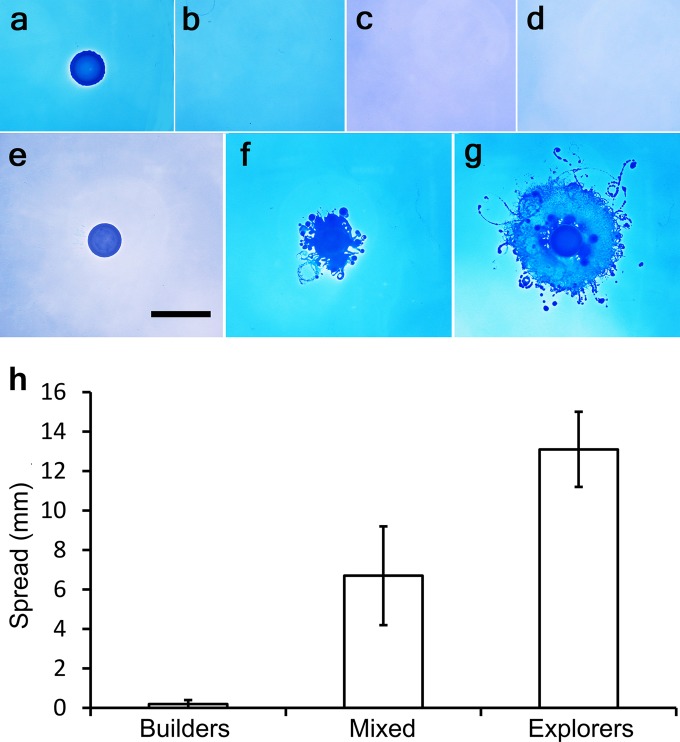
Investigation of the P. vortex subpopulation responsible for cargo transport. Explorers and builders from a P. vortex mixed culture were enriched, and the subpopulations as well as the mixed culture were coinoculated with Ampr E. coli, plated on LB agar with Amp (100 µg ml−1), and incubated for 12 h. (a to d) Controls. Each culture was plated on LB with 100 µg ml−1 Amp, as follows: Ampr E. coli (a), mixed culture (b), builders (c), and explorers (d). P. vortex (mixed culture, builders, and explorers) plated alone on Amp plates showed no growth, while Ampr E. coli managed to grow but did not spread. (e to g) Coinoculation results for the Ampr E. coli with P. vortex builders (e), a mixed culture (f), and explorers (g), respectively. The scale bar in panel e (10.6 mm) also applies to panels a to g. (h) Spreading of E. coli combined with P. vortex (either purified builders or explorers or a mixed culture).
FIG 5
FIG 5
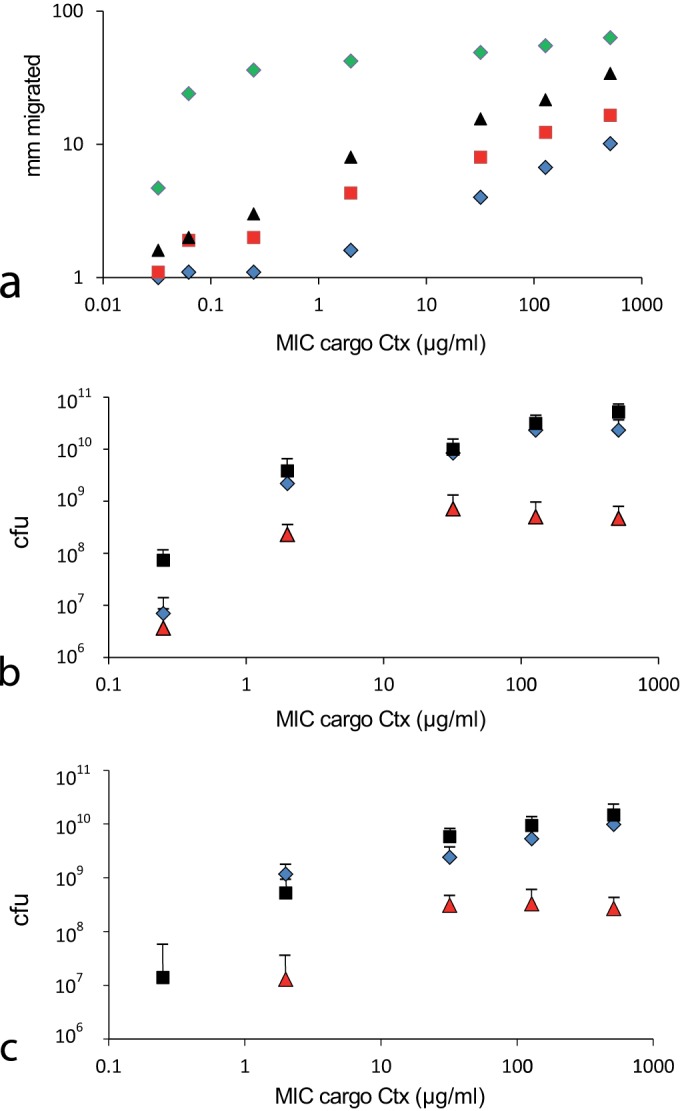
Relationship between the MIC of Ctx for the cargo bacteria and how this affects transport by P. vortex in the presence of this BLA. (a) Migration of a consortium of P. vortex coinoculated with E. coli strains with different levels of resistance to Ctx due to mutations within a TEM-1 type BL. Green diamonds, 0.3 µg ml−1 Ctx in MH agar; black triangles, 1 µg ml−1 Ctx; red squares, 10 µg ml−1 Ctx; blue diamonds, 100 µg ml−1 Ctx. The migration distance from the inoculation point on MH agar plates containing the antibiotic was measured after 72 h and plotted against the MIC of the cargo E. coli. (b) Quantification of cargo and transporter populations after coculture for 72 h on 14-cm-diameter MH agar plates containing 1 µg ml−1 Ctx, plotted against the MIC of Ctx for the cargo bacterium. Red triangles, E. coli strain plated alone; black squares, CFU for E. coli strain plated with P. vortex; blue diamonds, CFU for P. vortex plated with E. coli. (c) Quantification of cargo and transporter bacteria on MH agar containing 10 µg ml−1 Ctx plotted against the MIC of Ctx for the cargo bacterium. Red triangles, E. coli strain plated alone; black squares, CFU for E. coli strain plated with P. vortex; blue diamonds, CFU for P. vortex plated with E. coli. Due to widespread cell death, data points related to the viability of bacterial swarms with cargo bacteria on low-MIC Ctx agar were too small to be reliably quantified and were not plotted.
FIG 6
FIG 6
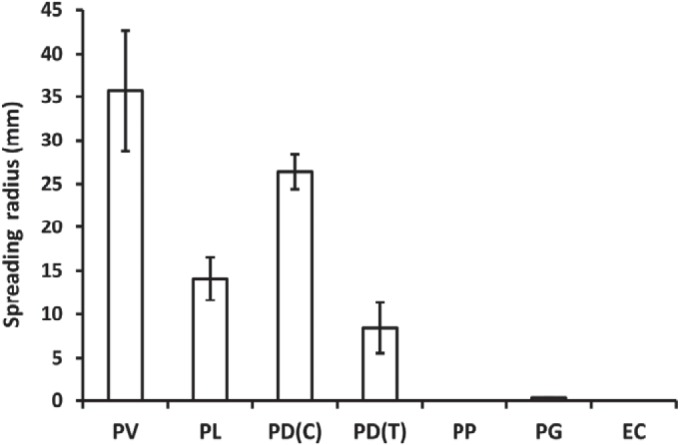
Transport by different Paenibacillus strains of Ampr E. coli in the presence of Amp. MH agar plates containing 200 µg ml−1 Amp were inoculated with a combination of Ampr E. coli and a strain of Paenibacillus, or in control experiments with individual strains. All of the Paenibacillus spp. were able to swarm, but none spread when inoculated alone, due to BLA sensitivity. PV, P. vortex plus E. coli V001; PL, P. lautus DSMZ3035 plus E. coli V001; PD(C), P. dendritiformis C454 (C morphotype) plus E. coli V001; PD(T), P. dendritiformis T454 (T morphotype) plus E. coli V001; PP, P. polymyxa DSMZ36 plus E. coli V001; PG, P. glucanolyticus 5162 plus E. coli V001; EC, E. coli V001 alone.

References

    1. Kearns DB. 2010. A field guide to bacterial swarming motility. Nat Rev Microbiol 8:634–644. doi: 10.1038/nrmicro2405. - DOI - PMC - PubMed
    1. Barak JD, Gorski L, Liang AS, Narm KE. 2009. Previously uncharacterised Salmonella enterica genes required for swarming play a role in seedling colonization. Microbiology 155:3701–3709. doi: 10.1099/mic.0.032029-0. - DOI - PubMed
    1. Mobley HL, Belas R, Lockatell V, Chippendale G, Trifillis AL, Johnson DE, Warren JW. 1996. Construction of a flagellum-negative mutant of Proteus mirabilis: effect on internalization by human renal epithelial cells and virulence in a mouse model of ascending urinary tract infection. Infect Immun 64:5332–5340. - PMC - PubMed
    1. Venturi V, Bertani I, Kerényi A, Netotea S, Pongor S. 2010. Coswarming and local collapse: quorum sensing conveys resilience to bacterial communities by localizing cheater mutants by Pseudomonas aeruginosa. PLoS One 5:e9998. doi: 10.1371/journal.pone.0009998. - DOI - PMC - PubMed
    1. Zhou J, Ma Q, Yi H, Wang L, Song H, Yuan Y-J. 2011. Metabolome profiling reveals metabolic cooperation between Bacillus megaterium and Ketogulonicigenium vulgare during induced swarm motility. Appl Environ Microbiol 77:7023–7030. doi: 10.1128/AEM.05123-11. - DOI - PMC - PubMed

Publication types

LinkOut - more resources