. 2015 Apr-Jun;25(2):88-101.
doi: 10.4103/0971-3026.155823.

Appropriateness criteria of FDG PET/CT in oncology

Affiliations

Appropriateness criteria of FDG PET/CT in oncology

Archi Agrawal et al. Indian J Radiol Imaging. 2015 Apr-Jun.

Abstract

(18)Fluorine-2-fluoro-2-Deoxy-d-glucose ((18)F-FDG) positron emission tomography/computerized tomography (PET/CT) is a well-established functional imaging method widely used in oncology. In this article, we have incorporated the various indications for (18)FDG PET/CT in oncology based on available evidence and current guidelines. Growing body of evidence for use of (18)FDG PET/CT in select tumors is also discussed. This article attempts to give the reader an overview of the appropriateness of using (18)F-FDG PET/CT in various malignancies.

Keywords: 18Fluorine-2-fluoro-2-deoxy-d-glucose; Cancer; guidelines for PET/CT; oncology; positron emission tomography; positron emission tomography/computerized tomography.


Conflict of interest statement

Conflict of Interest: None declared.

Figures

Figure 1 (A-F)
Figure 1 (A-F)
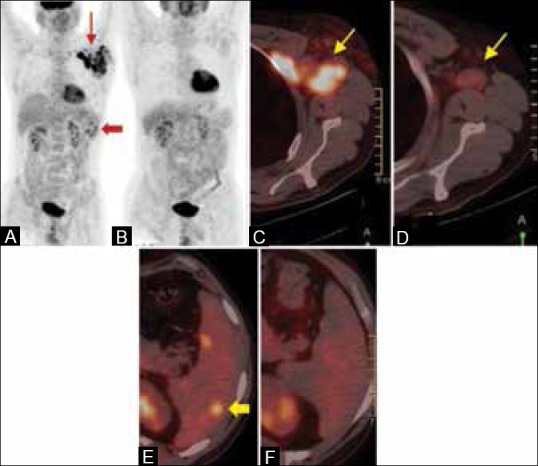
A case of Hodgkin's lymphoma. (A) The maximum intensity projection (MIP) PET pretreatment scan shows bulky left axillary adenopathy (arrows) and hypermetabolic splenic lesions - disease upstaged (block arrow). (B) MIP image of the same patient done after two cycles of chemotherapy (interim response assessment) shows complete metabolic resolution. The fused PET/CT image in the pretreatment scan (C) shows hypermetabolic left axillary nodes. The interim scan in (D) shows residual morphologic nodes with no significant FDG uptake. Hypermetabolic splenic lesions in (E) show complete metabolic and morphologic resolution in (F)
Figure 2 (A and B)
Figure 2 (A and B)
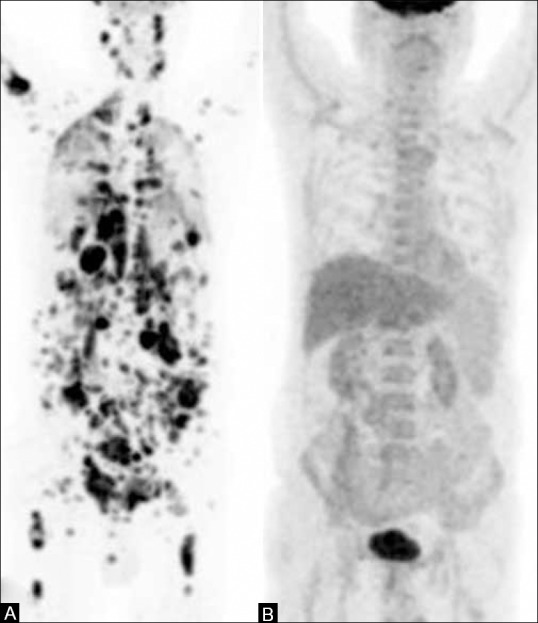
A 65-year-old male, a case of NHL. (A) The pretreatment PET MIP image shows extensive nodal and extranodal involvement (B) PET scan done after completion of six cycles of chemotherapy (post-treatment response assessment) shows complete metabolic resolution of disease
Figure 3 (A-C)
Figure 3 (A-C)
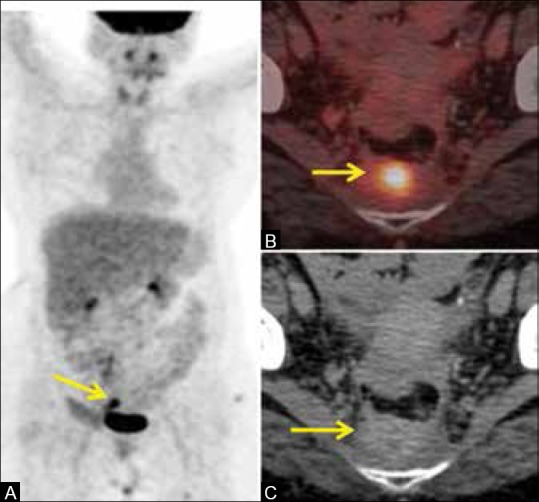
A case of carcinoma rectum post abdomino-perineal resection, 9 months post surgery with increasing CEA. (A) The MIP image of the PET scan shows a hypermetabolic focus in the pelvis (arrow) (B) Fused PET/CT image shows FDG-avid pre-sacral mass (arrow) suspicious for recurrent disease (C) CT image shows a pre-sacral mass. Indeterminate whether it is benign fibrosis or disease recurrence. Biopsy confirmed recurrence of adenocarcinoma
Figure 4 (A-C)
Figure 4 (A-C)
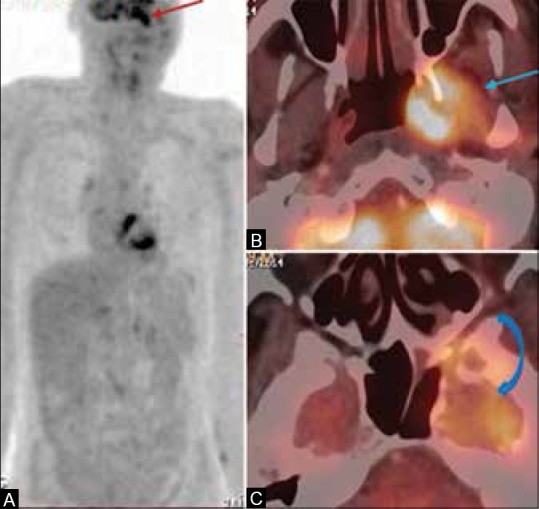
A 59-year-old male, a case of squamous carcinoma of left buccal mucosa, post surgery, chemotherapy, and external radiotherapy given a year back, presented with left facial palsy with no clinical evidence of disease. (A) The MIP image of the PET scan shows a hypermetabolic focus in the left infra-temporal fossa (ITF) (arrow) (B and C) Fused PET/CT image shows hypermetabolic mass in the left ITF involving the pterygoid muscles (arrow) with intracranial extension into the left cavernous sinus and left temporal lobe (curved arrow) suggestive of recurrent disease
Figure 5 (A-D)
Figure 5 (A-D)
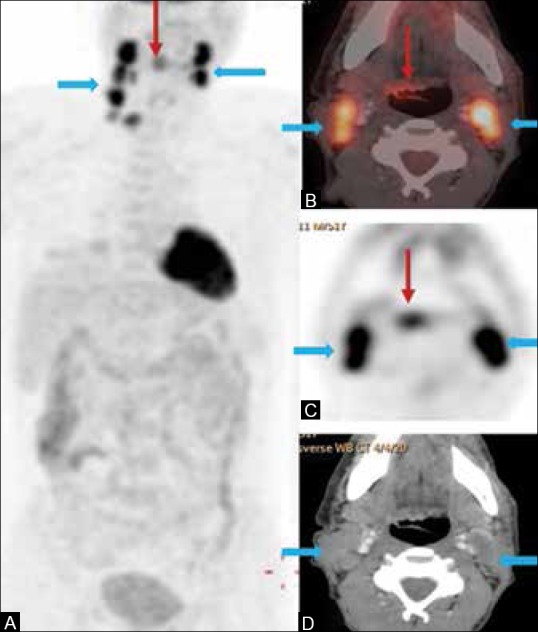
A 51-year-old old male presented with bilateral cervical adenopathy; biopsy revealed it as metastatic squamous cell cancer, unknown primary. (A) PET image shows hypermetabolic bilateral cervical adenopathy (block arrows) (B) Fused PET/CT image shows a subtle hypermetabolic lesion involving the right base tongue (BOT) and vallecula (arrow) (C) PET image shows the same (D) CECT image shows bilateral necrotic cervical nodes, but the primary lesion is not evident. Biopsy of the BOT and vallecula showed squamous cell carcinoma (primary detected)
Figure 6 (A-D)
Figure 6 (A-D)
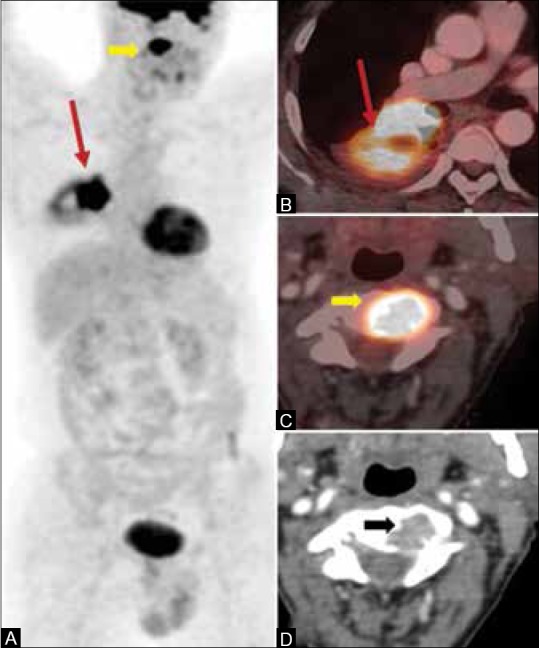
A 54-year-old male, diagnosed case of adenocarcinoma of the right lung. PET/CT scan done for initial staging shows hypermetabolic right lower lobe mass (arrows in A and B) and an unsuspected metastatic lesion in C2 vertebral body (block arrows in A, C, and D)
Figure 7 (A-F)
Figure 7 (A-F)
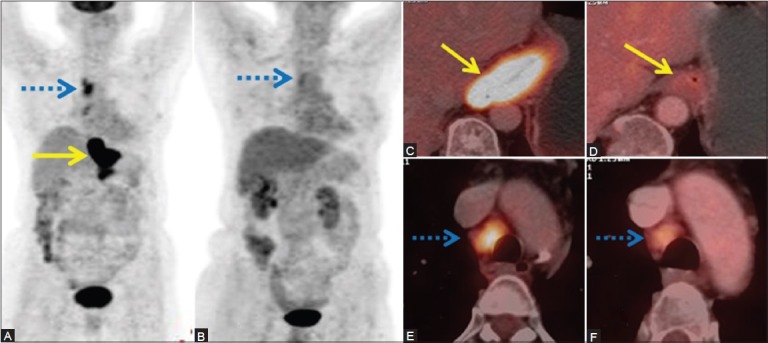
A case of adenocarcinoma of the distal esophagus. (A) Pretreatment MIP image shows hypermetabolic mass in the distal esophagus (arrow) and hypermetabolic metastatic mediastinal nodes (dashed arrow). (C and E) Fused PET/CT images showing the same. (B) Response assessment PET scan done after three cycles of neoadjuvant chemotherapy (NACT) shows complete metabolic and morphologic regression of the mass with partial metabolic and morphologic regression of the mediastinal nodes (dashed arrow) on MIP. (D), (F) The same is depicted in fused PET/CT images (arrow in d and dashed arrow in F)
Figure 8 (A-E)
Figure 8 (A-E)
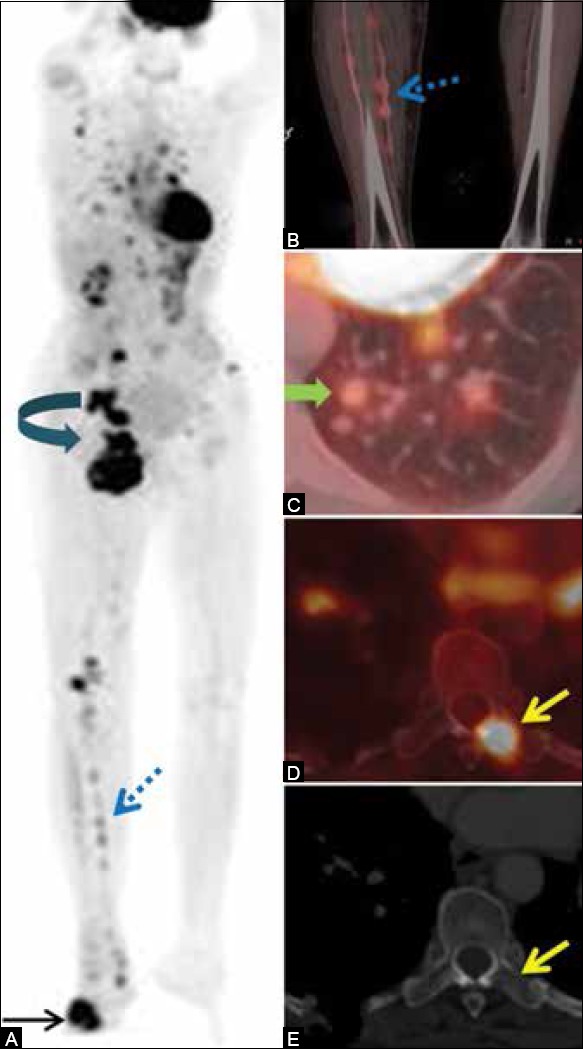
(A-E) A 65-year-old lady, a case of malignant melanoma of the right foot. PET/CT done for staging shows FDG-avid mass in the right foot [site of primary (arrow)], multiple interstitial nodules in the right lower leg (dashed arrows in A and B), right inguinal and pelvic nodal masses (curved arrow), multiple metastatic lung nodules (block arrow), and marrow metastasis in the dorsal vertebra (yellow arrow). PET/CT is a one-stop-shop imaging for detection of metastases in malignant melanoma

References

    1. A Guide to Clinical PET in Oncology. [Last accessed on 2014 Aug 16]. Available from: http://www.pub.iaea.org/MTCD/publications/PDF/te_1605_web.pdf .
    1. PET/CT Practice Guidelines in Oncology-Society of Nuclear Medicine and Molecular Imaging. [Last accessed on 2014 Aug 16]. Available from: http://www.snm.org/docs/PET./OncologyPracticeGuidelineSummary.pdf .
    1. Kostakoglu L, Cheson BD. Current role of FDG PET/CT in lymphoma. Eur J Nucl Med Mol Imaging. 2014;41:1004–27. - PubMed
    1. Hutchings M, Loft A, Hansen M, Pedersen LM, Berthelsen AK, Keiding S, et al. Positron emission tomography with or without computed tomography in the primary staging of Hodgkin's lymphoma. Haematologica. 2006;91:482–9. - PubMed
    1. Kwee TC, Kwee RM, Nievelstein RA. Imaging in staging of malignant lymphoma: A systematic review. Blood. 2008;111:504–16. - PubMed