. 2012 Aug 28:2013:178646.
doi: 10.5402/2013/178646. eCollection 2013.

Antimicrobial Pressure of Ciprofloxacin and Gentamicin on Biofilm Development by an Endoscope-Isolated Pseudomonas aeruginosa

Affiliations

Antimicrobial Pressure of Ciprofloxacin and Gentamicin on Biofilm Development by an Endoscope-Isolated Pseudomonas aeruginosa

Idalina Machado et al. ISRN Biotechnol. .

Abstract

This work aims at characterizing endoscope biofilm-isolated (PAI) and reference strain P. aeruginosa (PA) adhesion, biofilm formation and sensitivity to antibiotics. The recovery ability of the biofilm-growing bacteria subjected to intermittent antibiotic pressure (ciprofloxacin (CIP) and gentamicin (GM)), as well as the development of resistance towards antibiotics and benzalkonium chloride (BC), were also determined. The capacity of both strains to develop biofilms was greatly impaired in the presence of CIP and GM. Sanitization was not complete allowing biofilm recovery after the intermittent cycles of antibiotic pressure. The environmental pressure exerted by CIP and GM did not develop P. aeruginosa resistance to antibiotics nor cross-resistance towards BC. However, data highlighted that none of the antimicrobials led to complete biofilm eradication, allowing the recovery of the remaining adhered population possibly due to the selection of persister cells. This feature may lead to biofilm recalcitrance, reinforcement of bacterial attachment, and recolonization of other sites.


Figures
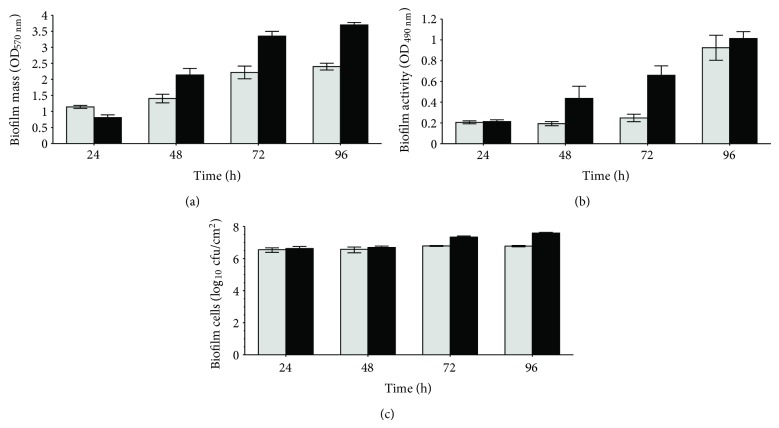
Figure 1
Figure 1
Biomass (OD570 nm) (a), metabolic activity (OD490 nm) (b) and number of cultivable cells (c) of P. aeruginosa ATCC (light grey) and P. aeruginosa isolated strain (black) biofilms. Biofilms where grown in TSB and characterized at 24, 48, 72 and 96 h. Bars represent the average of 3 independent repeats ± SD.
Figure 2
Figure 2
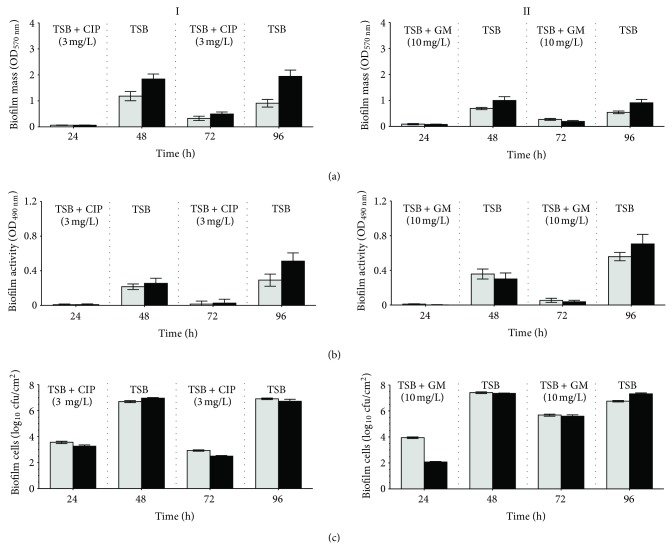
Biomass (OD570 nm) (a), metabolic activity (OD490 nm) (b), and number of cells (c) of P. aeruginosa ATCC (light grey) and P. aeruginosa isolated strain (black) biofilms. Biofilms were continuously grown in TSB for 96 h with the application of intermittent cycles for 24 h of 3 mg/mL of CIP (I) and 10 mg/mL GM (II).
Figure 3
Figure 3
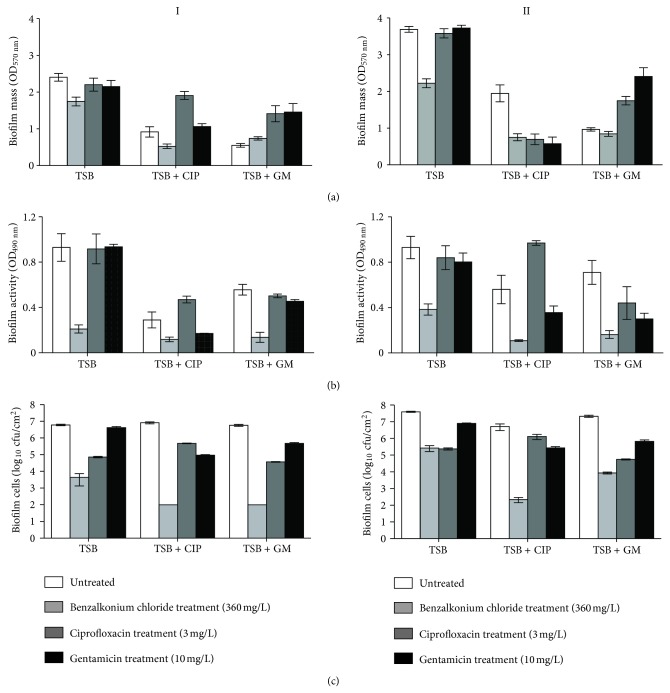
Biomass (OD570 nm) (a), metabolic activity (OD490 nm) (b), and number of cultivable cells (c) of 96-hour-old biofilms formed by P. aeruginosa ATCC (I) and P. aeruginosa isolated strain (II). Biofilms were continuously grown in TSB for 96 h (TSB) or with the application of intermittent cycles for 24 h of 3 mg/mL of CIP (TSB + CIP) and 10 mg/mL GM (TSB + GM). Normal biofilms (control, white) and treated with BC (light grey), CIP (dark grey), and GM (black).

References

    1. de Bentzmann S., Plésiat P. The Pseudomonas aeruginosa opportunistic pathogen and human infections. Environmental Microbiology. 2011;13(7):1655–1665. doi: 10.1111/j.1462-2920.2011.02469.x. - DOI - PubMed
    1. Costerton J. W., Stewart P. S., Greenberg E. P. Bacterial biofilms: a common cause of persistent infections. Science. 1999;284(5418):1318–1322. doi: 10.1126/science.284.5418.1318. - DOI - PubMed
    1. Hill K. E., Malic S., McKee R., et al. An in vitro model of chronic wound biofilms to test wound dressings and assess antimicrobial susceptibilities. Journal of Antimicrobial Chemotherapy. 2010;65(6):1195–1206. doi: 10.1093/jac/dkq105. - DOI - PubMed
    1. May T. B., Shinabarger D., Maharaj R., et al. Alginate synthesis by Pseudomonas aeruginosa: a key pathogenic factor in chronic pulmonary infections of cystic fibrosis patients. Clinical Microbiology Reviews. 1991;4(2):191–206. - PMC - PubMed
    1. Buss A. J., Been M. H., Borgers R. P., et al. Endoscope disinfection and its pitfalls-requirement for retrograde surveillance cultures. Endoscopy. 2008;40(4):327–332. doi: 10.1055/s-2007-995477. - DOI - PubMed

LinkOut - more resources