. 2015 Apr 20:7:ecurrents.outbreaks.9a6530ab7bb9096b34143230ab01cdef.
doi: 10.1371/currents.outbreaks.9a6530ab7bb9096b34143230ab01cdef.

Understanding the emergence of ebola virus disease in sierra leone: stalking the virus in the threatening wake of emergence

Affiliations

Understanding the emergence of ebola virus disease in sierra leone: stalking the virus in the threatening wake of emergence

Nadia Wauquier et al. PLoS Curr. .

Abstract

Since Ebola Virus Disease (EVD) was first identified in 1976 in what is now the Democratic Republic of Congo, and despite the numerous outbreaks recorded to date, rarely has an epidemic origin been identified. Indeed, among the twenty-one most documented EVD outbreaks in Africa, an index case has been identified four times, and hypothesized in only two other instances. The initial steps of emergence and spread of a virus are critical in the development of a potential outbreak and need to be thoroughly dissected and understood in order to improve on preventative strategies. In the current West African outbreak of EVD, a unique index case has been identified, pinpointing the geographical origin of the epidemic in Guinea. Herein, we provide an accounting of events that serve as the footprint of EVD emergence in Sierra Leone and a road map for risk mitigation fueled by lessons learned.

Keywords: Ebola Virus Disease; Sierra Leone; emergence; index case.


Figures
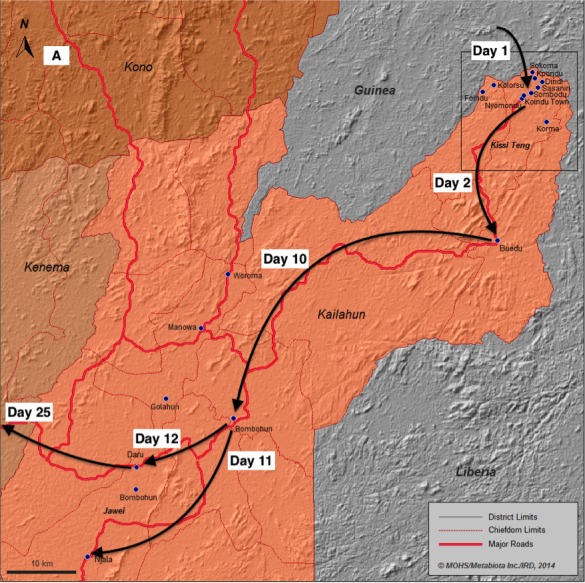
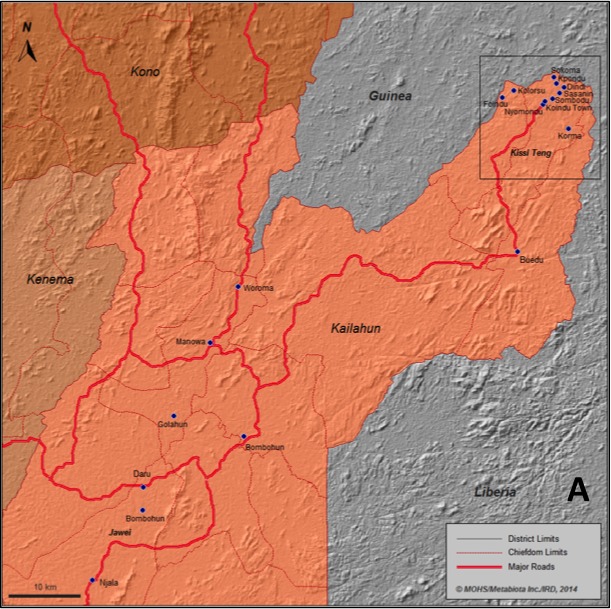
A. Ebola Virus Fever (EVD) emergence in Sierra Leone
The Kailahun District (Orange) that has been the first one reporting confirmed cases of EVD in country. Villages and town reporting EVD laboratory confirmed cases: Blue point; main road = red line; administrative boundaries = grey line. Black arrow = Chronology and direction of the EVD spread. Top right square delineate the emergence zone (see 1B) where intense transmission occurred for day 1 to day 21 after confirmation of the index case.
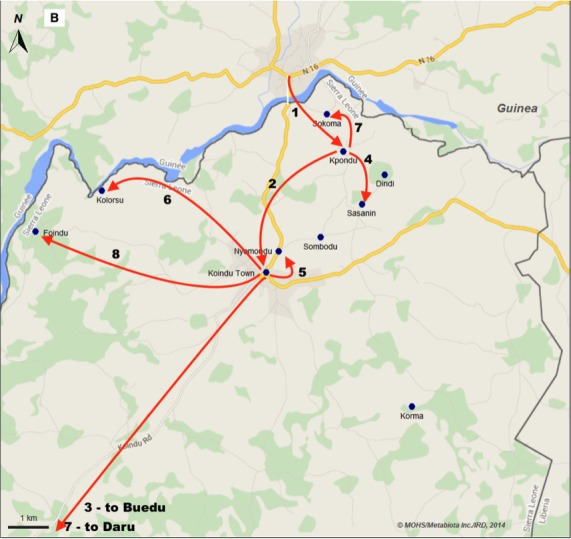
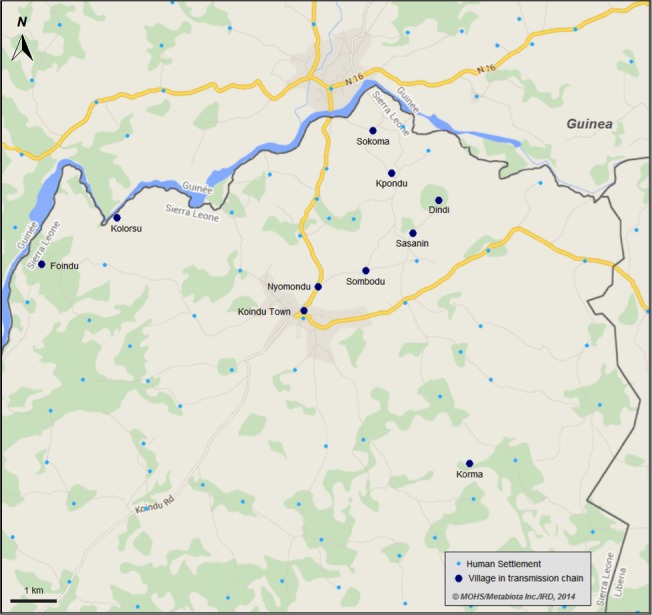
Fig 1B. Ebola Virus Fever (EVD) emergence in Sierra Leone.
The first villages (blue points) form the North Eastern part of the Kailahun District that reported confirmed case of EVD and become EVD epidemic chain of transmission. Red arrow = form 1 to 8 showing the chronology (numbers) and direction (arrow) of the spread of the EVD during the two first week of the epidemic.
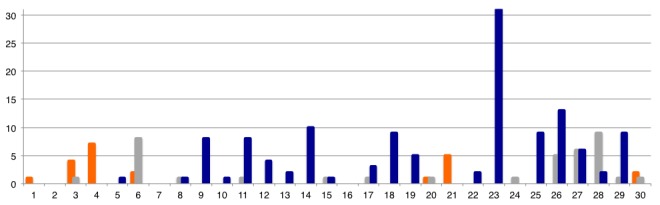
Ebola Virus Disease emergence in Sierra Leone, 2014: Main unprecedented epidemic chain by chiefdom, Kailahun District.
Ordinate = Number of case; abscise = Days; Bar = Three major epidemic chains that’s sparked the outbreak in country (Kissi Tengue = orange bar; Nongowa = Black bar; Jawei = Dark blue bar). Starting on day 1 as for the 25th of Mai 2014 when the first EVD case was confirmed form Kissi Tengue chiefdom. For each chiefdom, one can clearly observed two waves of cases: the second wave constituted by secondary contacts from the first wave (i.e. emerging case in the chiefdom territory) with an estimated incubation period of 10+/- 5 days between the two waves.
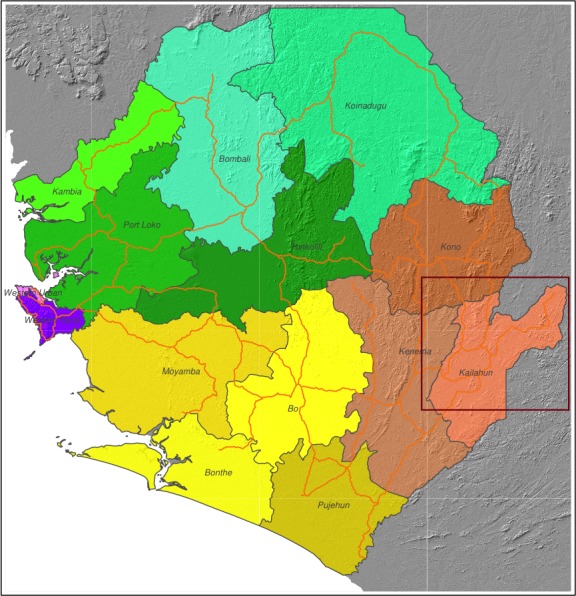
Figure S1. Administrative map of the Districts of Sierra Leone.
Green = Northern province districts (including Ebola Virus Disease epidemic districts of Port Loko and Kambia among others); Purple = Western areas districts; Yellow = Southern Province districts; Orange = Eastern province districts (including main Ebola Virus Disease epidemic of Kailahun and Kenema districts); Black line = district delineation; Orange line = main roads. Red square = Study area of Ebola Virus Disease emergence in country.
Figure S2. Primary site of Ebola Virus Disease (EVD) emergence featuring the Kailahun District, Eastern Province of Sierra Leone.
Square = northern tip of Kailahun District were EVD emerged in country; Blue solid circle = Villages with laboratory confirmed case of EVD (i.e. epidemic chain) during the 3 week time period after the first EVD laboratory confirmed case in country.
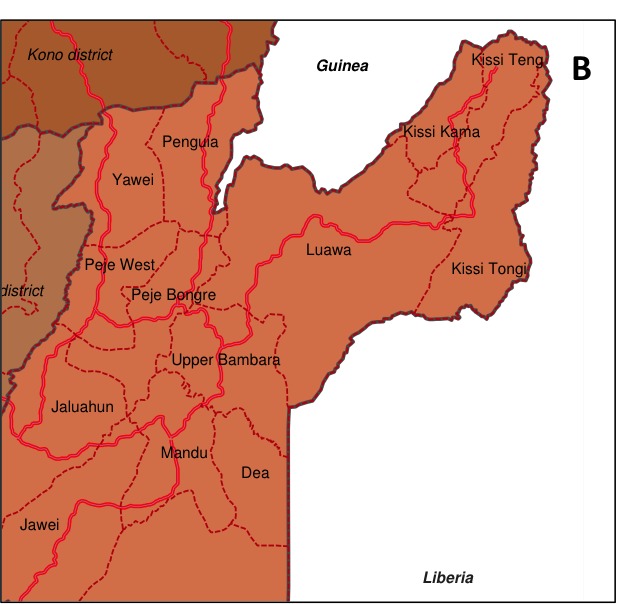
Figure S2B. Primary site of Ebola Virus Disease (EVD) emergence featuring the Kailahun District, Eastern Province of Sierra Leone.
Map of Northern Kailahun District featuring the chiefdoms and their border (red dotted line).
Figure S3. Northern Kailahun District (Eastern Province of Sierra Leone) where Ebola Virus Disease emerged in country on May 25, 2014.
Dark blue solid circle = Villages with epidemic chain of transmission during the 3 first week of EVD emergence in country (May to June 2014); Light blue solid circle = Villages without epidemic chain; Yellow line = main roads; Simple and double gray lines = secondary roads
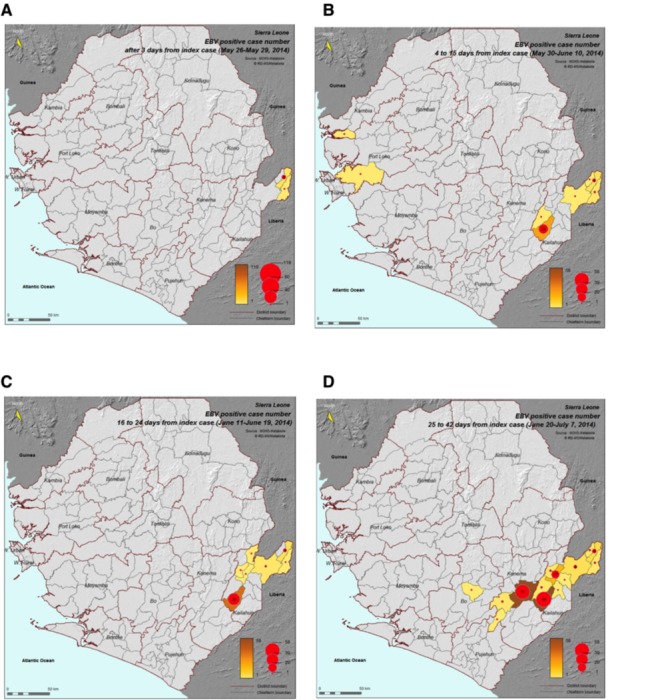
Figure S4. The spread of Ebola Virus Disease (EVD) during the first phase of its extension in Sierra Leone.
Laboratory cumulative confirmed EVD case by chiefdom for four consecutive period of time during the first phase of EVD epidemic in Sierra Leone (2014). Left to right, top to bottom: (A) May 26 to May 29; (B) May 30 to June 10. (C) June 11 to June 19. (D) June 20 to July 7.

References

    1. WHO. International Commission. "Ebola hemorrhagic fever in Zaire. Bulletin of the World Health Organization, 56, 271-293 (1976). - PMC - PubMed
    1. D.L. Heymann, J.S. Weisfeld, P.A. Webb, J.M. Johnson, T. Cairns, et al. Ebola Hemorrhagic Fever: Tandala, Zaire, 1977-1978. Journal of Infectious Diseases. 142, 372-376 (1980). - PubMed
    1. A.J. Georges, E.M. Leroy, A.A. Renaut, C.T. Benissan, R.J. Nabias et al. Ebola Hemorrhagic Fever Outbreaks in Gabon, 1994-1997: Epidemiologic and Health Control Issues. Journal of Infectious Diseases. 17, S65-75 (1999). - PubMed
    1. A. Khan, F.K. Tshioko, D.L. Heymann, B. Le Guenno, P. Nabeth, et al. The Reemergence of Ebola Hemorrhagic Fever, Democratic Republic of the Congo, 1995. Journal of Infectious Diseases. 1999; 179, S76-S86 (1999). - PubMed
    1. E.M. Leroy, A. Epelboin, V. Mondonge, X. Pourrut, J.P. Gonzalez et al. Human Ebola outbreak resulting from direct exposure to fruit bats in Luebo, Democratic Republic of Congo, 2007. Vector Borne Zoonotic Diseases. 6, 723-8 (2009). - PubMed

LinkOut - more resources