


State-building and human resources for health in fragile and conflict-affected states: exploring the linkages
- PMID: 25971407
- PMCID: PMC4488955
- DOI: 10.1186/s12960-015-0023-5
State-building and human resources for health in fragile and conflict-affected states: exploring the linkages
Abstract
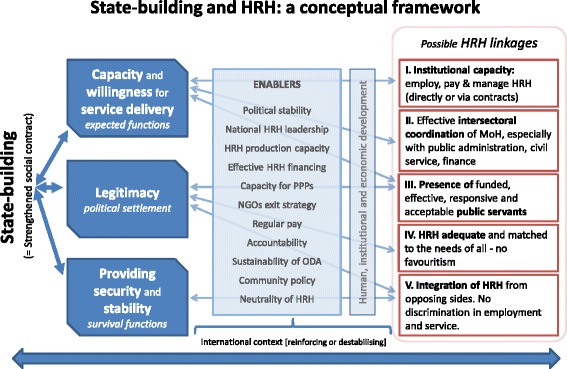
Background: Human resources for health are self-evidently critical to running a health service and system. There is, however, a wider set of social issues which is more rarely considered. One area which is hinted at in literature, particularly on fragile and conflict-affected states, but rarely examined in detail, is the contribution which health staff may or do play in relation to the wider state-building processes. This article aims to explore that relationship, developing a conceptual framework to understand what linkages might exist and looking for empirical evidence in the literature to support, refute or adapt those linkages.
Methods: An open call for contributions to the article was launched through an online community. The group then developed a conceptual framework and explored a variety of literatures (political, economic, historical, public administration, conflict and health-related) to find theoretical and empirical evidence related to the linkages outlined in the framework. Three country case reports were also developed for Afghanistan, Burundi and Timor-Leste, using secondary sources and the knowledge of the group.
Findings: We find that the empirical evidence for most of the linkages is not strong, which is not surprising, given the complexity of the relationships. Nevertheless, some of the posited relationships are plausible, especially between development of health cadres and a strengthened public administration, which in the long run underlies a number of state-building features. The reintegration of factional health staff post-conflict is also plausibly linked to reconciliation and peace-building. The role of medical staff as part of national elites may also be important.
Conclusions: The concept of state-building itself is highly contested, with a rich vein of scepticism about the wisdom or feasibility of this as an external project. While recognizing the inherently political nature of these processes, systems and sub-systems, it remains the case that state-building does occur over time, driven by a combination of internal and external forces and that understanding the role played in it by the health system and health staff, particularly after conflicts and in fragile settings, is an area worth further investigation. This review and framework contribute to that debate.
References
-
- OECD . State building in situations of fragility. Paris: OECD; 2008.
-
- LinkedIn. Group health systems in fragile and conflict affected states: a subgroup of Health Systems Global. https://www.linkedin.com/groups?home=&gid=6611870&trk=hp-feed-group-name. Accessed 3 Feb 2015.
-
- Mcloughlin C. Topic guide on fragile States. Birmingham, UK: Governance and Social Development Resource Centre, University of Birmingham; 2012.
MeSH terms
LinkOut - more resources
Full Text Sources
Other Literature Sources
Medical
Miscellaneous
