. 2015 May 14:16:156.
doi: 10.1186/s12859-015-0597-x.

ISOpureR: an R implementation of a computational purification algorithm of mixed tumour profiles

Affiliations

ISOpureR: an R implementation of a computational purification algorithm of mixed tumour profiles

Catalina V Anghel et al. BMC Bioinformatics. .

Abstract

Background: Tumour samples containing distinct sub-populations of cancer and normal cells present challenges in the development of reproducible biomarkers, as these biomarkers are based on bulk signals from mixed tumour profiles. ISOpure is the only mRNA computational purification method to date that does not require a paired tumour-normal sample, provides a personalized cancer profile for each patient, and has been tested on clinical data. Replacing mixed tumour profiles with ISOpure-preprocessed cancer profiles led to better prognostic gene signatures for lung and prostate cancer.

Results: To simplify the integration of ISOpure into standard R-based bioinformatics analysis pipelines, the algorithm has been implemented as an R package. The ISOpureR package performs analogously to the original code in estimating the fraction of cancer cells and the patient cancer mRNA abundance profile from tumour samples in four cancer datasets.

Conclusions: The ISOpureR package estimates the fraction of cancer cells and personalized patient cancer mRNA abundance profile from a mixed tumour profile. This open-source R implementation enables integration into existing computational pipelines, as well as easy testing, modification and extension of the model.


Figures
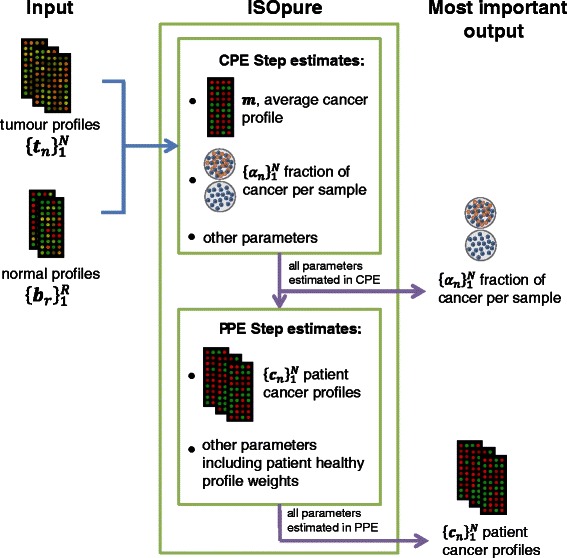
Figure 1
Figure 1
ISOpure workflow. An overview of the ISOpure algorithm, illustrating the inputs and the most important outputs of the Cancer Profile Estimation (CPE) and the Patient Profile Estimation (PPE) steps. The CPE step estimates an average cancer profile over all patients and the proportion of cancer in each tumour, as well as the patient healthy profiles (as weights of input profiles). The healthy profile weights are re-estimated in the PPE step. This second step estimates the purified cancer profile for each patient. All estimated parameters from the CPE and PPE steps are output by the ISOpureR functions ISOpure.step1.CPE and ISOpure.step2.PPE.
Figure 2
Figure 2
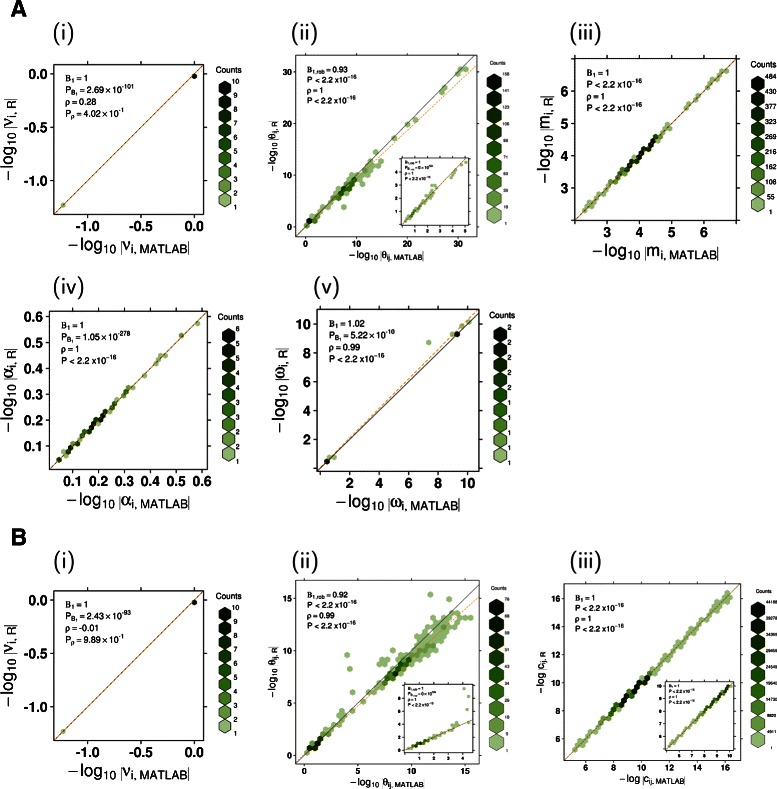
A comparison of parameters estimated by the MATLAB and R implementations of ISOpure for the Beer dataset. Each plot shows the entries of a parameter estimated using ISOpureR plotted against the corresponding entries estimated using the MATLAB code. The parameter is an average over 49 models run with different initial conditions (one MATLAB model for the Beer dataset resulted in a zero θ value, and was dropped). The line y=x is indicated in black, and the linear regression line, or robust regression line for θ, is dashed orange. (A) Parameters from the Cancer Profile Estimation step of ISOpure: (i) ν, the hyper-parameter for the Dirichlet distribution over θ, (ii) θ, the proportion of a patient sample from a known healthy-tissue profile, (iii) m, the average mRNA abundance cancer profile, (iv) α, the fraction of cancer cells for every patient sample, (v) ω a hyper-parameter for the Dirichlet distribution over m. (B) Parameters from the Patient Profile Estimation step of ISOpure: (i) ν, the hyper-parameter for the Dirichlet distribution over θ, (ii) θ, the proportion of a patient sample from a known healthy-tissue profile, (iii) c n, the purified mRNA abundance cancer profile for each patient.

References

    1. Ein-Dor L, Kela I, Getz G, Givol D, Domany E. Outcome signature genes in breast cancer: is there a unique set? Bioinformatics. 2005;21(2):171–8. doi: 10.1093/bioinformatics/bth469. - DOI - PubMed
    1. Ng CK, Weigelt B, A’Hern R, Bidard FC, Lemetre C, Swanton C, et al. Predictive performance of microarray gene signatures: impact of tumor heterogeneity and multiple mechanisms of drug resistance. Cancer Res. 2014;74(11):2946–61. doi: 10.1158/0008-5472.CAN-13-3375. - DOI - PMC - PubMed
    1. Fisher R, Pusztai L, Swanton C. Cancer heterogeneity: implications for targeted therapeutics. Br J Cancer. 2013;108(3):479–85. doi: 10.1038/bjc.2012.581. - DOI - PMC - PubMed
    1. Shen-Orr SS, Gaujoux R. Computational deconvolution: extracting cell type-specific information from heterogeneous samples. Curr Opin Immunol. 2013;25(5):571–8. doi: 10.1016/j.coi.2013.09.015. - DOI - PMC - PubMed
    1. Yau C, Mouradov D, Jorissen RN, Colella S, Mirza G, Steers G, et al. A statistical approach for detecting genomic aberrations in heterogeneous tumor samples from single nucleotide polymorphism genotyping data. Genome Biol. 2010; 11(9):92. - PMC - PubMed

Publication types