. 2015 Jul 2;126(1):61-8.
doi: 10.1182/blood-2015-02-626846. Epub 2015 May 13.

Hypermorphic mutation of phospholipase C, γ2 acquired in ibrutinib-resistant CLL confers BTK independency upon B-cell receptor activation

Affiliations

Hypermorphic mutation of phospholipase C, γ2 acquired in ibrutinib-resistant CLL confers BTK independency upon B-cell receptor activation

Ta-Ming Liu et al. Blood. .

Abstract

Ibrutinib has significantly improved the outcome of patients with relapsed chronic lymphocytic leukemia (CLL). Recent reports attribute ibrutinib resistance to acquired mutations in Bruton agammaglobulinemia tyrosine kinase (BTK), the target of ibrutinib, as well as the immediate downstream effector phospholipase C, γ2 (PLCG2). Although the C481S mutation found in BTK has been shown to disable ibrutinib's capacity to irreversibly bind this primary target, the detailed mechanisms of mutations in PLCG2 have yet to be established. Herein, we characterize the enhanced signaling competence, BTK independence, and surface immunoglobulin dependence of the PLCG2 mutation at R665W, which has been documented in ibrutinib-resistant CLL. Our data demonstrate that this missense alteration elicits BTK-independent activation after B-cell receptor engagement, implying the formation of a novel BTK-bypass pathway. Consistent with previous results, PLCG2(R665W) confers hypermorphic induction of downstream signaling events. Our studies reveal that proximal kinases SYK and LYN are critical for the activation of mutant PLCG2 and that therapeutics targeting SYK and LYN can combat molecular resistance in cell line models and primary CLL cells from ibrutinib-resistant patients. Altogether, our results engender a molecular understanding of the identified aberration at PLCG2 and explore its functional dependency on BTK, SYK, and LYN, suggesting alternative strategies to combat acquired ibrutinib resistance.


Figures

Figure 1
Figure 1
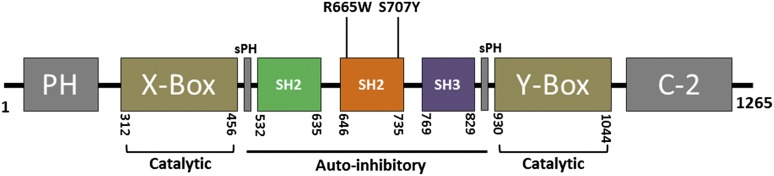
A diagram of the human PLCG2 gene. Depicts encompassed domains of human PLCG2. R665W and S707Y mutations identified in relapse CLL are harbored within the SH2 domain. PH, Pleckstrin homology. C-2, calcium binding motif; SH2, Src homology 2; SH3, Src homology 3; X-box, phosphatidylinositol-specific phospholipase C X domain; Y-box, phosphatidylinositol-specific phospholipase C Y domain.
Figure 2
Figure 2
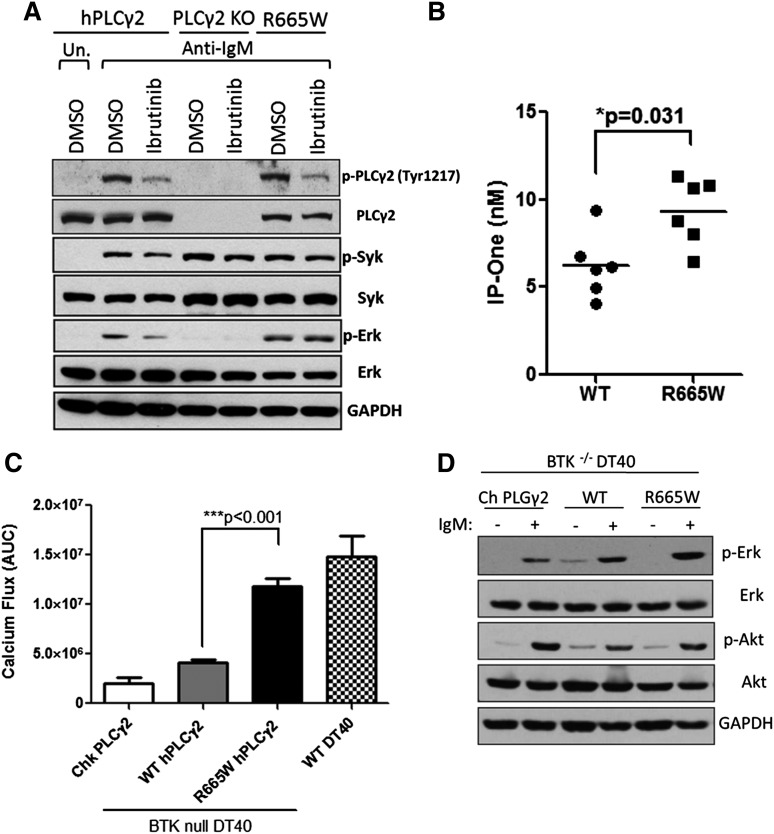
Hypermorphic mutation R665W acquires resistance to ibrutinib and functions independently to BTK. (A) Downstream phospho-protein activation upon 0.5 μg/ml α-IgM stimulation for 15 minutes was examined by western blots in comparison with WT PLCγ2 to R665W mutation in DT40 cells. (B) 293T cells were retrovirally transduced with WT PLCγ2 or R665W mutation. The production of IP3 upon 150 ng/ml epidermal growth factor stimulation was measured by IP1 (surrogate of IP3) accumulation using IP-One ELISA Kit (n = 3 repeated experiments). (C) Calcium flux in BTK-deficient DT40 lines introduced with WT PLCγ2 or R665W mutant were examined. Data represents the AUC from 6 replicates upon 3 μg/ml α-IgM stimulation, and (D) downstream phospho-protein activation was examined by western blots. DMSO, dimethylsulfoxide; KO, knockout; Un., untreated.
Figure 3
Figure 3
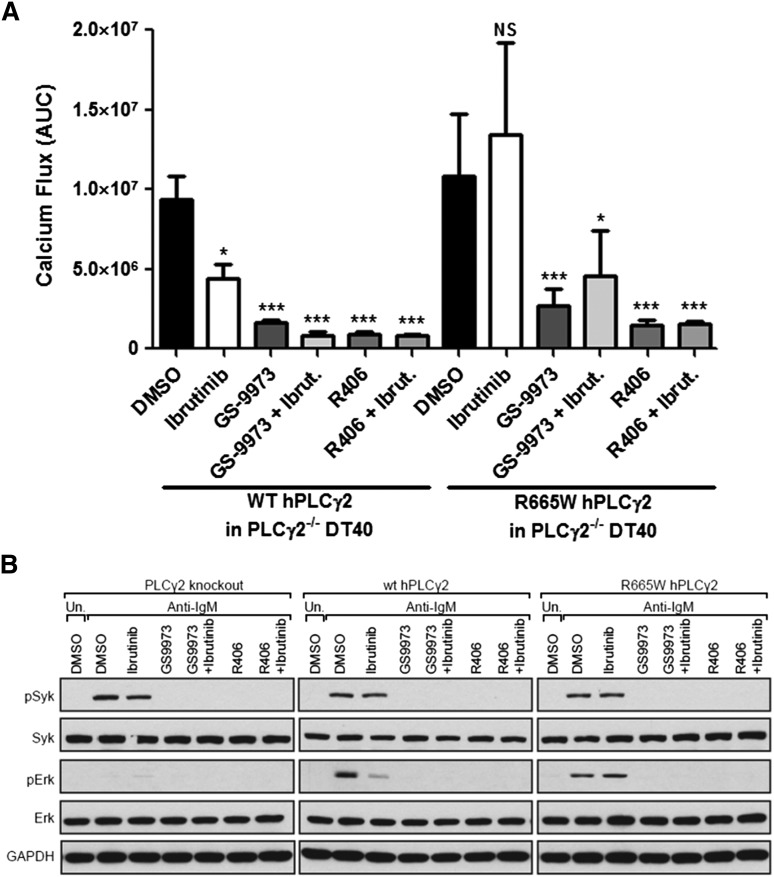
SYK inhibition abrogates PLCG2R665W induced downstream activation. (A) Calcium influx induced by 3 μg/ml α-IgM stimulation was measured in PLCγ2−/− DT40 stably expressed with either WT human PLCG2 or R665W mutant. The data represents AUC by 6 replicates. In the treatment settings, 1.0 μM ibrutinib was pretreated for 1 hour followed by washout; and 0.5 μM GS-9973 or 2.5 μM R406 was treated continuously. *P < .05; ***P < .001; NS = P > .05. (B) Downstream signaling was examined in PLCγ2−/− DT40 expressing either WT PLCG2 or R665W mutant. Cells were treated with 0.5 μg/ml α-IgM for 15 minutes; 1.0 μM ibrutinib was pretreated for 1 hour followed by washout; and 0.5 μM GS-9973 or 2.5 μM R406 was treated.
Figure 4
Figure 4
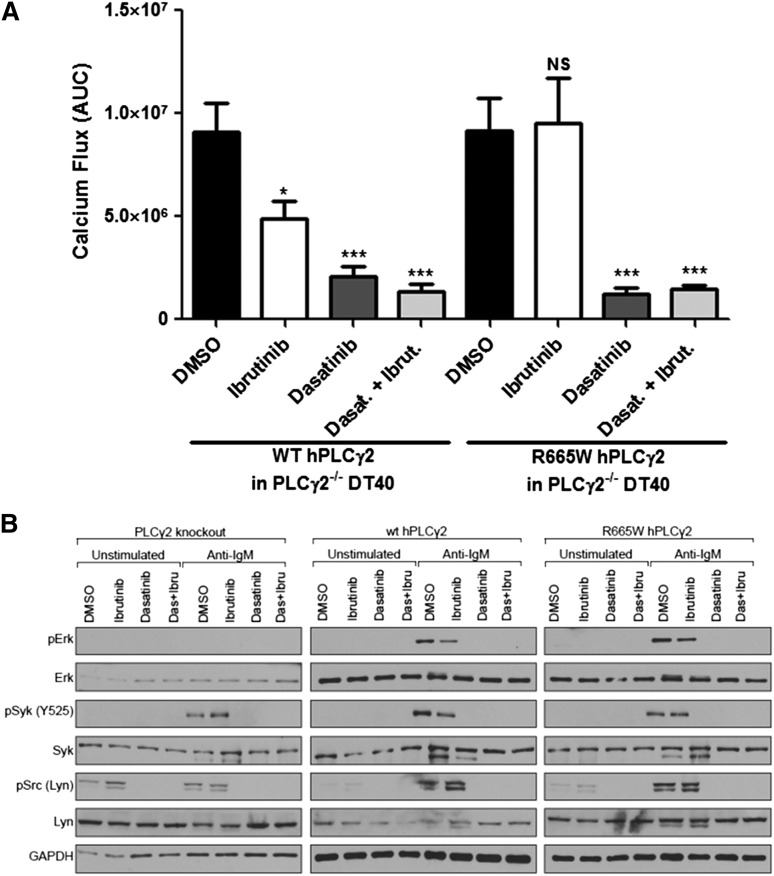
LYN suppression abrogates PLCG2R665W-mediated downstream activation. (A) Calcium flux induced by 3 μg/ml α-IgM stimulation was measured in PLCγ2−/− DT40 expressing WT human PLCG2 or R665W mutant. The data represents AUC by 6 replicates. In the treatment settings, 1.0 μM ibrutinib was pretreated for 1 hour followed by washout; 0.1 μM dasatinib was used. *P < .05; ***P < .001; NS = P > .05. (B) Downstream signaling was accessed in PLCγ2−/− DT40 expressing either WT human PLCγ2 or R665W mutant. Cells were treated with 0.5 μg/ml α-IgM; 1.0 μM ibrutinib was pretreated for 1 hour followed by washout; and 0.1 μM dasatinib was used.
Figure 5
Figure 5
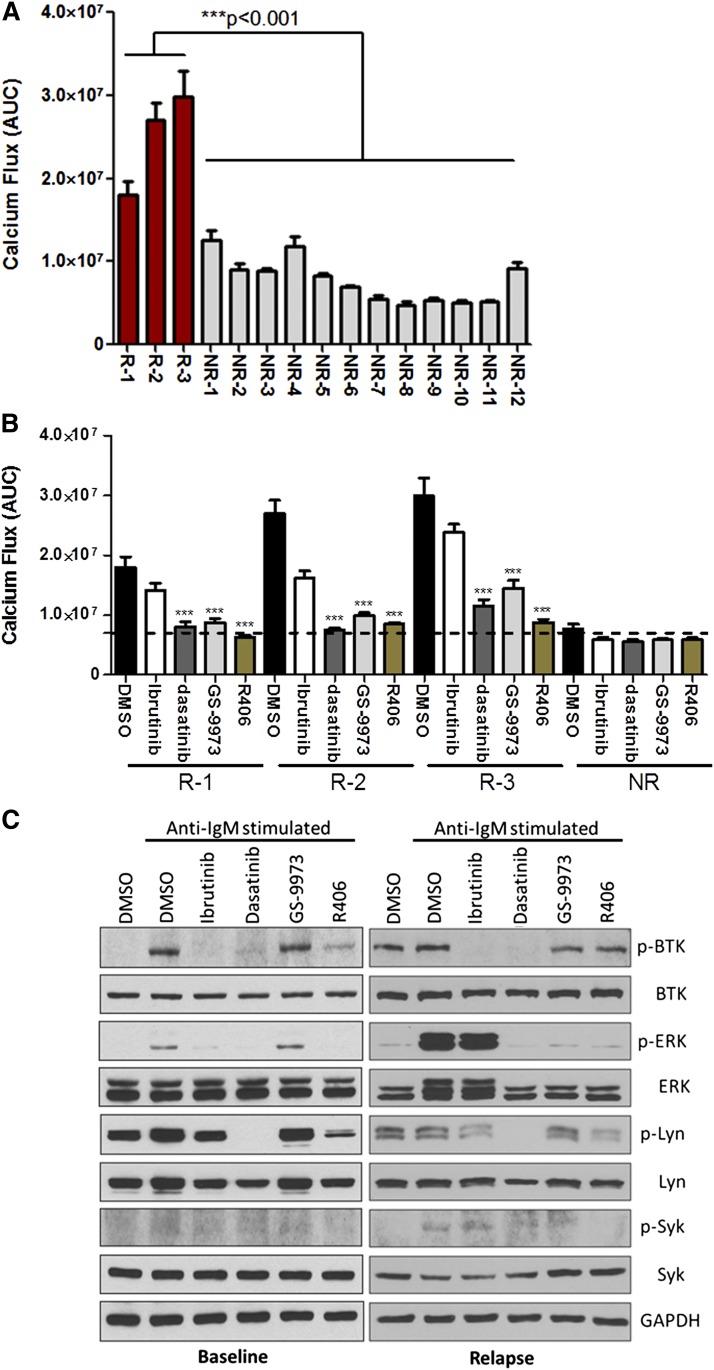
Hyperactive downstream signaling in relapse CLL acquired PLCγ2 variants can be blocked by targeting SYK or LYN. (A) Calcium flux from 3 individual relapse CLL (R) bearing mutated PLCγ2 or 12 nonresistant CLL samples (NR) were measured, and 5E6 cells per well in 96-half well microplates were stimulated with 10 μg/ml α-IgM at 37°C for 15 minutes, and then measured by BD Calcium Assay Kit. The data represent AUC from 7 and 12 replicates in resistant and nonresistant samples, respectively; 1.0 μM ibrutinib was pretreated for 1 hour followed by washout. (B) The data represents calcium release by 3 individual relapse CLL (R) or the mean of 12 nonresistant samples (NR) stimulated with 10 μg/ml α-IgM in the presence of 0.5 μM GS-9973, 2.5 μM R406, or 0.1 μM dasatinib; 1.0 μM ibrutinib was pretreated for 1 hour followed by washout. ***P < .001. (C) The downstream phospho-protein activation was accessed in CLL cells from a single patient (patient #2 in Table 1) in the baseline or relapse setting. The detailed information of the 3 relapsed CLL patient samples analyzed here are listed in Table 1.
Figure 6
Figure 6
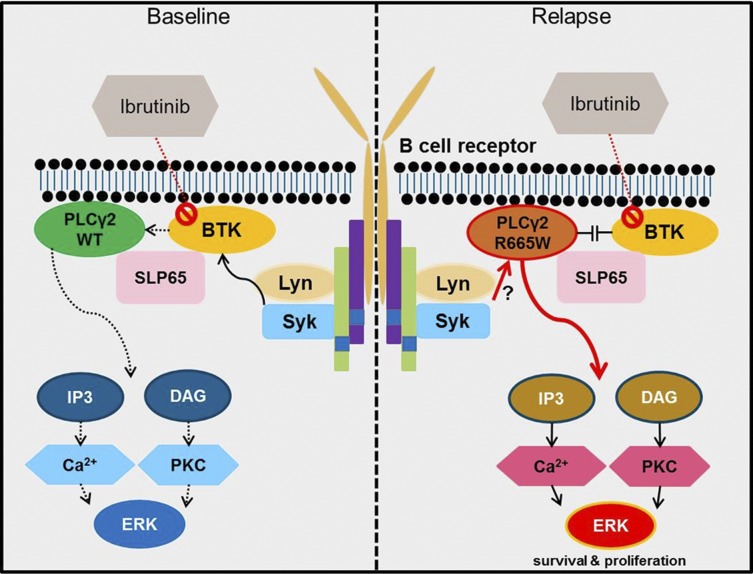
The diagram illustrates PLCG2R665W-mediated ibrutinib resistance. In treatment naïve CLL, proximal BCR signaling triggers downstream BTK activation. PLCγ2 is consequently activated in a BTK-dependent manner. Targeting BTK by ibrutinib can abrogate PLCγ2-initiated downstream survival signal (left panel); in contrast, mutant PLCγ2 (R665W) can be activated via SYK or LYN, bypassing BTK dependency in the resistant CLL, thereby propagating downstream survival signals despite ibrutinib treatment (right panel). PKC, protein kinase C.

References

    1. Gaidano G, Foà R, Dalla-Favera R. Molecular pathogenesis of chronic lymphocytic leukemia. J Clin Invest. 2012;122(10):3432–3438. - PMC - PubMed
    1. Chiorazzi N, Rai KR, Ferrarini M. Chronic lymphocytic leukemia. N Engl J Med. 2005;352(8):804–815. - PubMed
    1. Herishanu Y, Pérez-Galán P, Liu D, et al. The lymph node microenvironment promotes B-cell receptor signaling, NF-kappaB activation, and tumor proliferation in chronic lymphocytic leukemia. Blood. 2011;117(2):563–574. - PMC - PubMed
    1. Stevenson FK, Caligaris-Cappio F. Chronic lymphocytic leukemia: revelations from the B-cell receptor. Blood. 2004;103(12):4389–4395. - PubMed
    1. Hallek M, Fischer K, Fingerle-Rowson G, et al. International Group of Investigators; German Chronic Lymphocytic Leukaemia Study Group. Addition of rituximab to fludarabine and cyclophosphamide in patients with chronic lymphocytic leukaemia: a randomised, open-label, phase 3 trial. Lancet. 2010;376(9747):1164–1174. - PubMed

Publication types

MeSH terms