. 2015 Aug 1;24(15):4397-406.
doi: 10.1093/hmg/ddv176. Epub 2015 May 13.

Dominant, toxic gain-of-function mutations in gars lead to non-cell autonomous neuropathology

Affiliations

Dominant, toxic gain-of-function mutations in gars lead to non-cell autonomous neuropathology

Stuart J Grice et al. Hum Mol Genet. .

Abstract

Charcot-Marie-Tooth (CMT) neuropathies are collectively the most common hereditary neurological condition and a major health burden for society. Dominant mutations in the gene GARS, encoding the ubiquitous enzyme, glycyl-tRNA synthetase (GlyRS), cause peripheral nerve degeneration and lead to CMT disease type 2D. This genetic disorder exemplifies a recurring motif in neurodegeneration, whereby mutations in essential, widely expressed genes have selective deleterious consequences for the nervous system. Here, using novel Drosophila models, we show a potential solution to this phenomenon. Ubiquitous expression of mutant GlyRS leads to motor deficits, progressive neuromuscular junction (NMJ) denervation and pre-synaptic build-up of mutant GlyRS. Intriguingly, neuronal toxicity is, at least in part, non-cell autonomous, as expression of mutant GlyRS in mesoderm or muscle alone results in similar pathology. This mutant GlyRS toxic gain-of-function, which is WHEP domain-dependent, coincides with abnormal NMJ assembly, leading to synaptic degeneration, and, ultimately, reduced viability. Our findings suggest that mutant GlyRS gains access to ectopic sub-compartments of the motor neuron, providing a possible explanation for the selective neuropathology caused by mutations in a widely expressed gene.


Figures

Figure 1.
Figure 1.
Dominant, toxic effects caused by GlyRSP234KY lead to non-cell autonomous longevity and motor defects. (A) GlyRSWT and (B) GlyRSP234KY localization in the central nervous system of larvae ubiquitously (1032-GAL4) expressing UAS-garsWT_2 and UAS-garsP234KY_2, respectively. (C) GlyRSWT and (D) GlyRSP234KY localization at the NMJ in larvae neuronally expressing UAS-garsWT_2 and UAS-garsP234KY_2, respectively. Note that GlyRS expressed in neurons does not reach the peripheral synapse. (E and F) GlyRSP234KY toxicity was analysed by expressing garsP234KY ubiquitously (1032-GAL4), in mesoderm (how-GAL4), muscle (MHC-GAL4) or neurons (elav-GAL4) at 20°C (E) and 25°C (F). Transgene expression is lower at 20 than 25°C. Flies ubiquitously expressing garsWT (blue bars) and CD8::GFP (red bars) were used as controls. (G) Mutant garsP234KY flies reach the pupal stage, but fail to eclose and often become trapped in their pupal cases (arrow). The few flies that escape and reach adulthood display wing expansion defects (arrow head). (H) Ubiquitous, mesodermal and muscle expression of garsP234KY caused a significant loss of muscle contractions at 20°C. (I) Ubiquitous, mesodermal, muscle and neuronal driven garsP234KY expression also reduced larval muscle contractions at 25°C. For all graphs, *P < 0.05; **P < 0.01; ***P < 0.001 Dunn's multiple comparison test. For survival studies, 25 flies per genotype were scored over four independent experiments. For muscle contraction studies, at least 15 larvae were analysed per genotype. Scale bars = 10 μm.
Figure 2.
Figure 2.
garsP234KY expression causes NMJ defects. NMJs consist of boutons that grow in lines resembling beads on a string (arrowheads, A). Nerves were visualized with anti-HRP (red) and the post-synaptic apparatus with anti-DLG (green). (A) Representative NMJs from muscles 6 and 7 of control (1032-GAL4) and ubiquitous garsP234KY (1032-GAL4; UAS-garsP234KY) larvae at the late L3 stage. (B) Ubiquitous, mesodermal (how-GAL4) and muscle (MHC-GAL4) expression of garsP234KY caused a reduction in bouton number. (C) Ubiquitous, mesodermal and muscle expression also lead to an increase in bouton size. Neuronal garsP234KY expression (elav-GAL4) caused no overt synaptic phenotype. For all graphs, *P < 0.05, **P < 0.01, ***P < 0.001 Bonferroni's/Dunn's multiple comparison test. At least 20 larvae were scored per NMJ. Scale bars = 10 µm.
Figure 3.
Figure 3.
garsP234KY larvae display NMJ denervation and axonal defects. (A) Representative NMJs from late L3 larvae ubiquitously (1032-GAL4) expressing garsWT and garsP234KY. (B) Representative axonal segment pictures taken of the transverse nerve (TN) over muscles 6 and 7 in abdominal segment A2 in late L3 control, garsWT (1032-GAL4), garsP234KY (1032-GAL4) and garsP234KY mesodermal (how-GAL4) larvae. (C) Quantification of the normalized Brp fluorescence at the NMJ showing ubiquitous, mesodermal and muscle garsP234KY expression leads to reduced Brp signal. (D) Quantification of the number of Brp-positive foci in the TN showing that ubiquitous, mesodermal and muscle garsP234KY expression leads to increased Brp accumulation. For all graphs, *P < 0.05, **P < 0.01, ***P < 0.001 Bonferroni's/Dunn's multiple comparison test. At least 20 NMJs and axons were analysed per genotype. Scale bars = 10 µm.
Figure 4.
Figure 4.
GlyRSP234KY secretion leads to non-cell autonomous build-up at the neuronal membrane. (AF) L3 larval NMJs were stained under non-permeabilization conditions to assess GlyRSP234KY binding to the neuronal extracellular membrane. (A) HA staining was not observed at the membrane in control flies. (B) Ubiquitous garsP234KY expression, but not (C) garsWT expression, leads to a build-up of GlyRS at the neuronal membrane. (D) Mesodermal and (E) muscle expression of garsP234KY also causes a build-up of GlyRSP234KY on the neuronal membrane. GlyRSP234KY appeared to associate with the whole pre-synapse and axonal regions. (F) Neuronally expressed GlyRSP234KY did not localize to the synapse. (G) Quantification of the HA fluorescence at the synapse. Ten NMJs were analysed per genotype. Scale bars = 10 µm.
Figure 5.
Figure 5.
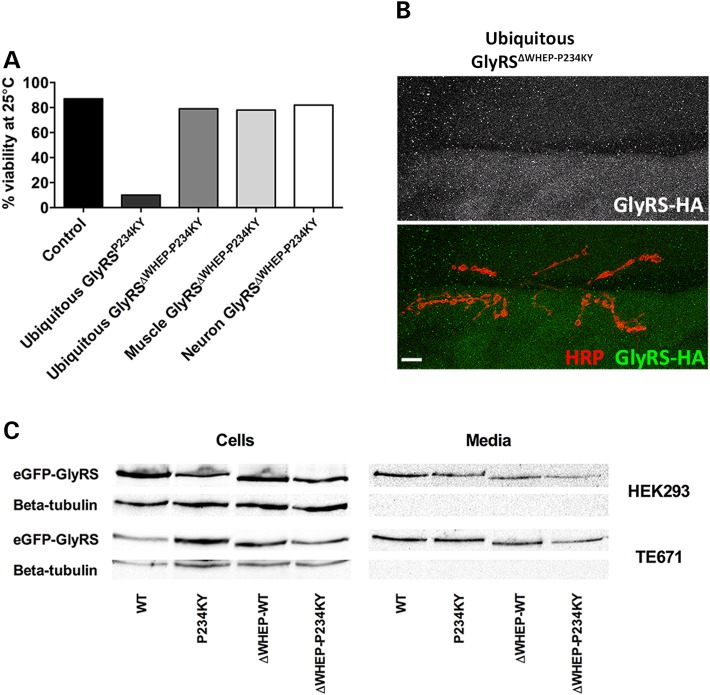
GlyRS toxicity and synapse binding, but not secretion, are dependent on the WHEP domain. (A) Removal of the WHEP domain abrogated the pathology associated with both ubiquitous and muscle expression of mutant gars in vivo; garsΔWHEP-P234KY expression had no effect on larval viability. (B) GlyRSΔWHEP-P234KY did not associate with the neuronal membrane (using non-permeabilization conditions). (C) To determine whether WHEP deletion restricts GlyRS secretion and is the principal cause of the abolished mutant pathology, eGFP-tagged GARSWT and GARSP234KY with or without the WHEP domain were expressed in human kidney (HEK293) and muscle-like (TE671) cells. Deletion of the WHEP domain did not affect secretion of wild-type or mutant GlyRS. The localization of all GlyRS proteins was similar in both cell lines and with each protein tag (data not shown). Scale bars = 10 µm.

References

    1. Antonellis A., Ellsworth R.E., Sambuughin N., Puls I., Abel A., Lee-Lin S.Q., Jordanova A., Kremensky I., Christodoulou K., Middleton L.T., et al. (2003) Glycyl tRNA synthetase mutations in Charcot-Marie-Tooth disease type 2D and distal spinal muscular atrophy type V. Am. J. Hum. Genet., 72, 1293–1299. - PMC - PubMed
    1. Jordanova A., Irobi J., Thomas F.P., Van Dijck P., Meerschaert K., Dewil M., Dierick I., Jacobs A., De Vriendt E., Guergueltcheva V., et al. (2006) Disrupted function and axonal distribution of mutant tyrosyl-tRNA synthetase in dominant intermediate Charcot-Marie-Tooth neuropathy. Nat. Genet., 38, 197–202. - PubMed
    1. Latour P., Thauvin-Robinet C., Baudelet-Mery C., Soichot P., Cusin V., Faivre L., Locatelli M.C., Mayencon M., Sarcey A., Broussolle E., et al. (2010) A major determinant for binding and aminoacylation of tRNA(Ala) in cytoplasmic Alanyl-tRNA synthetase is mutated in dominant axonal Charcot-Marie-Tooth disease. Am. J. Hum. Genet., 86, 77–82. - PMC - PubMed
    1. McLaughlin H.M., Sakaguchi R., Liu C., Igarashi T., Pehlivan D., Chu K., Iyer R., Cruz P., Cherukuri P.F., Hansen N.F., et al. (2010) Compound heterozygosity for loss-of-function lysyl-tRNA synthetase mutations in a patient with peripheral neuropathy. Am. J. Hum. Genet., 87, 560–566. - PMC - PubMed
    1. Gonzalez M., McLaughlin H., Houlden H., Guo M., Yo-Tsen L., Hadjivassilious M., Speziani F., Yang X.L., Antonellis A., Reilly M.M., et al. (2013) Exome sequencing identifies a significant variant in methionyl-tRNA synthetase (MARS) in a family with late-onset CMT2. J. Neurol. Neurosurg. Psychiatry, 84, 1247–1249. - PMC - PubMed

Publication types

MeSH terms

Substances

Supplementary concepts