. 2015 Jul;53(7):2238-50.
doi: 10.1128/JCM.02495-14. Epub 2015 May 13.

Evaluation of Unbiased Next-Generation Sequencing of RNA (RNA-seq) as a Diagnostic Method in Influenza Virus-Positive Respiratory Samples

Affiliations

Evaluation of Unbiased Next-Generation Sequencing of RNA (RNA-seq) as a Diagnostic Method in Influenza Virus-Positive Respiratory Samples

Nicole Fischer et al. J Clin Microbiol. 2015 Jul.

Abstract

Unbiased nontargeted metagenomic RNA sequencing (UMERS) has the advantage to detect known as well as unknown pathogens and, thus, can significantly improve the detection of viral, bacterial, parasitic, and fungal sequences in public health settings. In particular, conventional diagnostic methods successfully identify the putative pathogenic agent in only 30% to 40% of respiratory specimens from patients with acute respiratory illness. Here, we applied UMERS to 24 diagnostic respiratory specimens (bronchoalveolar lavage [BAL] fluid, sputum samples, and a swab) from patients with seasonal influenza infection and 5 BAL fluid samples from patients with pneumonia that tested negative for influenza to validate RNA sequencing as an unbiased diagnostic tool in comparison to conventional diagnostic methods. In addition to our comparison to PCR, we evaluated the potential to retrieve comprehensive influenza virus genomic information and the capability to detect known superinfecting pathogens. Compared to quantitative real-time PCR for influenza viral sequences, UMERS detected influenza viral sequences in 18 of 24 samples. Complete influenza virus genomes could be assembled from 8 samples. Furthermore, in 3 of 24 influenza-positive samples, additional viral pathogens could be detected, and 2 of 24 samples showed a significantly increased abundance of individual bacterial species known to cause superinfections during an influenza virus infection. Thus, analysis of respiratory samples from known or suspected influenza patients by UMERS provides valuable information that is relevant for clinical investigation.


Figures

FIG 1
FIG 1
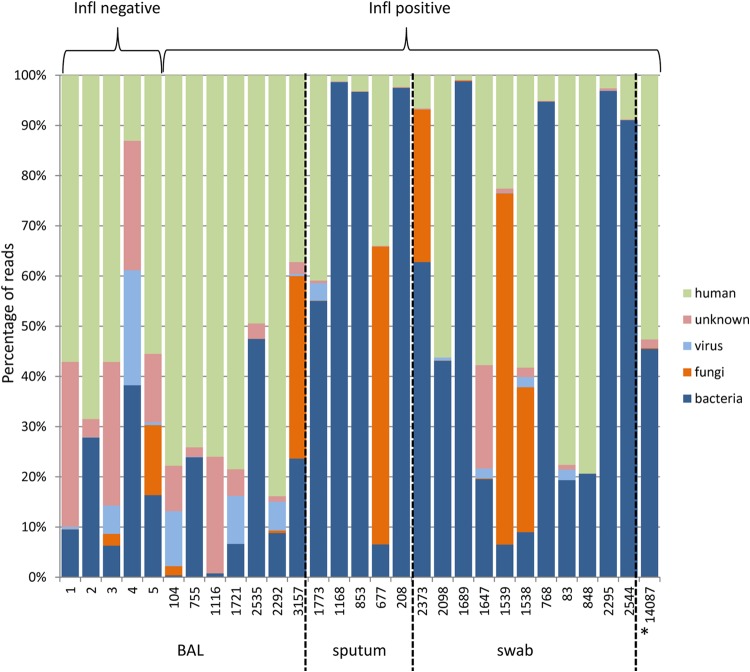
Diagnostic sample composition at the phylum level for digitally subtracted host reads as well as reads mapped to taxonomically classified sequence contigs. Phylum profiles (proportion of all reads) for bacteria, fungi, and viruses are shown for the individual samples. Sample 14,087 (labeled with *) originated from a tracheal secretion.
FIG 2
FIG 2
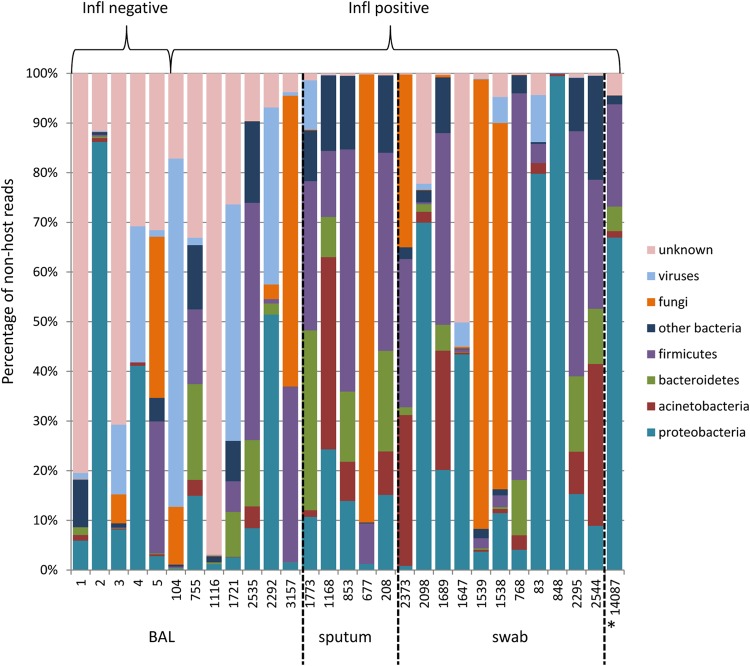
Diagnostic sample composition at the phylum level without host sequences. Phylum profiles (percentage of reads mapping to nonhost contigs) for bacteria, fungi, and viruses are shown for the individual samples. Sample 14,087 (labeled with *) originated from a tracheal secretion.
FIG 3
FIG 3
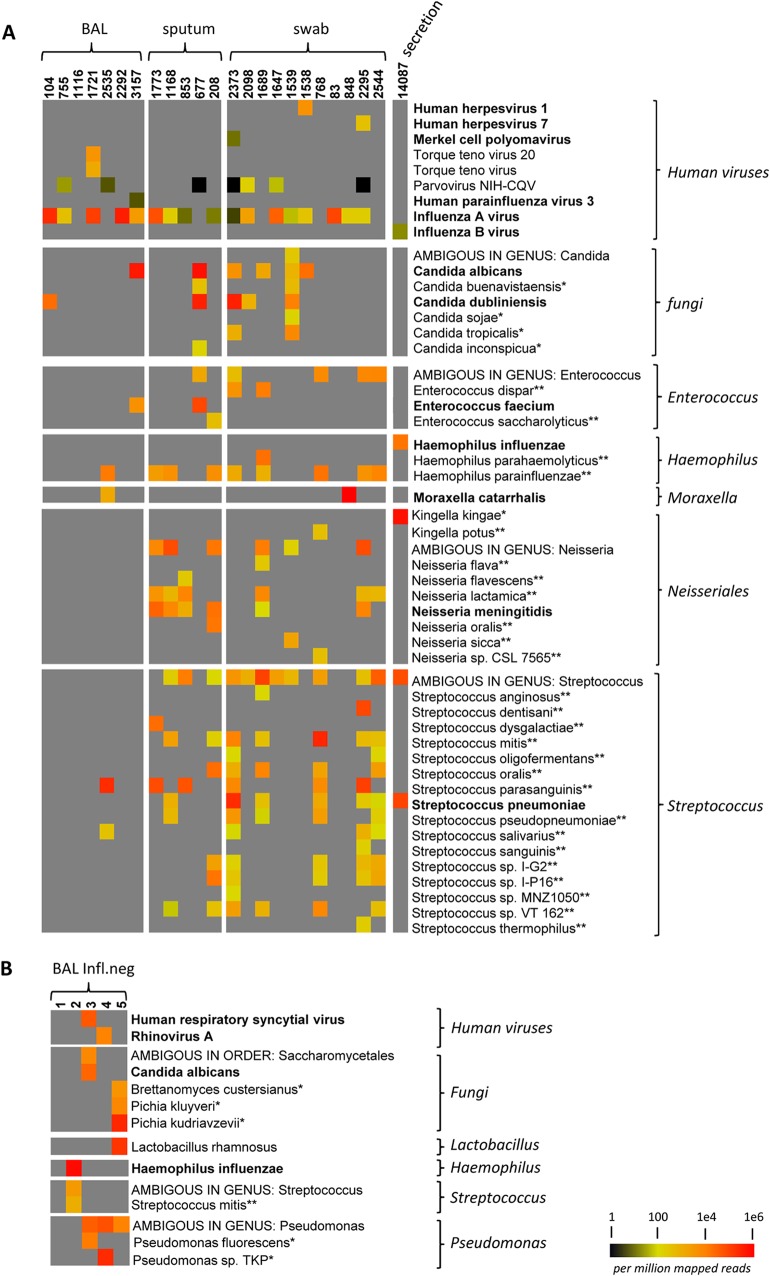
Next-generation sequencing of RNA (RNA-seq) of clinical respiratory samples. (A) RNA-seq results obtained from BAL fluid, swab, or sputum samples with influenza A (InflA) or influenza B (InflB) (sample 14,097) infection. (B) RNA-seq results of RNA isolated from influenza-negative BAL fluid samples. The relative and normalized abundance of reads mapping to bacterial or viral species (in reads per million mapped reads [RPM]) is represented according to the heat map legend shown in the lower right corner. A gray rectangle indicates no reads were detected. For bacteria and fungi, only contigs with >2,000 RPM and BLAST hits covering at least 80% of the contig sequence with at least 80% sequence identity, were included. In addition, only contigs with an unambiguous classification on the selected taxonomy level were considered. Bacteria, fungi, or viruses associated with respiratory diseases are indicated in bold letters. *, common environmental microorganism; **, nonpathogenic commensal bacteria.
FIG 4
FIG 4
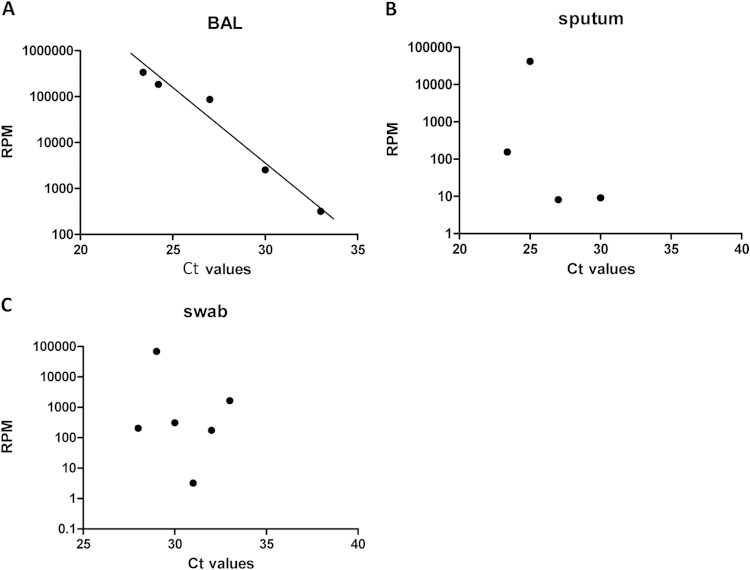
Correlation between reads per million mapped reads (RPM) matching influenza A virus sequences and CT values of influenza A virus-specific RT-qPCR in BAL fluid samples (A), sputum samples (B), and swab samples (C).
FIG 5
FIG 5
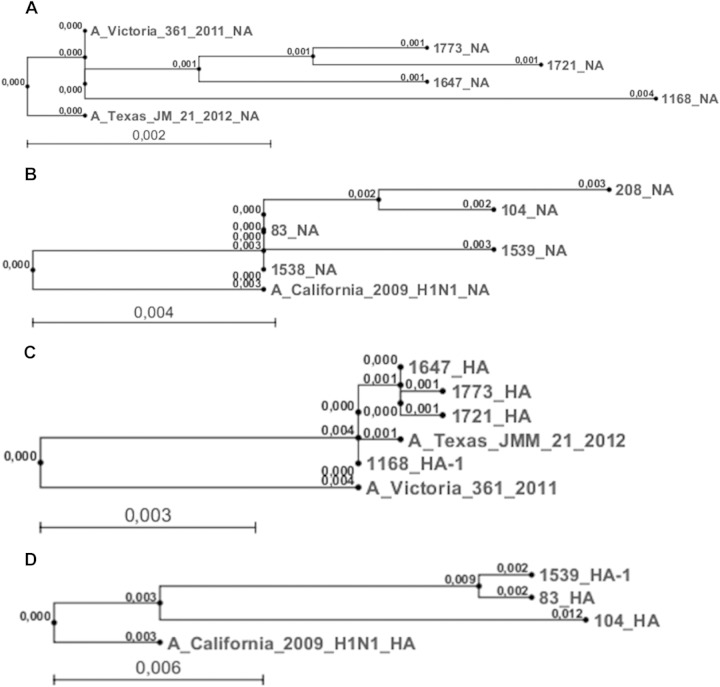
Phylogenetic tree summarizing NA sequence alignment to vaccine strain NA A/Victoria/361/2011 (GenBank accession number KC342647.1), H3N2, and vaccine strain A/Texas/21/2012 (KC891013.1) (A) and vaccine strain A/California/4/2009 (FJ966084), H1N1 (B). (A) A total of 1,400 nucleotides were aligned by applying Clustal W alignment. The phylogenetic tree was created using neighbor-joining tree alignment and CLC workbench. Phylogenetic tree summarizing HA sequence alignment to vaccine strain HA A/Victoria/361/2011 (KC306165.1), H3N2, and vaccine strain A/Texas/21/2012 (KC891060.1) (C) and vaccine strain A/California/4/2009 (FJ966082), H1N1 (D). (C) A total of 1,701 nucleotides were aligned using Clustal W alignment. The phylogenetic tree was created using neighbor-joining tree alignment and CLC workbench. Scale bar represents substitutions per site; numbers at node points indicate the branch length.

References

    1. Metersky ML, Masterton RG, Lode H, File TM Jr, Babinchak T. 2012. Epidemiology, microbiology, and treatment considerations for bacterial pneumonia complicating influenza. Int J Infect Dis 16:e321–331. doi:10.1016/j.ijid.2012.01.003. - DOI - PubMed
    1. Seki M, Kosai K, Yanagihara K, Higashiyama Y, Kurihara S, Izumikawa K, Miyazaki Y, Hirakata Y, Tashiro T, Kohno S. 2007. Disease severity in patients with simultaneous influenza and bacterial pneumonia. Intern Med 46:953–958. doi:10.2169/internalmedicine.46.6364. - DOI - PubMed
    1. Chertow DS, Memoli MJ. 2013. Bacterial coinfection in influenza: a grand rounds review. JAMA 309:275–282. doi:10.1001/jama.2012.194139. - DOI - PubMed
    1. Dawood FS, Iuliano AD, Reed C, Meltzer MI, Shay DK, Cheng PY, Bandaranayake D, Breiman RF, Brooks WA, Buchy P, Feikin DR, Fowler KB, Gordon A, Hien NT, Horby P, Huang QS, Katz MA, Krishnan A, Lal R, Montgomery JM, Molbak K, Pebody R, Presanis AM, Razuri H, Steens A, Tinoco YO, Wallinga J, Yu H, Vong S, Bresee J, Widdowson MA. 2012. Estimated global mortality associated with the first 12 months of 2009 pandemic influenza A H1N1 virus circulation: a modelling study. Lancet Infect Dis 12:687–695. doi:10.1016/S1473-3099(12)70121-4. - DOI - PubMed
    1. Joseph C, Togawa Y, Shindo N. 2013. Bacterial and viral infections associated with influenza. Influenza Other Respir Viruses 7(Suppl 2):S105–S113. doi:10.1111/irv.12089. - DOI - PMC - PubMed

Publication types

MeSH terms