


Epizootiological Investigation of Getah Virus Infection among Racehorses in Japan in 2014
- PMID: 25972425
- PMCID: PMC4473224
- DOI: 10.1128/JCM.00550-15
Epizootiological Investigation of Getah Virus Infection among Racehorses in Japan in 2014
Abstract
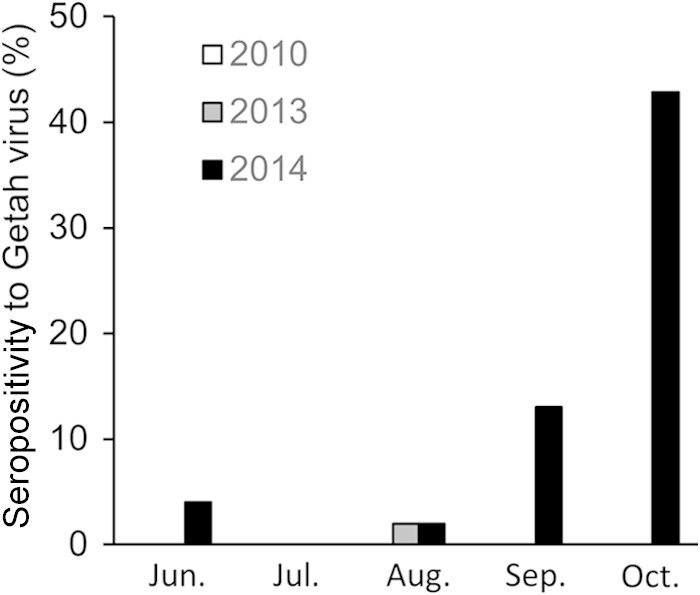
To clarify the factors causing an outbreak in 2014 of Getah virus infection among racehorses at the Miho training center, Japan, we isolated virus strains and performed an epizootiological investigation of affected horses and related horse populations. Three Getah virus isolates were recovered from clinical samples, and one of them (14-I-605) was used in a virus-neutralizing test. Of the affected horses (n = 33), 20 (60.6%) were 2-year-olds. We investigated the histories of Getah virus vaccination of the affected horses and the whole population at the Miho training center. Among the 2-year-old population, the prevalence of the disease in horses that had been vaccinated once was 14.1%. This was significantly higher than that in horses that had been vaccinated twice or more (1.3%; P < 0.01). Among horses that had entered the training center from farms in Ibaraki Prefecture surrounding the training center and from neighboring Chiba Prefecture, the rate of seropositivity for Getah virus was 13.0% in September 2014 and 42.9% in October 2014; that in the corresponding periods in 2010 and 2013 was 0%. In conclusion, we identified two possible causes of the outbreak of Getah virus infection in the training center in 2014: (i) the existence of susceptible horses that had received only one dose of vaccination before the outbreak and (ii) increased risk of exposure to the virus because of epizootic Getah virus infection among horses on surrounding farms in Ibaraki and Chiba prefectures.
Copyright © 2015, American Society for Microbiology. All Rights Reserved.
Figures
References
-
- Fukunaga Y, Kumanomido T, Kamada M. 2000. Getah virus as an equine pathogen. Vet Clin North Am Pract 16:605–617. - PubMed
MeSH terms
Substances
LinkOut - more resources
Full Text Sources
