


Cutting edge: Role of osteopontin and integrin αv in T cell-mediated anti-inflammatory responses in endotoxemia
- PMID: 25972484
- PMCID: PMC4458449
- DOI: 10.4049/jimmunol.1500623
Cutting edge: Role of osteopontin and integrin αv in T cell-mediated anti-inflammatory responses in endotoxemia
Abstract
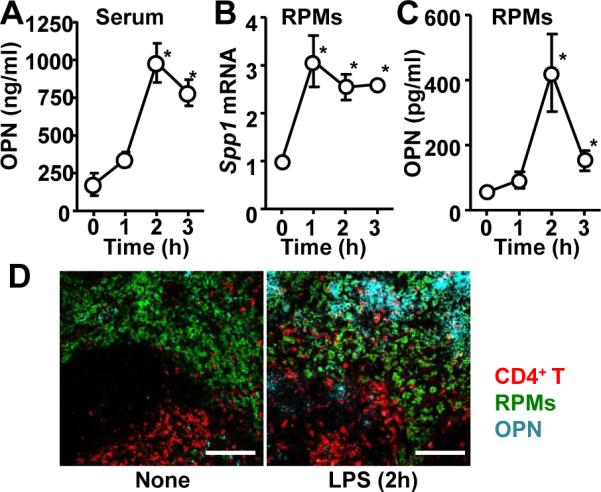
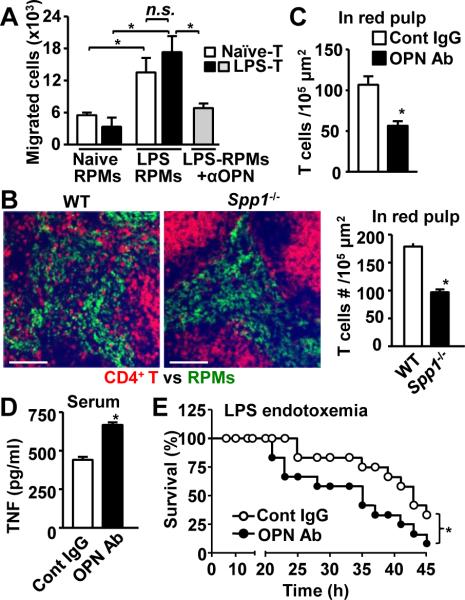
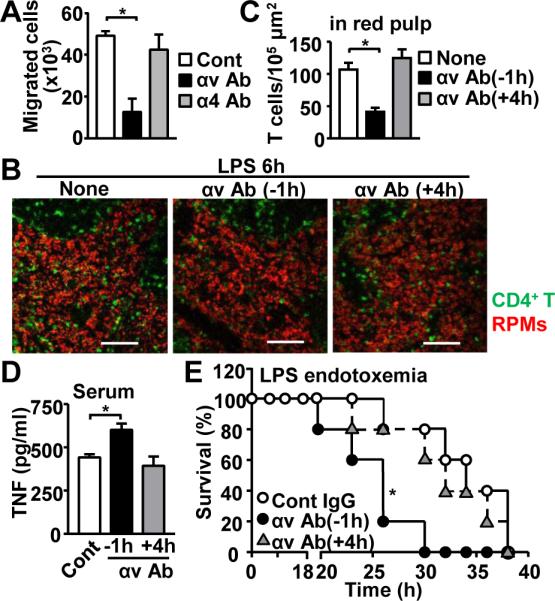
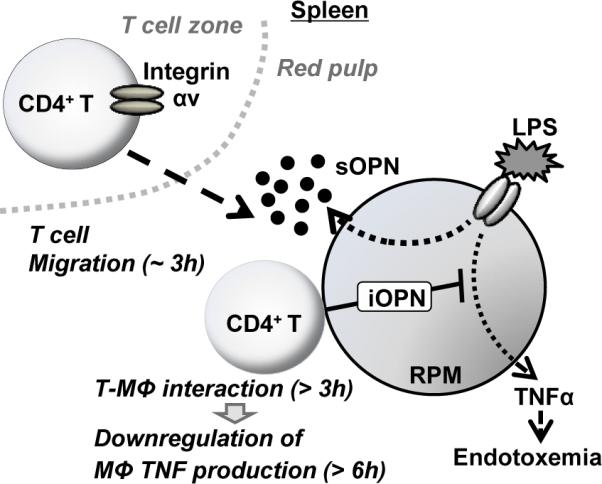
The immune system is equipped with mechanisms that downregulate hyperinflammation to avoid collateral damage. We demonstrated recently that unprimed T cells downregulate macrophage TNF production through direct interaction with macrophages in the spleen during LPS endotoxemia. How T cell migration toward macrophages occurs upon LPS injection is still not clear. In this study, we demonstrate that secreted osteopontin (sOPN) plays a role in the T cell migration to initiate the suppression of hyperinflammation during endotoxemia. Osteopontin levels in splenic macrophages were upregulated 2 h after LPS treatment, whereas T cell migration toward macrophages was observed 3 h after treatment. Neutralization of sOPN and blockade of its receptor, integrin αv, significantly inhibited CD4(+) T cell migration and increased susceptibility to endotoxemia. Our study demonstrates that the sOPN/integrin αv axis, which induces T cell chemotaxis toward macrophages, is critical for suppressing hyperinflammation during the first 3 h of endotoxemia.
Copyright © 2015 by The American Association of Immunologists, Inc.
Figures
References
-
- Heyninck K, Beyaert R. The cytokine-inducible zinc finger protein A20 inhibits IL-1-induced NF-kappaB activation at the level of TRAF6. FEBS letters. 1999;442:147–150. - PubMed
-
- Heyninck K, De Valck D, Vanden Berghe W, Van Criekinge W, Contreras R, Fiers W, Haegeman G, Beyaert R. The zinc finger protein A20 inhibits TNF-induced NF-kappaB-dependent gene expression by interfering with an RIP- or TRAF2-mediated transactivation signal and directly binds to a novel NF-kappaB-inhibiting protein ABIN. The Journal of cell biology. 1999;145:1471–1482. - PMC - PubMed
-
- Saitoh T, Fujita N, Jang MH, Uematsu S, Yang BG, Satoh T, Omori H, Noda T, Yamamoto N, Komatsu M, Tanaka K, Kawai T, Tsujimura T, Takeuchi O, Yoshimori T, Akira S. Loss of the autophagy protein Atg16L1 enhances endotoxin-induced IL-1beta production. Nature. 2008;456:264–268. - PubMed
-
- Nakahira K, Haspel JA, Rathinam VA, Lee SJ, Dolinay T, Lam HC, Englert JA, Rabinovitch M, Cernadas M, Kim HP, Fitzgerald KA, Ryter SW, Choi AM. Autophagy proteins regulate innate immune responses by inhibiting the release of mitochondrial DNA mediated by the NALP3 inflammasome. Nature immunology. 2011;12:222–230. - PMC - PubMed
Publication types
MeSH terms
Substances
Grants and funding
LinkOut - more resources
Full Text Sources
Other Literature Sources
Research Materials
