


Review
doi: 10.3389/fphar.2015.00090.
eCollection 2015.
Will drug resistance against dolutegravir in initial therapy ever occur?
Affiliations
- PMID: 25972810
- PMCID: PMC4413831
- DOI: 10.3389/fphar.2015.00090
Item in Clipboard
Review
Will drug resistance against dolutegravir in initial therapy ever occur?
Front Pharmacol.
.
Abstract
Dolutegravir (DTG) is a second-generation integrase strand transfer inhibitor (INSTI) and INSTIs are the latest class of potent anti-HIV drugs. Compared to the first generation INSTIs, raltegravir, and elvitegravir, DTG shows a limited cross-resistance profile. More interestingly, clinical resistance mutations to DTG in treatment-naive patents have not been observed to this date. This review summarizes recent studies on resistance mutations to DTG and on our understanding of the mechanisms of resistance to DTG as well as future directions for research.
Keywords: HIV; antiretroviral; drug resistance; integrase inhibitors.
Figures
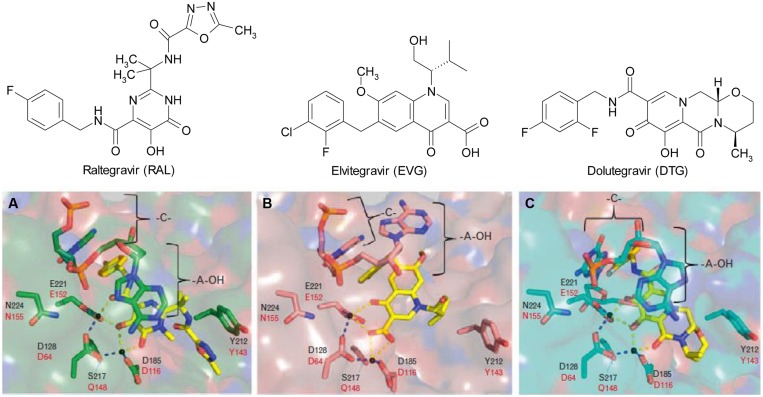
Chemical structures of (A) raltegravir (RAL), (B) elvitegravir (EVG), and (C) dolutegravir (DTG) and their binding modes to the prototype foamy virus (PFV) integrase active site (Quashie et al., 2013b).
References
-
- Abram M. E., Hluhanich R. M., Goodman D. D., Andreatta K. N., Margot N. A., Ye L., et al. (2013). Impact of primary elvitegravir resistance-associated mutations in HIV-1 integrase on drug susceptibility and viral replication fitness. Antimicrob. Agents Chemother. 57 2654–2663 10.1128/AAC.02568-12 - DOI - PMC - PubMed
-
- Anstett K., Mesplede T., Quashie P., Oliveira M. W. (2014). “Primary mutations that confer resistance to raltegravir and elvitegravir are incompatible with the R263K mutation that is associated with low-level resistance to dolutegravir,” in Proceedings of the 20th International AIDS Conference Melbourne, VIC.
-
- Cahn P., Pozniak A. L., Mingrone H., Shuldyakov A., Brites C., Andrade-Villanueva J. F., et al. (2013). Dolutegravir versus raltegravir in antiretroviral-experienced, integrase-inhibitor-naive adults with HIV: week 48 results from the randomised, double-blind, non-inferiority SAILING study. Lancet 382 700–708 10.1016/S0140-6736(13)61221-0 - DOI - PubMed
Publication types
LinkOut - more resources
Full Text Sources
Other Literature Sources
