. 2015:2015:917345.
doi: 10.1155/2015/917345. Epub 2015 Apr 20.

Gene Expression Profiling and Pathway Network Analysis Predicts a Novel Antitumor Function for a Botanical-Derived Drug, PG2

Affiliations

Gene Expression Profiling and Pathway Network Analysis Predicts a Novel Antitumor Function for a Botanical-Derived Drug, PG2

Yu-Lun Kuo et al. Evid Based Complement Alternat Med. 2015.

Abstract

PG2 is a botanical drug that is mostly composed of Astragalus polysaccharides (APS). Its role in hematopoiesis and relieving cancer-related fatigue has recently been clinically investigated in cancer patients. However, systematic analyses of its functions are still limited. The aim of this study was to use microarray-based expression profiling to evaluate the quality and consistency of PG2 from three different product batches and to study biological mechanisms of PG2. An integrative molecular analysis approach has been designed to examine significant PG2-induced signatures in HL-60 leukemia cells. A quantitative analysis of gene expression signatures was conducted for PG2 by hierarchical clustering of correlation coefficients. The results showed that PG2 product batches were consistent and of high quality. These batches were also functionally equivalent to each other with regard to how they modulated the immune and hematopoietic systems. Within the PG2 signature, there were five genes associated with doxorubicin: IL-8, MDM4, BCL2, PRODH2, and BIRC5. Moreover, the combination of PG2 and doxorubicin had a synergistic effect on induced cell death in HL-60 cells. Together with the bioinformatics-based approach, gene expression profiling provided a quantitative measurement for the quality and consistency of herbal medicines and revealed new roles (e.g., immune modulation) for PG2 in cancer treatment.


Figures
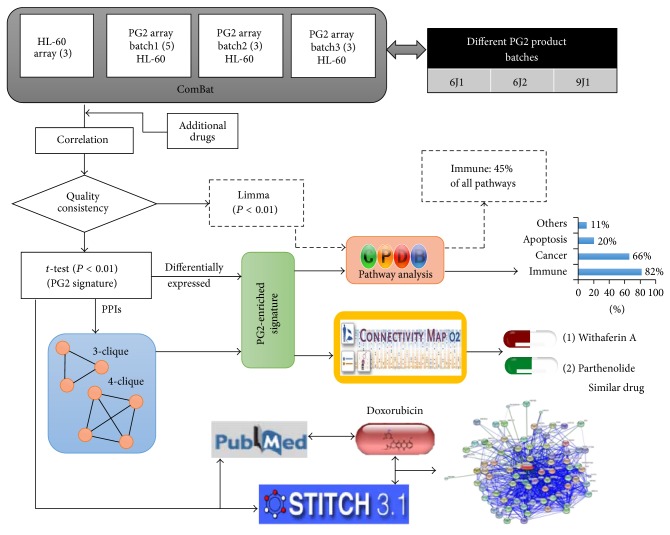
Figure 1
Figure 1
Schematic illustration of using PG2 gene signatures to infer PG2 quality and consistency, as well as the pathways induced by PG2. ComBat package was used to adjust the batch effect before analyzing expression profiles. To elucidate the consistency of three PG2 preparations, additional small molecule drugs and herbal extracts were included to test whether they are similar between each preparation according to correlation coefficient. Analysis of gene expression profiling, limma, t-test, topological clique, and fold-change cut-off analyses were used to identify the PG2-enriched signature. Chemical-protein interaction analysis via STITCH reveals a link between doxorubicin and PG2. Moreover, most of the immune-related pathways were retrieved from CPDB using the PG2-enriched signature. Finally, using the Connectivity Map tool, which used ranking by KS enrichment scores, two drugs were identified (withaferin A and parthenolide) that exhibit gene signatures similar to the PG2-enriched signature.
Figure 2
Figure 2
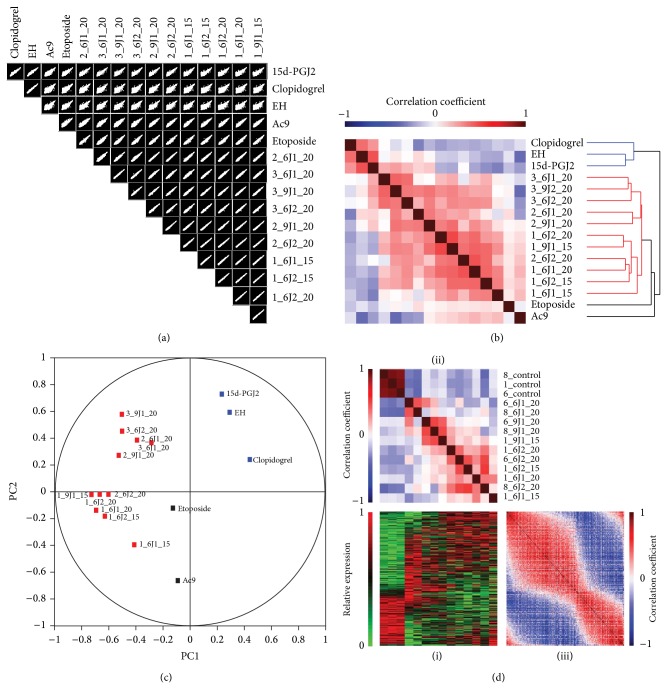
Scatter-plot matrix and correlation map with hierarchical clustering analysis show similarities between PG2 samples. (a) Scatter-plot matrix using all 54,675 probe sets for the gene expression profiles of HL-60 cells treated with PG2, 15-delta prostaglandin J2 (15d-PGJ2), clopidogrel, Vitis ficifolia var. taiwaniana (EH), Antrodia Camphorata (Ac9), and etoposide. All of the PG2 samples have very similar gene expression profiles because most of the data points fall very close to the 45° line. (b) The Pearson product-moment correlation matrix between the 16 samples, using relative expression for all 54,675 probe sets, is displayed by the GAP environment and sorted by the HCT_R2E algorithm. Both the sorted correlation matrix map and the dendrogram branching structure clearly indicate that all of the 11 PG2 samples form a cluster relative to the other samples. (c) The correlation plot of the first two components from the principal component analysis (PCA) of the same data reconfirms the findings in (b). (d) Three matrix maps (expression profile matrix (i), sample correlation matrix (ii), and gene correlation matrix (iii)) were calculated for the relative expression profile of 14 samples (3 vehicles and 11 PG2) with 646 upregulated genes and 465 downregulated genes, sorted and displayed by the GAP environment with the R2E (rank-two elliptical seriation) algorithm. The interaction pattern of the two sample groups (vehicle and PG2) on the two clear gene clusters (up- and downregulated genes) suggests that the PG2 signature is a well-defined gene set that can be used to analyze PG2.
Figure 3
Figure 3
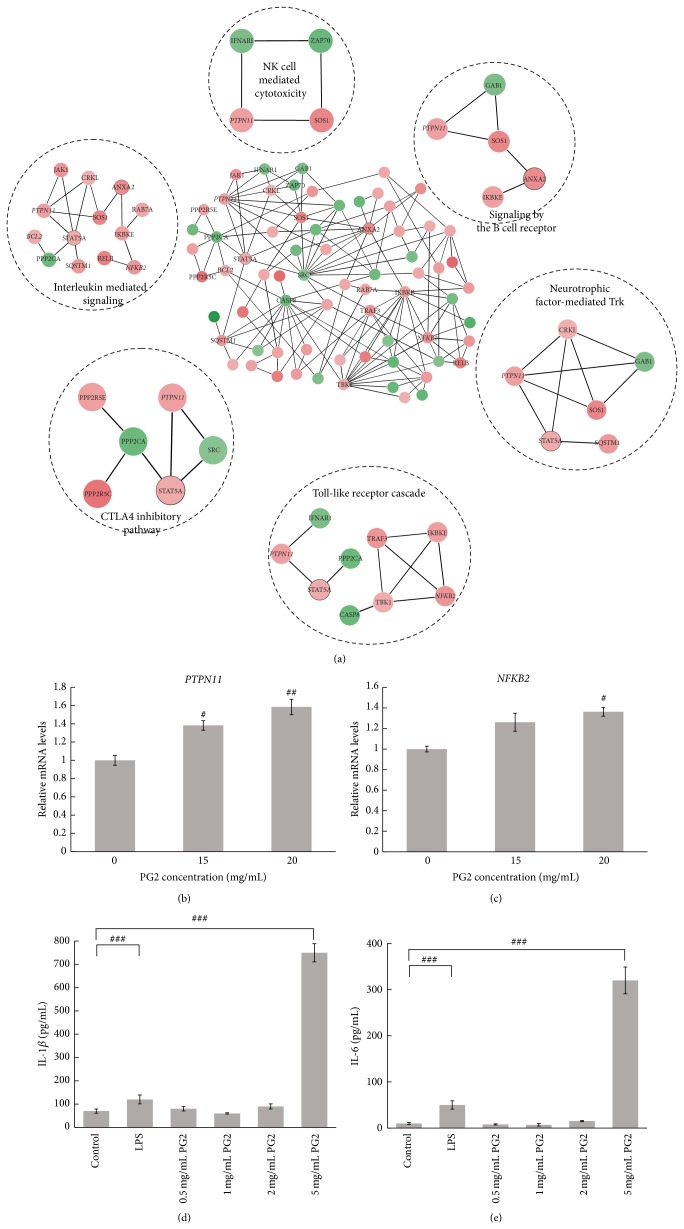
Network analysis of PG2-enriched signature reveals the connection to immune function. (a) The subnetwork was composed of 87 genes, including graph-based clique and overexpressed genes. These genes were subsequently analyzed using CPDB pathway analysis. As indicated in this figure, several subnetworks were identified, including several immune-related signaling pathways, such as interleukin-mediated signaling, toll-like signaling, Trk receptor signaling, and the CTLA4 inhibitory pathway. Links represent a protein-protein interaction in the network. The size of each node is based on the number of links to other nodes. Nodes with upregulated and downregulated genes are colored in red and green, respectively. The depth of color indicates the gene expression level fold change. Several genes from PG2-enriched signature, represented by a black borderline on a node (e.g., STAT5A in CTLA4 inhibitory pathway), are not in the original pathway analysis but are included in the pathways of the subnetworks based on a literature survey. The network was visualized using Cytoscape 3.0 (http://www.cytoscape.org/). HL-60 cells were treated with different concentrations of PG2 for 6 hr. (b) PTPN11 and (c) NFKB2 mRNA was measured by Q-RT PCR and normalized to β-actin (n = 3). PG2 treatment alone drastically increased the production of IL-1β (d) and IL-6 (e) in human THP-1 macrophages (n = 3) (# P < 0.05; ## P < 0.01; ### P < 0.001).
Figure 4
Figure 4
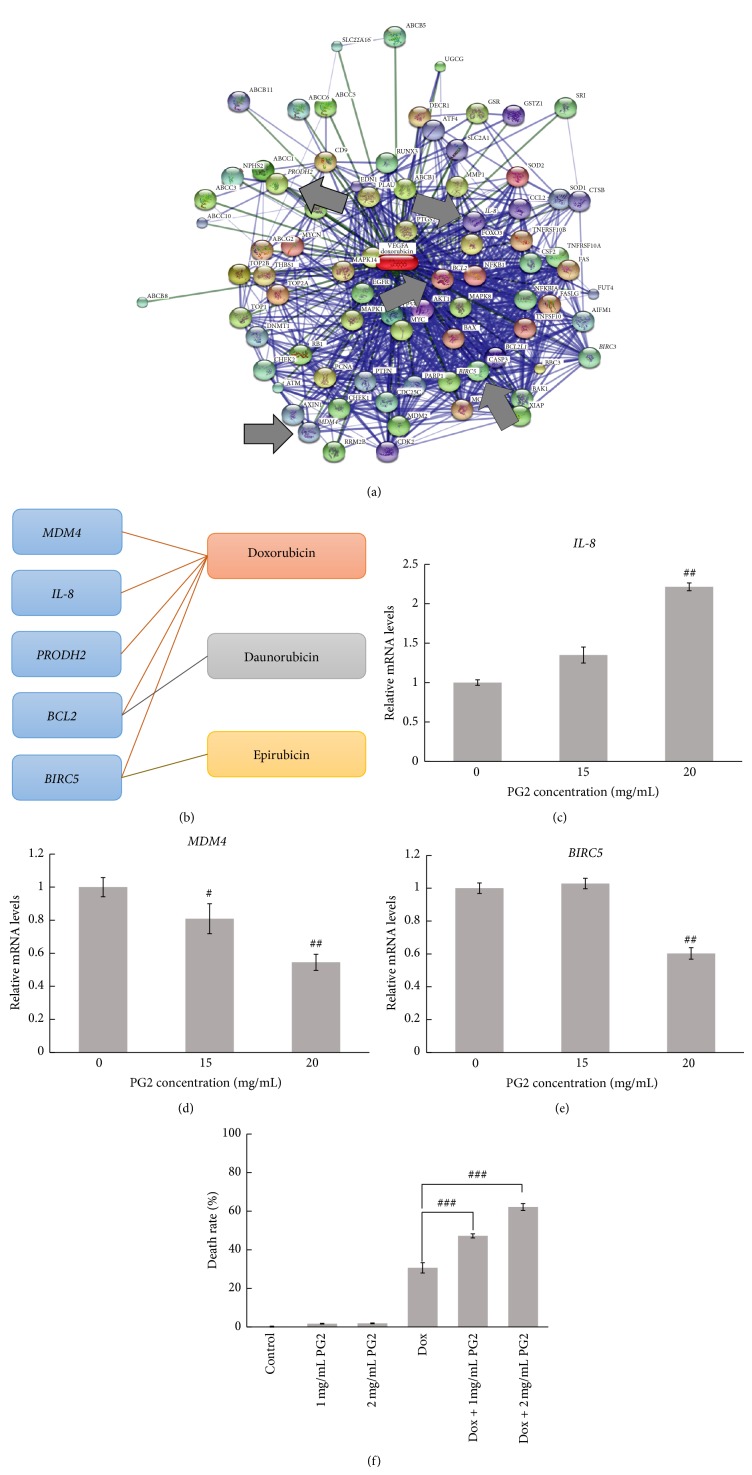
The effect of combining PG2 and doxorubicin on cell death in HL-60 cells. (a) The top 80 confidence interactions associated with doxorubicin were obtained from STITCH. Five of these (MDM4, IL-8, PRODH2, BCL2, and BIRC5) are derived from the PG2 signature and interact with doxorubicin (identified with arrows). Associated strength is represented by the thickness of the line. Protein-protein interactions are colored in blue, and chemical-protein interactions are colored in green. (b) Drug-target interactions between anthracyclines and PG2. Among these, daunorubicin and epirubicin are associated with only one interactor. HL-60 cells were treated with different concentrations of PG2 for 6 hr. (c) IL8, (d) MDM4, and (e) BIRC5 gene expressions were measured by Q-RT-PCR and normalized to β-actin (n = 3). (f) HL-60 cells were treated with various concentrations of PG2 in the presence or absence of doxorubicin (0.75 µg/mL). Cell viability was determined by the trypan blue exclusion assay. Data are expressed as the mean ± standard deviation (SD) of three repeats. A representative result from three independent experiments is shown (n = 5) (# P < 0.05; ## P < 0.01; ### P < 0.001 versus vehicle control group).

References

    1. Zhao C., Zhou Y., Ping J., Xu L. Traditional Chinese medicine for treatment of liver diseases: progress, challenges and opportunities. Journal of Integrative Medicine. 2014;12(5):401–408. doi: 10.1016/S2095-4964(14)60039-X. - DOI - PMC - PubMed
    1. Chen Y., Fu D.-Y., He Y.-M., et al. Effects of Chinese herbal medicine Yiqi Huaju Formula on hypertensive patients with metabolic syndrome: a randomized, placebo-controlled trial. Journal of Chinese Integrative Medicine. 2013;11(3):184–194. doi: 10.3736/jintegrmed2013031. - DOI - PubMed
    1. Ling C. Q., Yue X. Q., Ling C. Three advantages of using traditional Chinese medicine to prevent and treat tumor. Journal of Integrative Medicine. 2014;12(4):331–335. doi: 10.1016/s2095-4964(14)60038-8. - DOI - PubMed
    1. McKenna D., Hughes K., Jones K. Astragalus. Alternative Therapies in Health and Medicine. 2002;8(6):34–41. - PubMed
    1. Jiang J., Wu C., Gao H., Song J., Li H. Effects of astragalus polysaccharides on immunologic function of erythrocyte in chickens infected with infectious bursa disease virus. Vaccine. 2010;28(34):5614–5616. doi: 10.1016/j.vaccine.2010.06.025. - DOI - PubMed

LinkOut - more resources