


CD147 and MMP-9 expressions in type II/III adenocarcinoma of esophagogastric junction and their clinicopathological significances
- PMID: 25973085
- PMCID: PMC4396308
CD147 and MMP-9 expressions in type II/III adenocarcinoma of esophagogastric junction and their clinicopathological significances
Abstract
Objectives: To investigate CD147 and matrix metalloproteinase-9 (MMP-9) expressions in type II/III adenocarcinoma of esophagogastric junction (AEG), and their clinicopathological significances.
Methods: Seventy-four patients clinically and pathologically diagnosed with type II/III AEG were analyzed, each undergoing radical total gastrectomy and Roux-en-Y esophagojejunostomy. The avidin streptavidin-perosidase immunohistochemistry technique was used to detect CD147 and MMP-9 in type II/III AEGs and 20 para-tumor controls, and their correlations with clinicopathological data and their reciprocal relationship were then analyzed. Kaplan-Meier survival analysis was conducted to reveal their prognostic significances. SPSS 20.0 was used for data analysis. A difference was statistically significant with P < 0.05, and very significant with P < 0.01.
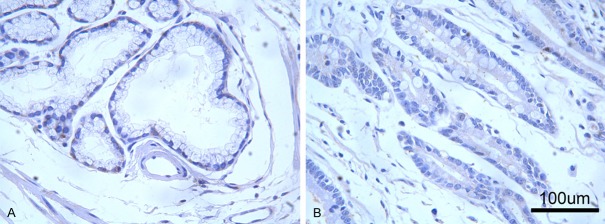
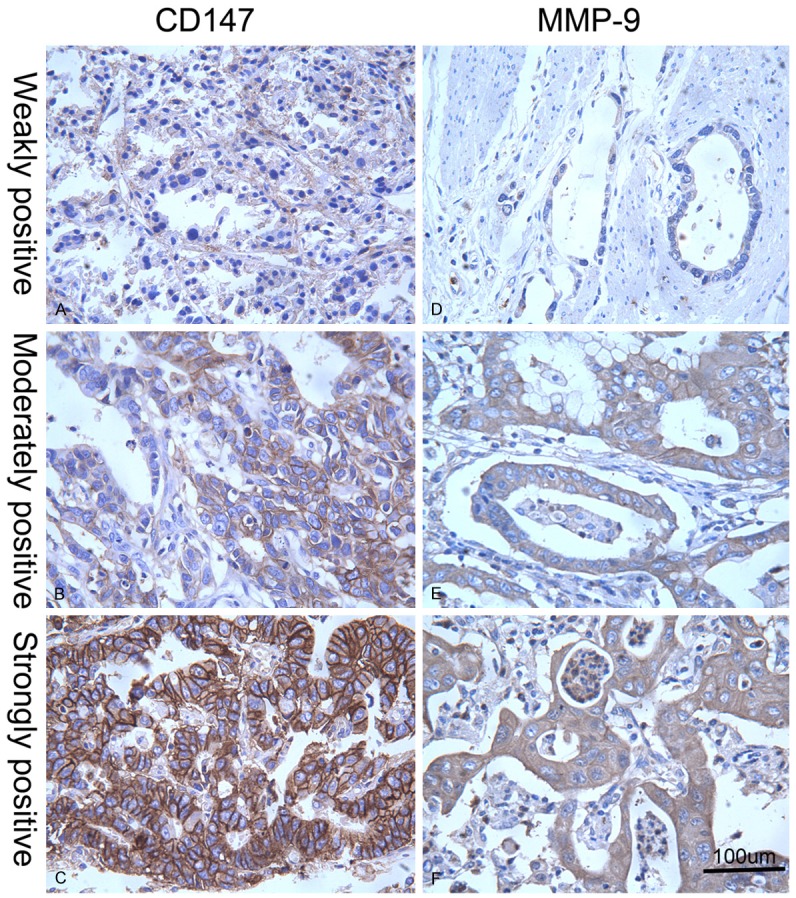
Results: In type II/III AEG CD147 and MMP-9 were mainly expressed on cellular membrane of in tumor cell cytoplasm. MMP-9 expression was significantly stronger at tumor-stroma junction and front edge of invasion. Their positive rates were significantly higher in malignant tissues than para-tumor tissues (P < 0.01 for both). There existed a significant positive correlation between both expressions (P < 0.05). They were significantly more highly expressed in cancers with lymphatic metastasis (P < 0.01 for both), at TNM III/IV stages (P < 0.01 for both), and with poor differentiation grade (P < 0.05 for both). Higher CD147 and MMP-9 expression rates were correlated with inferior postsurgical survivals (P < 0.05 for both).
Conclusions: CD147 and MMP-9 could be novel biomarkers for type II/III AEG, and potentially predict tumor progression and prognosis. They are worth further investigation.
Keywords: Adenocarcinoma of esophagogastric junction; CD147; matrix metalloproteinase 9; prognosis; tumor progression.
Figures
References
-
- Jemal A, Bray F, Center MM, Ferlay J, Ward E, Forman D. Global cancer statistics. CA Cancer J Clin. 2011;61:69–90. - PubMed
-
- Suh YS, Han DS, Kong SH, Lee HJ, Kim YT, Kim WH, Lee KU, Yang HK. Should adenocarcinoma of the esophagogastric junction be classified as esophageal cancer? A comparative analysis according to the seventh AJCC TNM classification. Ann Surg. 2012;255:908–915. - PubMed
-
- Mine S, Sano T, Hiki N, Yamada K, Kosuga T, Nunobe S, Shigaki H, Yamaguchi T. Thoracic lymph node involvement in adenocarcinoma of the esophagogastric junction and lower esophageal squamous cell carcinoma relative to the location of the proximal end of the tumor. Ann Surg Oncol. 2014;21:1596–1601. - PubMed
-
- Hasegawa S, Yoshikawa T, Rino Y, Oshima T, Aoyama T, Hayashi T, Sato T, Yukawa N, Kameda Y, Sasaki T, Ono H, Tsuchida K, Cho H, Kunisaki C, Masuda M, Tsuburaya A. Priority of lymph node dissection for Siewert type II/III adenocarcinoma of the esophagogastric junction. Ann Surg Oncol. 2013;20:4252–4259. - PubMed
-
- Huang L, Xu A, Li T, Han W, Wu S, Wang Y. Detection of perioperative cancer antigen 72-4 in gastric juice pre- and post-distal gastrectomy and its significances. Med Oncol. 2013;30:651. - PubMed
Publication types
MeSH terms
Substances
LinkOut - more resources
Full Text Sources
Other Literature Sources
Medical
Research Materials
Miscellaneous