Teaching and assessing professionalism in medical learners and practicing physicians
- PMID: 25973263
- PMCID: PMC4422450
- DOI: 10.5041/RMMJ.10195
Teaching and assessing professionalism in medical learners and practicing physicians
Abstract
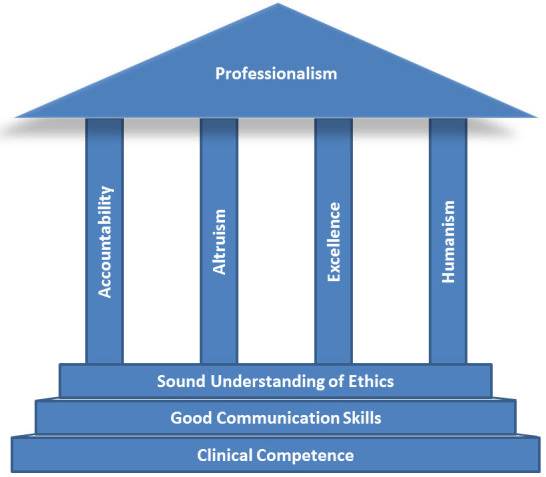
Professionalism is a core competency of physicians. Clinical knowledge and skills (and their maintenance and improvement), good communication skills, and sound understanding of ethics constitute the foundation of professionalism. Rising from this foundation are behaviors and attributes of professionalism: accountability, altruism, excellence, and humanism, the capstone of which is professionalism. Patients, medical societies, and accrediting organizations expect physicians to be professional. Furthermore, professionalism is associated with better clinical outcomes. Hence, medical learners and practicing physicians should be taught and assessed for professionalism. A number of methods can be used to teach professionalism (e.g. didactic lectures, web-based modules, role modeling, reflection, interactive methods, etc.). Because of the nature of professionalism, no single tool for assessing it among medical learners and practicing physicians exists. Instead, multiple assessment tools must be used (e.g. multi-source feedback using 360-degree reviews, patient feedback, critical incident reports, etc.). Data should be gathered continuously throughout an individual's career. For the individual learner or practicing physician, data generated by these tools can be used to create a "professionalism portfolio," the totality of which represents a picture of the individual's professionalism. This portfolio in turn can be used for formative and summative feedback. Data from professionalism assessments can also be used for developing professionalism curricula and generating research hypotheses. Health care leaders should support teaching and assessing professionalism at all levels of learning and practice and promote learning environments and institutional cultures that are consistent with professionalism precepts.
Keywords: Assessment; ethics; medical education; medical professionalism; professionalism.
Figures
References
-
- Osler W. The growth of a profession. Can Med Surg J. 14:1885–6. 129–55.
-
- Gove PB, Merriam-Webster Editorial Staff . Webster’s Third New International Dictionary of the English Language, Unabridged. Springfield, MA: G & C Merriam Company; 1961.
-
- ACGME Outcome Project. General competencies. Chicago, IL: Accreditation Council for Graduate Medical Education; 2007. Available at: http://tinyurl.com/q4524cy. Accessed February 2, 2015.
-
- ACGME Outcome Project. Advancing education in medical professionalism. Chicago IL: Accreditation Council for Graduate Medical Education; 2004. Available at: http://tinyurl.com/nff3w2s. Accessed February 2, 2015.
Publication types
LinkOut - more resources
Full Text Sources