Review
. 2015 Jan 15;5(2):472-80.
eCollection 2015.

Circular RNAs in cancer: novel insights into origins, properties, functions and implications

Affiliations
Review

Circular RNAs in cancer: novel insights into origins, properties, functions and implications

Jingqiu Li et al. Am J Cancer Res. .

Abstract

Circular RNAs (circRNAs) are a large class of RNAs that, unlike linear RNAs, form covalently closed continuous loops and have recently shown huge capabilities as gene regulators in mammals. These circRNAs mainly arise from exons or introns, and are differentially generated by back splicing or lariat introns. Interestingly, they are found to be enormously abundant, evolutionally conserved and relatively stable in cytoplasm. These features confer numerous potential functions to circRNAs, such as acting as microRNA (miRNA) sponges, binding to RNA-associated proteins to form RNA-protein complexes and then regulating gene transcription. Importantly, circRNAs associate with cancer-related miRNAs and the circRNA-miRNA axes are involved in cancer-related pathways. Some synthetic circRNAs have shown the remarkable anti-cancer effects. Though circRNAs are ancient molecules, the huge therapeutic potentials of circRNAs are recently being discovered from the laboratory to the clinic. Here, we review the current understanding of the roles of circRNAs in cancers and the potential implications of circRNAs in cancer targeted therapy.

Keywords: Circular RNA; anti-cancer; microRNA sponge; targeted therapy.


Figures

Figure 1
Figure 1
CircRNAs are generated in nucleus and are very stable in cytoplasm. A. The origin of circRNAs. i. The unusual splicing machinery “backsplice” and generate exonic circRNAs whose 5’ and 3’ ends are covalently linked. ii. The intron-derived circRNAs are generated from lariat introns that escape debranching. Sequences near the 5-splice site (yellow box) and branch point (red box) are minimally sufficient for an intron to escape debranching and become a stable circRNA. B. CircRNAs locate in cytoplasm. CircRNAs either undergo nuclear export or are released to the cytoplasm via nuclear pore complex (NPC), where they enjoy extraordinary stability, likely as a result of resistance to debranching enzymes (DBE) and RNA exonucleases (REN).
Figure 2
Figure 2
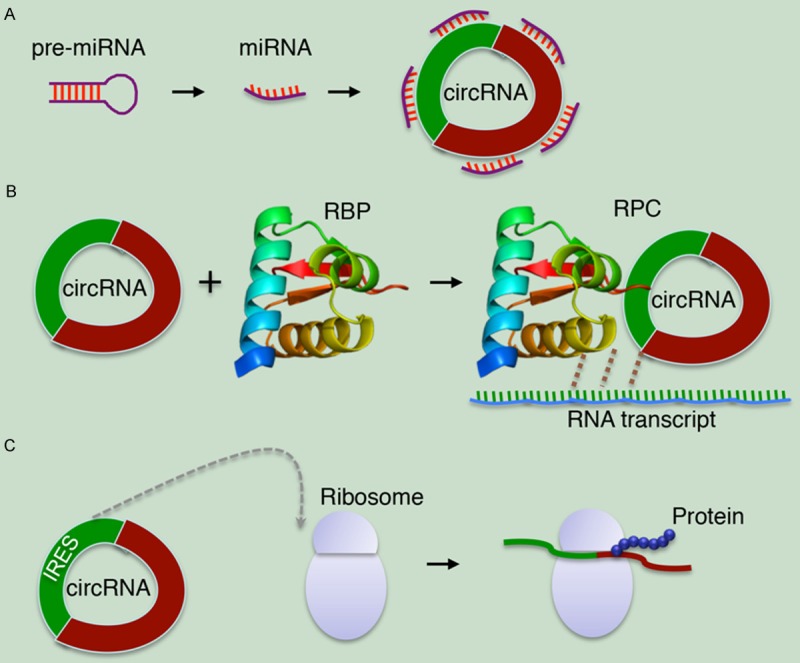
Models of circRNA-mediated gene expression regulation. A. CircRNA functions as a miRNA inhibitor. B. CircRNA binds to RNA-binding protein (RBP) to form RNA-protein complex (RPC) and then interacts with the linear transcript of gene. C. The synthetic circRNA that contains an internal ribosome entry site (IRES) can be translated into a protein product in vitro.
Figure 3
Figure 3
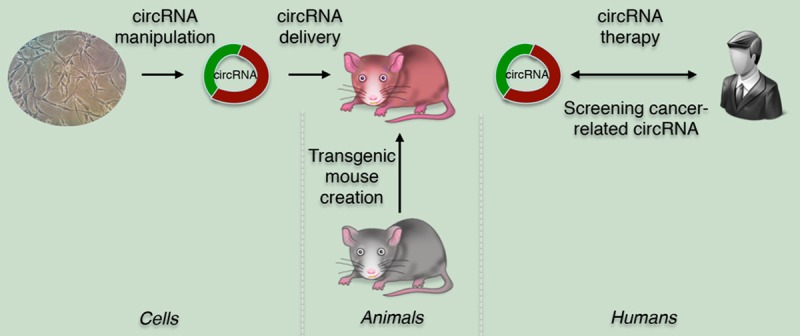
CircRNAs involvement in cancer: from bench to clinic. At the cell level, the specific circRNA and its role in function are discovered and identified. In the in vivo experiment, the transgenic mouse is created and then the specific circRNA is delivered to this animal model to analyze the changes in phenotype. Prior to the clinic trial, the functional target circRNA is screened from cancer patient. The targeted therapy can be used in humans by delivering the therapeutic circRNA to various cancer patients.

References

    1. Sanger HL, Klotz G, Riesner D, Gross HJ, Kleinschmidt AK. Viroids are single-stranded covalently closed circular RNA molecules existing as highly base-paired rod-like structures. Proc Natl Acad Sci U S A. 1976;73:3852–3856. - PMC - PubMed
    1. Memczak S, Jens M, Elefsinioti A, Torti F, Krueger J, Rybak A, Maier L, Mackowiak SD, Gregersen LH, Munschauer M, Loewer A, Ziebold U, Landthaler M, Kocks C, le Noble F, Rajewsky N. Circular RNAs are a large class of animal RNAs with regulatory potency. Nature. 2013;495:333–338. - PubMed
    1. Jeck WR, Sorrentino JA, Wang K, Slevin MK, Burd CE, Liu J, Marzluff WF, Sharpless NE. Circular RNAs are abundant, conserved, and associated with ALU repeats. RNA. 2013;19:141–157. - PMC - PubMed
    1. Salzman J, Gawad C, Wang PL, Lacayo N, Brown PO. Circular RNAs are the predominant transcript isoform from hundreds of human genes in diverse cell types. PLoS One. 2012;7:e30733. - PMC - PubMed
    1. Capel B, Swain A, Nicolis S, Hacker A, Walter M, Koopman P, Goodfellow P, Lovell-Badge R. Circular transcripts of the testis-determining gene Sry in adult mouse testis. Cell. 1993;73:1019–1030. - PubMed

LinkOut - more resources