


The Relationship Between Perceived Racism/Discrimination and Health Among Black American Women: a Review of the Literature from 2003 to 2013
- PMID: 25973361
- PMCID: PMC4426269
- DOI: 10.1007/s40615-014-0043-1
The Relationship Between Perceived Racism/Discrimination and Health Among Black American Women: a Review of the Literature from 2003 to 2013
Abstract
Objectives: The purpose of this paper was to systematically review the literature investigating the relationship between perceived racism/discrimination and health among black American women.
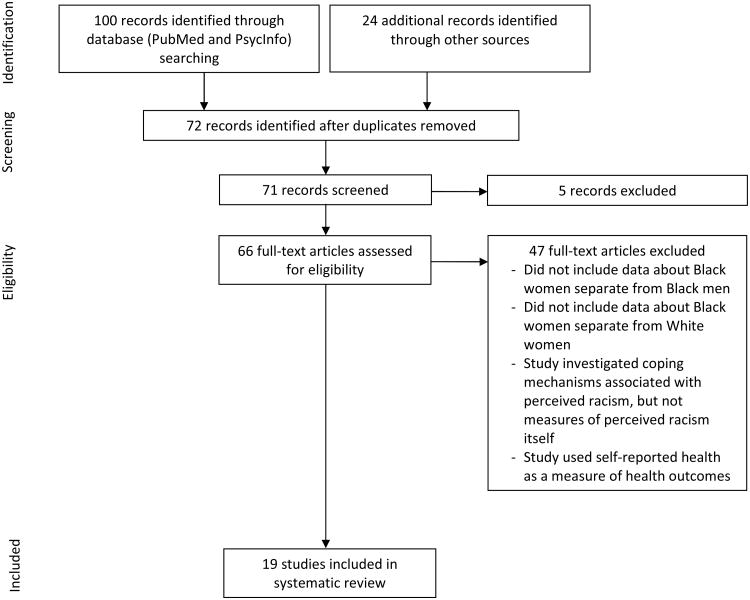
Methods: Searches for empirical studies published from January 2003 to December 2013 were conducted using PubMed and PsycInfo. Articles were assessed for possible inclusion using the Preferred Reporting Items for Systematic Reviews and Meta-Analyses (PRISMA) 2009 framework. In addition, the Agency for Healthcare Research and Quality (AHRQ) system for rating the strength of scientific evidence was used to assess the quality of studies included in the review.
Results: Nineteen studies met criteria for review. There was mixed evidence for general relationships between perceived racism/discrimination and health. Consistent evidence was found for the relationship between adverse birth outcomes, illness incidence, and cancer or tumor risk and perceived racism/discrimination. Inconsistent findings were found for the relationship between perceived racism/discrimination and heart disease risk factors. There was no evidence to support the relationship between perceived racism/discrimination and high blood pressure.
Conclusions: There is mixed evidence to support the association between perceived racism/discrimination and overall objective health outcomes among black American women. The strongest relationship was seen between perceived racism/discrimination and adverse birth outcomes. Better understanding of the relationship between health and racism/discrimination can aid in identifying race-based risk factors developing primary prevention strategies. Future studies should aim to investigate the role of perceived racism/discrimination as a specific chronic stressor within discrete pathogenesis models.
Conflict of interest statement
Conflict of Interest Statement: Dr. VanHoose is supported by the Eunice Kennedy Shriver National Institute of Child Health & Development of the National Institutes of Health under Award Number K12HD052027. Dr. Johnson and Ms. Black declare that they have no conflict of interest.
References
-
- Ward E, Jemal A, Cokkinides V, Singh GK, Cardinez C, Ghafoor A, et al. Cancer disparities by race/ethnicity and socioeconomic status. CA: A Cancer Journal for Clinicians. 2004;54(2):78–93. - PubMed
-
- Geronimus AT, Bound J, Waidmann TA, Hillemeier MM, Burns PB. Excess mortality among blacks and whites in the United States. New England Journal of Medicine. 1996;335(21):1552–8. - PubMed
-
- Clark R, Anderson NB, Clark VR, Williams DR. Racism as a stressor for African Americans: A biopsychosocial model. American psychologist. 1999;54(10):805–16. - PubMed
Publication types
MeSH terms
Grants and funding
LinkOut - more resources
Full Text Sources
Other Literature Sources
Miscellaneous