. 2015 Feb 9;4(1):e57-63.
doi: 10.1016/j.eats.2014.11.005. eCollection 2015 Feb.

Anatomic reconstruction of the medial patellofemoral ligament using the fascia lata as an autograft

Affiliations

Anatomic reconstruction of the medial patellofemoral ligament using the fascia lata as an autograft

Alexander Haupert et al. Arthrosc Tech. .

Abstract

The medial patellofemoral ligament (MPFL) ensures stability of the patella against lateral forces. In cases of recurrent lateral patellar luxation, surgical reconstruction of the MPFL has an important role in treating lateral patellar instability. Several biomechanical studies have presented valuable pieces of information about various techniques for re-creating this medial patellofemoral complex mainly using the gracilis tendon as an autograft. However, with the increasing number of MPFL reconstructions, there are also an increasing number of patients requiring revision MPFL reconstruction. Therefore alternative graft options may become more relevant. Furthermore, the gracilis tendon as a tubular graft may not be able to fully restore patellofemoral kinematics compared with the native MPFL. This article introduces a surgical technique using the fascia lata as an alternative graft option for the anatomic reconstruction of the MPFL.


Figures
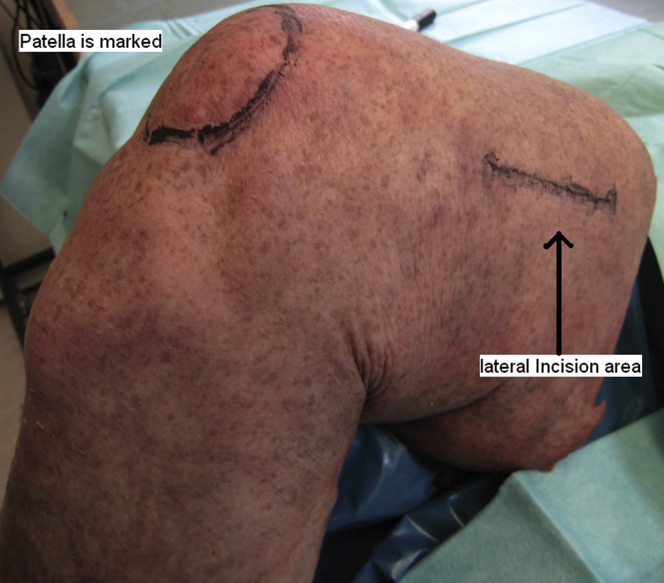
Fig 1
Fig 1
View of cadaveric specimen from lateral side. The patella is marked with a circle. The lateral incision for harvesting of the fascia lata autograft is marked approximately 4 fingerbreadths above the patella.
Fig 2
Fig 2
View from lateral side. The proximal (femoral) side is on the right, and the distal (tibial) side is on the left. The subcutaneous tissue is opened. The fascia lata is exposed and presents as gleaming and tense. An area of 10 mm in width and 12 cm in length is identified and marked with a felt pen. Two Langenbeck clips retain and move the skin in the desired direction.
Fig 3
Fig 3
View from lateral side. The proximal (femoral) side is on the right, and the distal (tibial) side is on the left. After harvesting, the remaining tractus iliotibialis is closed using a thin, absorbable, continuous suture. The subcutaneous tissue is also closed with thin, absorbable sutures in the next step.
Fig 4
Fig 4
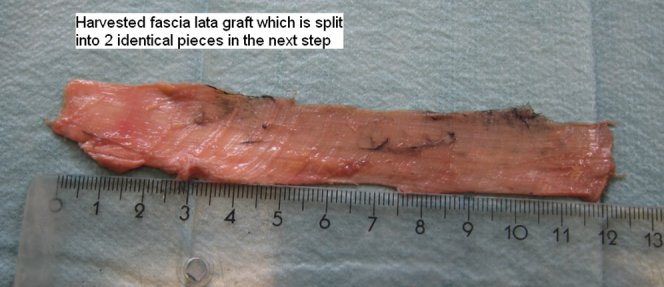
Harvested fascia lata autograft with a length of 12 cm and width of 10 mm. This graft is cleared of muscle and fat using a blunt scissor.
Fig 5
Fig 5
The autograft is divided into 2 separate grafts that are sutured at each end using a whipstitch technique, creating 2 grafts of 5 mm in width and 12 cm in length. Each end should not appear too bulky because of possible non-fitting inside the created tunnels. If bulkiness is present, cutting with a preparation scissor is recommended without weakening the suture's fixation.
Fig 6
Fig 6
View from medial side. The proximal (femoral) side is on the right, and the distal (tibial) side is on the left. The skin incision is enlarged for demonstration purposes. The joint capsule remains untouched and intact. After the patellar bone has been cleared of tissue with a Luer forceps, the 2 tunnels inside the upper two-thirds of the patellar medial margin are created, parallel to each other.
Fig 7
Fig 7
View from medial side. The proximal (femoral) side is on the left, and the distal (tibial) side is on the right. The grafts are fixed at the medial patella with 2 press-fit anchors (4.75-mm SwiveLock). The remaining FiberWire sutures at the patella can be cut with a scalpel. The free ends of each graft are shuttled to the femoral incision side through the second and third layers of the original medial patellofemoral ligament (MPFL) in the next step.
Fig 8
Fig 8
View from medial side. Proximal (femoral) side is on the left and the distal (tibial) side with the tuberositas tibiae (Tub. tib.) is on the left. The grafts are shuttled between the second and third layers of the original medial patellofemoral ligament (MPFL) to the femoral attachment point. Final femoral fixation follows using a bioabsorbable interference screw.
Fig 9
Fig 9
Radiographic image of straight lateral view. The femoral insertion point is determined under fluoroscopic control. The elongation of the femoral posterior cortex and the most posterior point of the Blumensaat line are marked in red. (MPFL, medial patellofemoral ligament.)

References

    1. Schmeling A. Aktuelle Aspekte der patellofemoralen Instabilität. SFA Arthroskopie Aktuell. 2010;23:1–27.
    1. Andrish J. The biomechanics of patellofemoral stability. J Knee Surg. 2004;17:35–39. - PubMed
    1. Warren L.F., Marshall J.L. The supporting structures and layers on the medial side of the knee: An anatomical analysis. J Bone Joint Surg Am. 1979;61:56–62. - PubMed
    1. Panagiotopoulos E., Strzelczyk P., Herrmann M. Cadaveric study on static medial patellar stabilizers: The dynamizing role of the vastus medialis obliquus on medial patellofemoral ligament. Knee Surg Sports Traumatol Arthrosc. 2006;14:7–12. - PubMed
    1. Philippot R., Chouteau J., Wegrzyn J. Medial patellofemoral ligament anatomy: Implications for its surgical reconstruction. Knee Surg Sports Traumatol Arthrosc. 2009;17:475–479. - PubMed

LinkOut - more resources