. 2015 May 14:5:10170.
doi: 10.1038/srep10170.

Impact of spatial dispersion, evolution, and selection on Ebola Zaire Virus epidemic waves

Affiliations

Impact of spatial dispersion, evolution, and selection on Ebola Zaire Virus epidemic waves

Taj Azarian et al. Sci Rep. .

Abstract

Ebola virus Zaire (EBOV) has reemerged in Africa, emphasizing the global importance of this pathogen. Amidst the response to the current epidemic, several gaps in our knowledge of EBOV evolution are evident. Specifically, uncertainty has been raised regarding the potential emergence of more virulent viral variants through amino acid substitutions. Glycoprotein (GP), an essential component of the EBOV genome, is highly variable and a potential site for the occurrence of advantageous mutations. For this study, we reconstructed the evolutionary history of EBOV by analyzing 65 GP sequences from humans and great apes over diverse locations across epidemic waves between 1976 and 2014. We show that, although patterns of spatial dispersion throughout Africa varied, the evolution of the virus has largely been characterized by neutral genetic drift. Therefore, the radical emergence of more transmissible variants is unlikely, a positive finding, which is increasingly important on the verge of vaccine deployment.


Figures
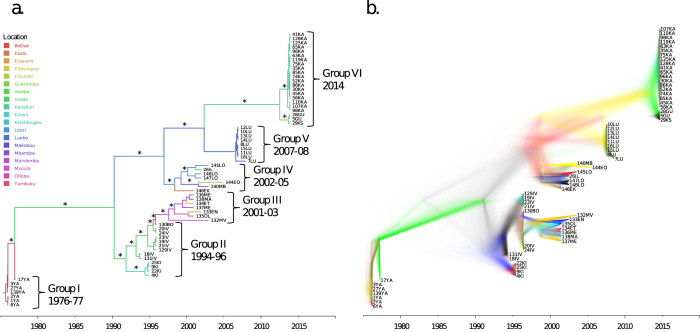
Figure 1
Figure 1. Bayesian MCC genealogy and DensiTree representation of posterior distribution of trees from Bayesian phylogenetic analysis.
(a) Bayesian maximum clade credibility (MCC) tree of EBOV GP gene with branch lengths scaled in time by enforcing a relaxed molecular clock. Strain labels are colored to indicate the sampling location according to the legend in the figure. Branches labeled with an asterisks are well supported, having a posterior probability >0.85. (b) A posterior distribution of trees was obtained from Bayesian phylogenetic analysis of EBOV GP gene using GMRF Skygrid model and relaxed molecular clock as implemented in BEAST v1.8.0. Tip dates for each node represent the year of isolate collection. DensiTree provides a visualization of the posterior distribution of trees and the frequency of node clustering for support of clades in the overall topology. Branches are colored based on distinct clades. Well-supported branches are indicated by solid colors whereas webs represent little agreement.
Figure 2
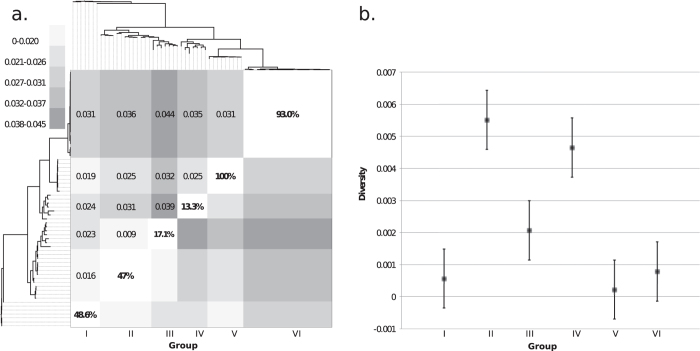
Figure 2. Comparison of between and within group evolutionary diversity with phylogenetic signal.
(a) Between group estimates of evolutionary diversity (i.e. nucleotide substitutions per site from averaging over all sequence pairs between groups) using maximum composite likelihood model with a gamma distribution. Each group represents a distinct group (I - VI) defining a specific epidemic. Percentages along the diagonal represent the results from likelihood mapping phylogenetic signal analysis (material and methods). The greater the percentage, the higher the “star-like” signal for each clade. (b) Within group estimates for evolutionary diversity and standard errors using the maximum composite likelihood model with a gamma distribution for six distinct groups representing distinct epidemics.
Figure 3
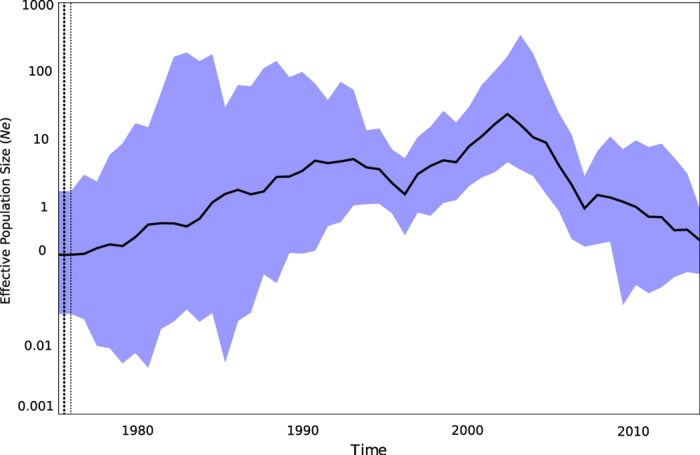
Figure 3. Effective population size (Ne) estimates from Bayesian phylogenetic analysis.
The solid black line and the shaded blue upper and lower bounds represent, respectively, median and 95% high posterior density (95% HPD) intervals estimates of Ne over time. Ne values were estimated in BEAST package v1.8.0 employing a non-parametric Gaussian Markov randomfield (GMRF) Skygrid evolutionary model assuming a relaxed clock.
Figure 4
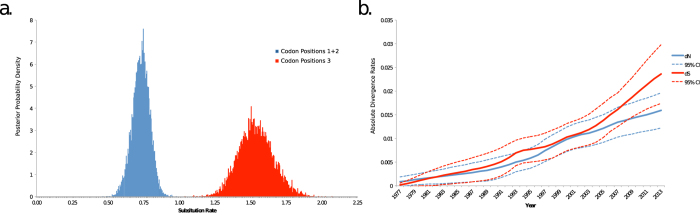
Figure 4. EBOV absolute non-synonymous and synonymous divergence over time.
(a) Posterior probability density of evolutionary rates for 1 + 2 (blue) and 3rd (red) codon positions (b) Mean non-synonymous (dN) and synonymous (dS) divergence along backbone branches from a sub-sample of trees from the posterior distribution during the Ebola epidemics are represented by blue and red lines, respectively. Dashed lines represent one standard deviation above and below mean dN or dS. The y-axis represents the number of nucleotide changes per site.

References

    1. Feldmann H. & Geisbert T. W. Ebola haemorrhagic fever. Lancet 377, 849–62 (2011). - PMC - PubMed
    1. Feldmann H., Klenk H.-D. & Sanchez A. in Unconv. Agents Unclassif. Viruses SE - 8 ( Kaaden O.-R., Eichhorn W. & Czerny C.-P. ) 7, 81–100 Springer: Vienna, , 1993).
    1. WHO. Ebola virus disease. Available at www.who.int/csr/don/archive/disease/ebola/en/. (2014) (Date of Access: 10/28/2014)
    1. Médecins Sans Frontières , M. S. Filovirus haemorrhagic fever guideline. Barcelona, Spain Médecins Sans Front. 1, 39–48 (2008).
    1. Pourrut X. et al. The natural history of Ebola virus in Africa. Microbes Infect. 7, 1005–14 (2005). - PubMed

MeSH terms