. 2015 May 14:5:10241.
doi: 10.1038/srep10241.

Lung microbiota across age and disease stage in cystic fibrosis

Affiliations

Lung microbiota across age and disease stage in cystic fibrosis

Bryan Coburn et al. Sci Rep. .

Abstract

Understanding the significance of bacterial species that colonize and persist in cystic fibrosis (CF) airways requires a detailed examination of bacterial community structure across a broad range of age and disease stage. We used 16S ribosomal RNA sequencing to characterize the lung microbiota in 269 CF patients spanning a 60 year age range, including 76 pediatric samples from patients of age 4-17, and a broad cross-section of disease status to identify features of bacterial community structure and their relationship to disease stage and age. The CF lung microbiota shows significant inter-individual variability in community structure, composition and diversity. The core microbiota consists of five genera - Streptococcus, Prevotella, Rothia, Veillonella and Actinomyces. CF-associated pathogens such as Pseudomonas, Burkholderia, Stenotrophomonas and Achromobacter are less prevalent than core genera, but have a strong tendency to dominate the bacterial community when present. Community diversity and lung function are greatest in patients less than 10 years of age and lower in older age groups, plateauing at approximately age 25. Lower community diversity correlates with worse lung function in a multivariate regression model. Infection by Pseudomonas correlates with age-associated trends in community diversity and lung function.


Figures
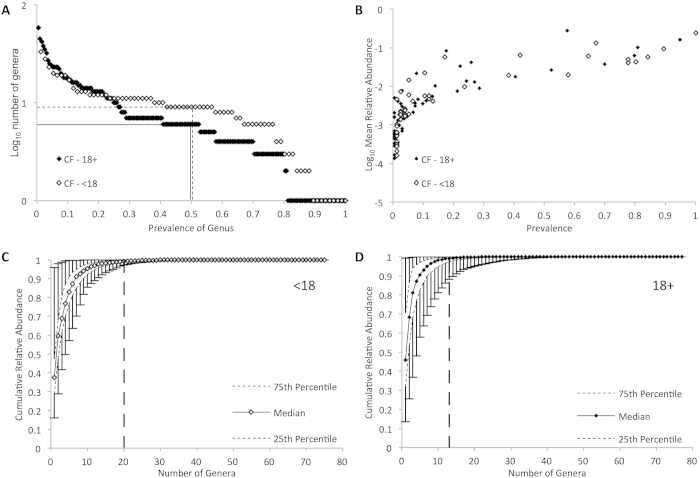
Figure 1
Figure 1
Genus level summary of bacterial population structure in cystic fibrosis (CF) in pediatric and adult sputum samples by 16S rRNA gene sequencing, after exclusion of operational taxonomic units that account for less than 0.005% sequence in the entire dataset. (A) Number of genera in pediatric (open diamonds) and adult (filled diamonds) specimens plotted by prevalence. Dashed (pediatric) and solid (adult) lines indicate core microbiota (genus present in >50% of samples). (B) Mean relative abundance of genera in pediatric (open diamonds) and adult (filled diamonds) specimens plotted by prevalence (C and D) Cumulative relative abundance of genera within a sputum sample of pediatric (C) and adult (D) CF patients plotted by number of genera. Error bars indicate range of values, and vertical dashed lines indicate the number of OTUs accounting for 99% of total sequence.
Figure 2
Figure 2
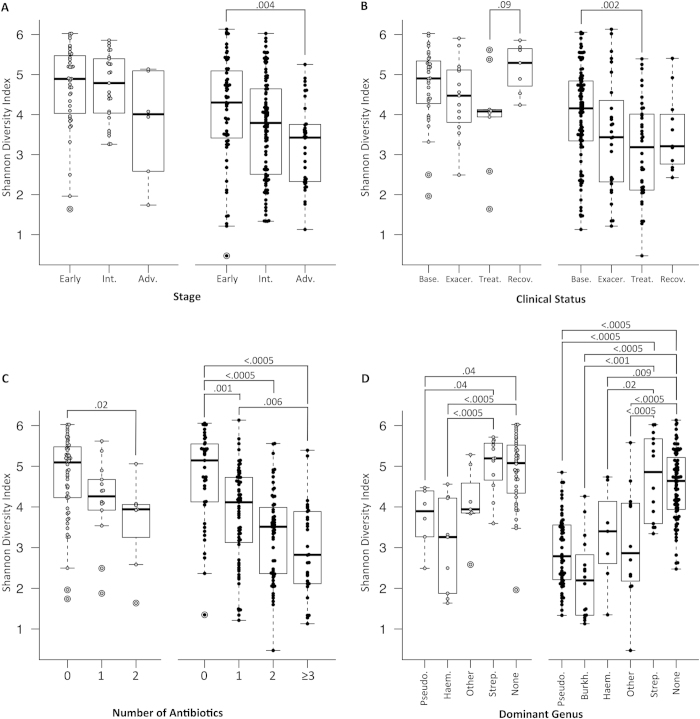
Within-sample (alpha) diversity of sputum specimens from CF patients. Boxplots represent minimum-25th centile-median-75th centile-maximum values and markers indicate individual patients. Open markers indicate pediatric patients and filled markers indicate adult patients. Alpha diversity was summarized using the Shannon diversity index, with diversity increasing on the y axis. Samples were grouped and compared by (A) disease stage (B) clinical status, (C) number of antibiotics being administered at the time of sample collection, and (D) dominant genus. P-values represent the results of t-tests between groups, within pediatric and adult cohorts. Stage, clinical status, treatment groups and dominant genus are defined in the Methods section. Abbreviations: Int.= intermediate, Adv.= advanced, Base.= baseline, Exacer. = exacerbation, Recov. = recovery, Pseudo. = Pseudomonas, Haem. = Haemophilus, Strep. = Streptococcus, Burk. = Burkholderia, None = No dominant genus.
Figure 3
Figure 3
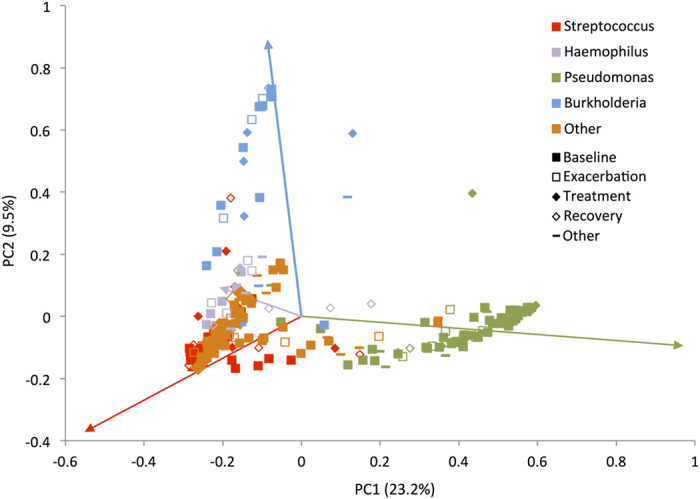
Between-sample (beta) diversity of sputum specimens from CF patients. Bray-Curtis dissimilarity principal coordinates analysis (PCoA) was used to generate ordination of beta-diversity in two dimensions. Principal coordinates 1 and 2 (PC1 and PC2) explain 23.2% and 9.5% of the variance in Bray-Curtis dissimilarity respectively (x and y axes). Increasing distance in two-dimensional space represents increasingly dissimilar community structures. The marker style indicates samples were obtained from patients at clinical baseline, exacerbation, treatment, recovery or other as defined in the Methods section. Samples are colored according to most abundant genus. Colored arrows in the plot indicate Pearson correlation coefficients between genus relative abundance and each principal coordinate, with the line colors corresponding to the genus color in the legend.
Figure 4
Figure 4
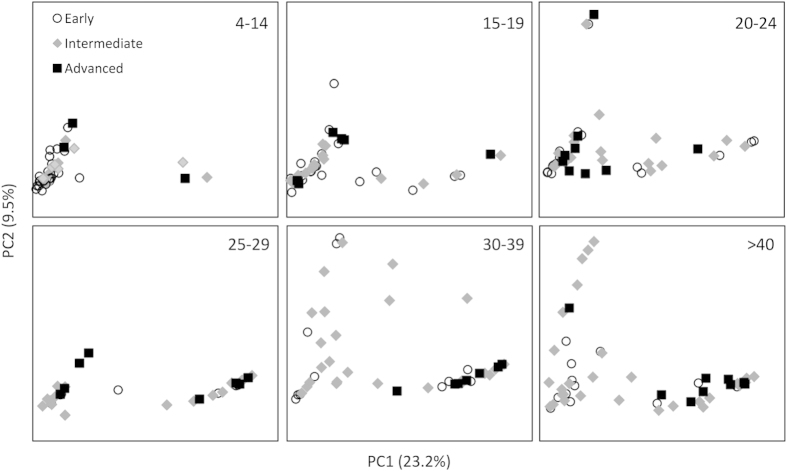
PCoA by Bray-Curtis dissimilarity was plotted by age group as indicated in the upper right corner of each panel. Markers represent individual patients and marker style indicates disease stage at the time of sample collection. Principal coordinates 1 and 2 correlate with relative abundance of Pseudomonas and Burkholderia, respectively as in Fig. 3.
Figure 5
Figure 5
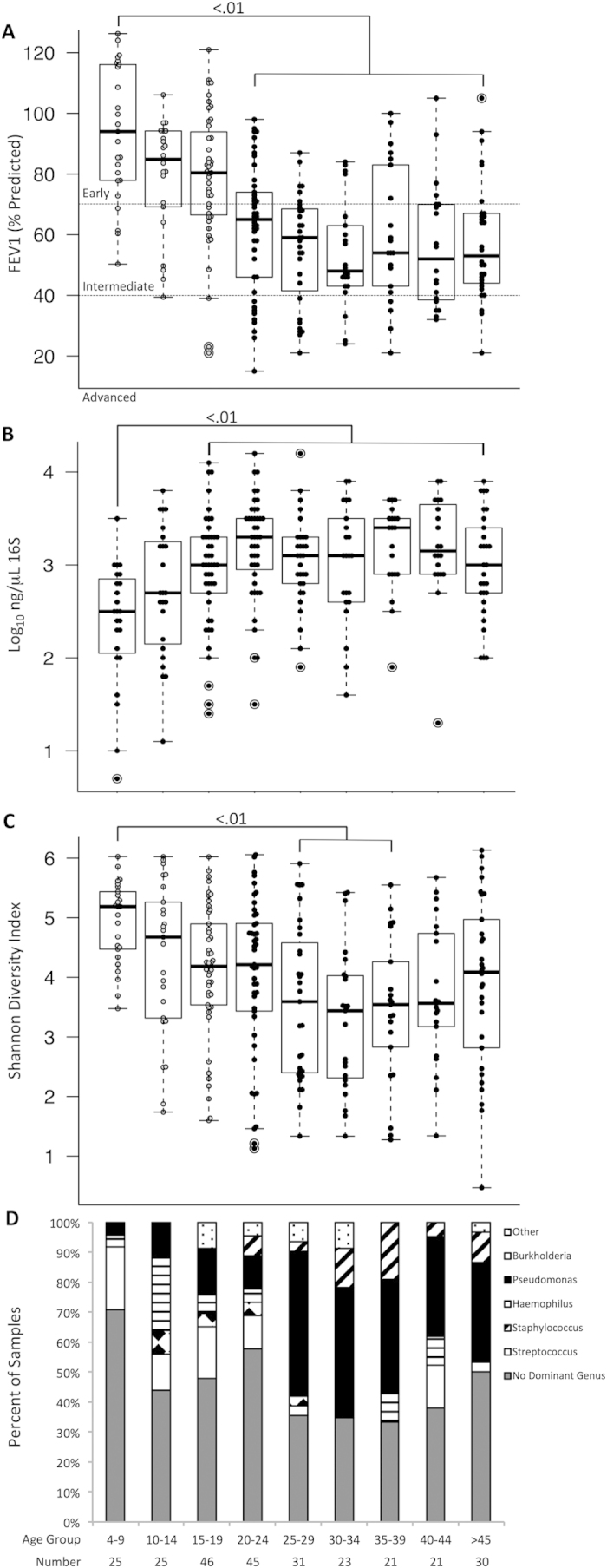
(A) Age dependent changes in lung function (FEV1% predicted), (B) bacterial load (ng/μL 16S rRNA), (C) alpha diversity (Shannon diversity index) and (D) dominant genus (defined in Methods) demonstrate concordant changes in lung function, diversity and increased prevalence of Pseudomonas and Burkholderia with increasing age. Chi-squared significance for panel D is P < 0.0005.

References

    1. Kosorok M. R. et al. Acceleration of lung disease in children with cystic fibrosis after Pseudomonas aeruginosa acquisition. Pediatr Pulmonol 32, 277–287 (2001). - PubMed
    1. Huang N. N. et al. Clinical features, survival rate, and prognostic factors in young adults with cystic fibrosis. Am. J. Med 82, 871–879 (1987). - PubMed
    1. Lewin L. O., Byard P. J. & Davis P. B. Effect of Pseudomonas cepacia colonization on survival and pulmonary function of cystic fibrosis patients. J. Clin Epidemiol 43, 125–131 (1990). - PubMed
    1. Surette M. G. The cystic fibrosis lung microbiome. Ann Am Thorac Soc 11 Suppl 1, S61–65, 10.1513/AnnalsATS.201306-159MG (2014). - DOI - PubMed
    1. Delhaes L. et al. The airway microbiota in cystic fibrosis: a complex fungal and bacterial community--implications for therapeutic management. PLoS One 7, e36313, 10.1371/journal.pone.0036313 (2012). - DOI - PMC - PubMed

Publication types

Substances