Review
. 2015 May;35(2):184-98.
doi: 10.1055/s-0035-1550055. Epub 2015 May 14.

Antifibrotic therapies in the liver

Affiliations
Review

Antifibrotic therapies in the liver

W Z Mehal et al. Semin Liver Dis. 2015 May.

Abstract

Significant progress has been made in understanding the principles underlying the development of liver fibrosis. This includes appreciating its dynamic nature, the importance of active fibrolysis in fibrosis regression, and the plasticity of cell populations endowing them with fibrogenic or fibrolytic properties. This is complemented by an increasing array of therapeutic targets with known roles in the progression or regression of fibrosis. With a key role for fibrosis in determining clinical outcomes and encouraging data from recently Food and Drug Administration-approved antifibrotics for pulmonary fibrosis, the development and validation of antifibrotic therapies has taken center stage in translational hepatology. In addition to summarizing the recent progress in antifibrotic therapies, the authors discuss some of the challenges ahead, such as achieving a better understanding of the interindividual heterogeneity of the fibrotic response, how to match interventions with the ideal patient population, and the development of better noninvasive methods to assess the dynamics of fibrogenesis and fibrolysis. Together, these advances will permit a better targeting and dose titration of individualized therapies. Finally, the authors discuss combination therapy with different antifibrotics as possibly the most potent approach for treating fibrosis in the liver.


Figures

Fig. 1
Fig. 1
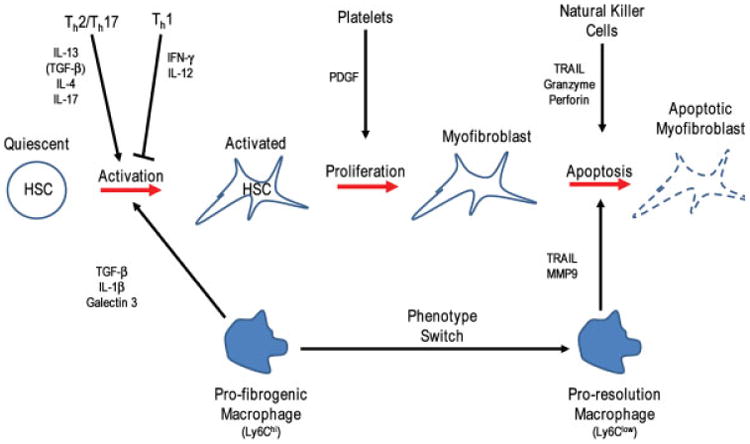
Multiple interactions between immune and profibrogenic cells. The progression of hepatic stellate cells (HSCs) from the quiescent to activated, to myofibroblasts, and eventually apoptosis is greatly influenced by paracrine signals from infiltrating blood monocytes which become tissue macrophages. At the initiation of injury, these tissue macrophages provide activation and proliferation signals, and during the resolution phase they provide apoptotic and reversion signals, but also actively digest and remove excess extracellular matrix. Additionally, innate (natural killer) and adaptive (Th1, Th2, and Th17) immune cells provide signals that can increase or decrease macrophage mediated fibrogenesis. Indirect cytokine production is shown in brackets. IL, interleukin; PDGF, platelet-derived growth factor; TGF, transforming growth factor.
Fig. 2
Fig. 2
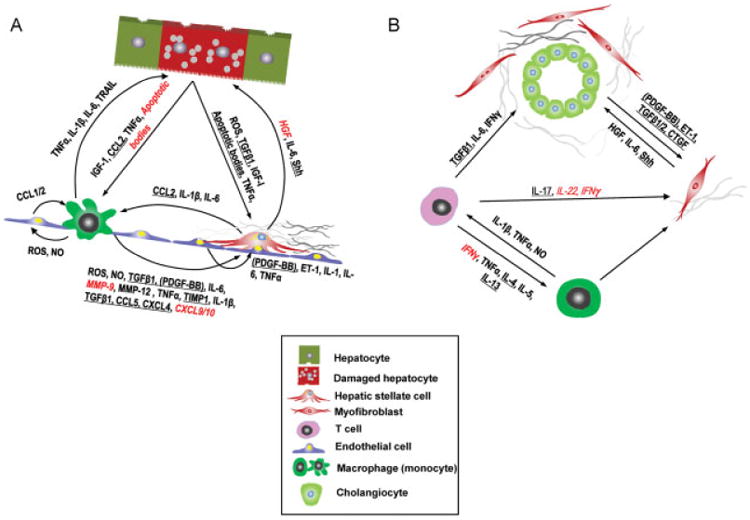
Multicellular context of fibrogenesis and fibrolysis: The postulated major cellular functional units and secreted factors that should be addressed in their complexity when designing effective antifibrotic strategies. (A) Vascular and (B) biliary unit. Profibrogenic targets are underlined, in contrast to putative fibrolysis-inducing targets in italics and red. Profibrogenic targets are underlined, in contrast to putative fibrolysis-inducing targets in italics. Modified from Schuppan and Kim. Baso, basophil; CCL, CC chemokine ligand; CTGF, connective tissue growth factor; CXCL, CXC chemokine ligand; ET-1, endothelin-1; HGF, hepatocyte growth factor; IFN, interferon; IGF, insulin-like growth factor; IL, interleukin; MMP, matrix metalloproteinase; NO, nitric oxide; PDGF-BB, platelet-derived growth factor with two subunits B (in parenthesis because a recent study indicates that most if not all PDGF-BB in liver fibrosis derives from activated platelets; PMN, polymorphonuclear neutrophil; ROS, reactive oxygen species; TNFα, tumor necrosis factor α; Shh, sonic hedgehog; TGFβ1, transforming growth factor β1; Th, T helper cell; TIMP, tissue inhibitor of metalloproteinases; TRAIL, TNF-related apoptosis-inducing ligand; Treg, regulatory T cell.

References

    1. Schuppan D, Kim YO. Evolving therapies for liver fibrosis. J Clin Invest. 2013;123(5):1887–1901. - PMC - PubMed
    1. Mederacke I, Hsu CC, Troeger JS, et al. Fate tracing reveals hepatic stellate cells as dominant contributors to liver fibrosis independent of its aetiology. Nat Commun. 2013;4:2823. - PMC - PubMed
    1. Wells RG. Portal fibroblasts in biliary fibrosis. Curr Pathobiol Rep. 2014;2(4):185–190. - PMC - PubMed
    1. Luedde T, Kaplowitz N, Schwabe RF. Cell death and cell death responses in liver disease: mechanisms and clinical relevance. Gastroenterology. 2014;147(4):765–783. e4. - PMC - PubMed
    1. Friedman SL, Sheppard D, Duffield JS, Violette S. Therapy for fibrotic diseases: nearing the starting line. Sci Transl Med. 2013;5(167):167s. r1. - PubMed

Publication types

MeSH terms

Substances