


doi: 10.1080/00223891.2015.1038388.
Epub 2015 May 15.
Examining the Factor Structure and Structural Invariance of the PANAS Across Children, Adolescents, and Young Adults
Affiliations
- PMID: 25975209
- PMCID: PMC4609236
- DOI: 10.1080/00223891.2015.1038388
Item in Clipboard
Examining the Factor Structure and Structural Invariance of the PANAS Across Children, Adolescents, and Young Adults
J Pers Assess.
2015.
Abstract
It is unclear what factor structure best represents the Positive and Negative Affect Schedule (PANAS) from childhood to adulthood. The PANAS structure was examined in a sample of 555 children (M age = 11.66, SD = 1.24), 608 adolescents (M age = 15.45, SD = 1.09), and 553 young adults (M age = 18.75, SD = 1.00). A partially invariant model consisting of Positive Affect, Fear, and Distress factors best represented the PANAS across all age groups, indicating that the underlying constructs are the same across age but that the factors become increasingly interrelated with increasing age.
Figures
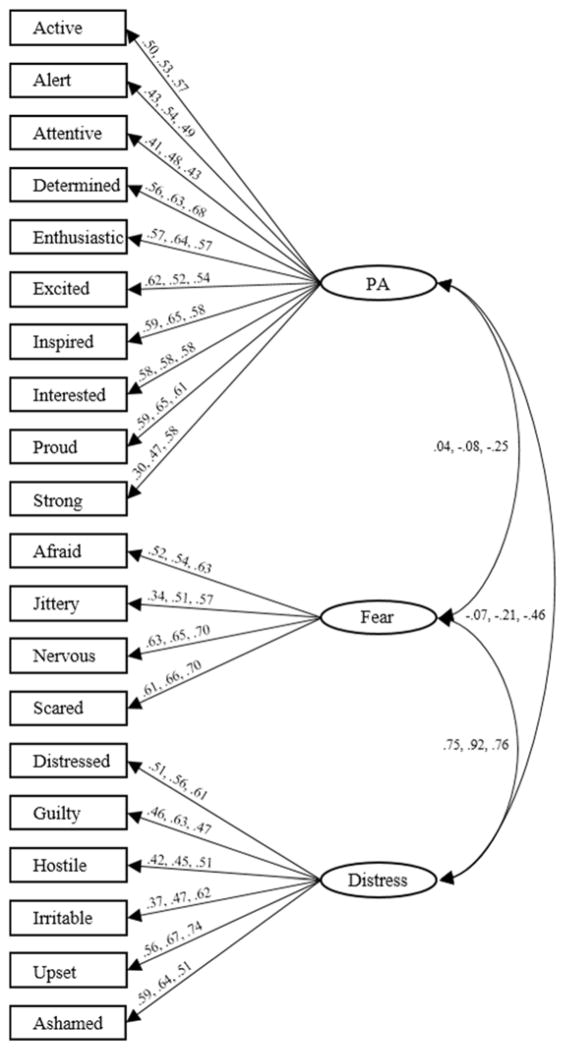
Standardized parameter estimates for the three-factor model of PA, Fear, and Distress in children, adolescents, and adults, respectively. PA = Positive Affect. Error terms and residual variances have been omitted for clarity.
References
-
- Bushman BB, Crowley SL. Is the structure of affect similar for younger and older children? Cross-sectional differences in negative and positive affectivity. Journal of Psychoeducational Assessment. 2010;28:31–39. doi: 10.1177/0734282909337584. - DOI
Publication types
MeSH terms
Grants and funding
LinkOut - more resources
Full Text Sources
Other Literature Sources
Medical