. 2015 May 15;16(1):382.
doi: 10.1186/s12864-015-1584-3.

Genomic and experimental evidence for multiple metabolic functions in the RidA/YjgF/YER057c/UK114 (Rid) protein family

Affiliations

Genomic and experimental evidence for multiple metabolic functions in the RidA/YjgF/YER057c/UK114 (Rid) protein family

Thomas D Niehaus et al. BMC Genomics. .

Abstract

Background: It is now recognized that enzymatic or chemical side-reactions can convert normal metabolites to useless or toxic ones and that a suite of enzymes exists to mitigate such metabolite damage. Examples are the reactive imine/enamine intermediates produced by threonine dehydratase, which damage the pyridoxal 5'-phosphate cofactor of various enzymes causing inactivation. This damage is pre-empted by RidA proteins, which hydrolyze the imines before they do harm. RidA proteins belong to the YjgF/YER057c/UK114 family (here renamed the Rid family). Most other members of this diverse and ubiquitous family lack defined functions.

Results: Phylogenetic analysis divided the Rid family into a widely distributed, apparently archetypal RidA subfamily and seven other subfamilies (Rid1 to Rid7) that are largely confined to bacteria and often co-occur in the same organism with RidA and each other. The Rid1 to Rid3 subfamilies, but not the Rid4 to Rid7 subfamilies, have a conserved arginine residue that, in RidA proteins, is essential for imine-hydrolyzing activity. Analysis of the chromosomal context of bacterial RidA genes revealed clustering with genes for threonine dehydratase and other pyridoxal 5'-phosphate-dependent enzymes, which fits with the known RidA imine hydrolase activity. Clustering was also evident between Rid family genes and genes specifying FAD-dependent amine oxidases or enzymes of carbamoyl phosphate metabolism. Biochemical assays showed that Salmonella enterica RidA and Rid2, but not Rid7, can hydrolyze imines generated by amino acid oxidase. Genetic tests indicated that carbamoyl phosphate overproduction is toxic to S. enterica cells lacking RidA, and metabolomic profiling of Rid knockout strains showed ten-fold accumulation of the carbamoyl phosphate-related metabolite dihydroorotate.

Conclusions: Like the archetypal RidA subfamily, the Rid2, and probably the Rid1 and Rid3 subfamilies, have imine-hydrolyzing activity and can pre-empt damage from imines formed by amine oxidases as well as by pyridoxal 5'-phosphate enzymes. The RidA subfamily has an additional damage pre-emption role in carbamoyl phosphate metabolism that has yet to be biochemically defined. Finally, the Rid4 to Rid7 subfamilies appear not to hydrolyze imines and thus remain mysterious.


Figures
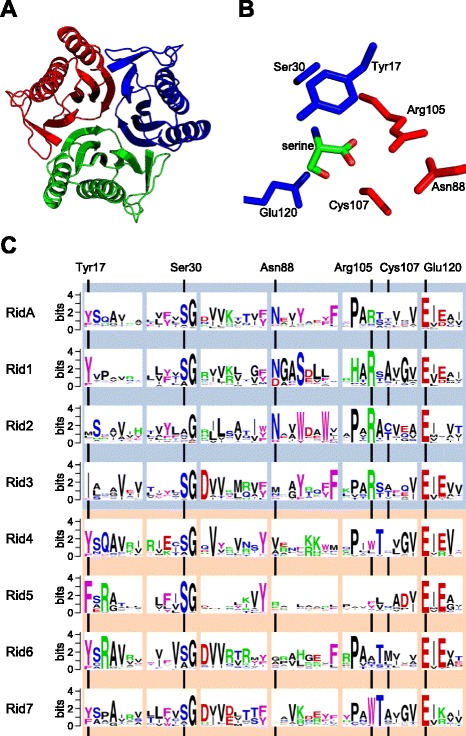
Figure 1
Figure 1
Sequence features of Rid family members. (A) Typical trimeric organization of a RidA protein, Escherichia coli TdcF. (B) TdcF active site with bound serine molecule. Residues of adjacent monomers are colored red or blue. (C) Sequence logos show the conservation and relative frequencies of residues in the archetypal RidA and seven subfamilies (Rid1-Rid7). The six regions shown correspond to the footprint regions used to differentiate the subfamilies.
Figure 2
Figure 2
Phylogenetic distribution of the Rid family. Phylogenetic distribution of the Rid family. Occurrence of Rid family members is mapped onto a Tree of life (http://itol.embl.de). This phylogenetic tree of all three domains of life was constructed by Ciccarelli et al., 2006 [29] using the alignment of a concatenation of 31 orthologous proteins occurring in ~200 representative species with sequenced genomes. Bar size indicates the number of RidA gene copies per subfamily present in each of the genomes shown. Relative genome size is indicated by the size of the outermost gray bars (excluding eukaryotes).
Figure 3
Figure 3
Rid family member genes cluster on prokaryotic chromosomes with genes encoding various PLP-dependent enzymes. Gene models show the orientation of clustered genes in representative prokaryotic genomes. Pie charts show the relative frequency with which clustering occurs with various Rid subfamilies. The color scheme for Rid subfamilies is the same as in Figure 2. Genes in white have unrelated functions.
Figure 4
Figure 4
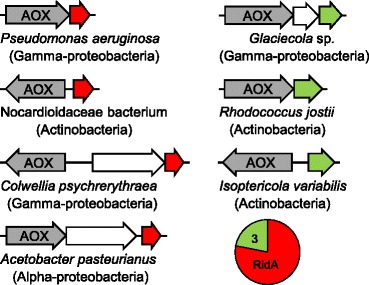
Rid family member genes cluster on bacterial chromosomes with genes belonging to the amine oxidases (AOX) family. The layout and color scheme are as in Figure 3.
Figure 5
Figure 5
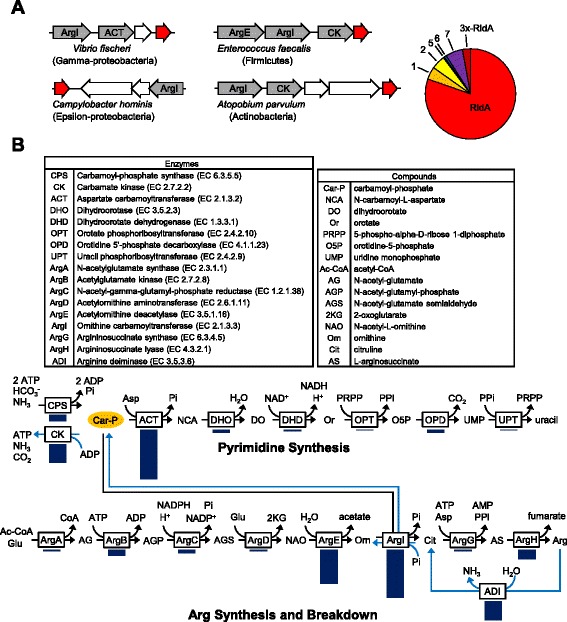
Rid family genes cluster on bacterial chromosomes with pyrimidine and arginine metabolism genes, particularly those related to carbamoyl phosphate. (A) The layout is the same as in Figure 3. (B) The metabolic pathways of pyrimidine and arginine synthesis (black arrows) and breakdown (light blue arrows) are shown. Dark blue bars under each enzyme indicate the relative proportion of genomes (in the set of 981 genomes analyzed) in which each gene of pyrimidine or arginine metabolism is clustered on the chromosome with a Rid family gene. The longest bar (ACT in the pyrimidine pathway) corresponds to 58 instances of clustering.
Figure 6
Figure 6
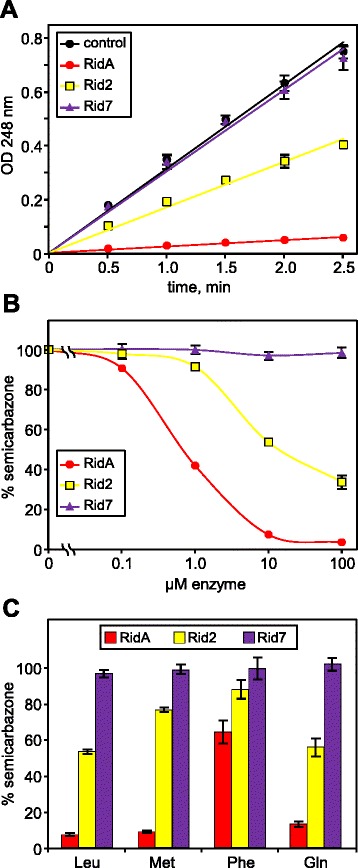
S. enterica RidA and Rid2, but not Rid7, accelerate hydrolysis of imine products of L-amino acid oxidase. (A) Semicarbazone formation in assays containing leucine with or without 10 μM Rid protein. (B) Semicarbazone formation in assays containing leucine and various amounts of Rid protein. (C) Semicarbazone formation in assays containing various amino acid substrates and 10 μM Rid protein. Error bars indicate SE from at least three replicate assays. Data in B and C represent the amount of semicarbazone formation as a percent of control assays containing no Rid protein.
Figure 7
Figure 7
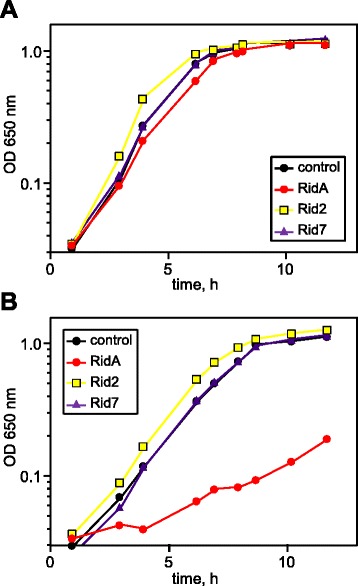
S. enterica cells lacking ridA are sensitive to induction of carbamoyl phosphate synthetase. Cells were grown at 37°C in nutrient broth with (A) no additions or (B) supplemented with 0.1 mM IPTG. Growth was monitored by optical density at 650 nm. All strains contain an insertion in argI, the gene encoding ornithine carbamoyltransferase, and harbor plasmid-encoded CarB under the control of an IPTG-inducible promoter. Strains are represented in the figure legends by the Rid protein they lack. Strain names and relevant genotypes are RidA (DM14200), Rid2 (DM14307), Rid7 (DM14223), and control (DM14203). Data shown are representative of at least three independent experiments done in biological triplicate on separate days.
Figure 8
Figure 8
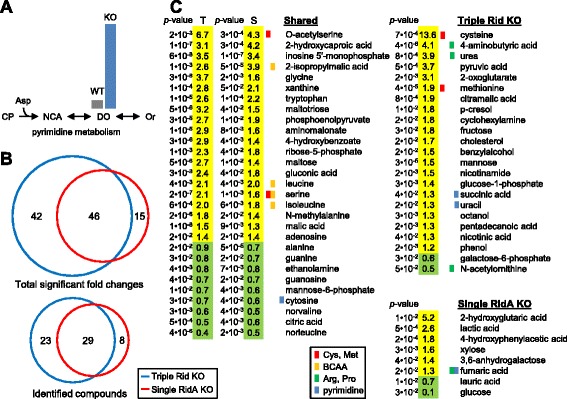
Metabolomic analysis of S. enterica Rid knockouts reveals widespread metabolic disturbances. Wild-type S. enterica and triple Rid KO (ridA Rid2 Rid7; DM14100), and for GC-MS also single RidA KO (ridA; DM3480), cultures were grown, harvested, and analyzed as described in Methods. (A) HILIC-TOF-MS identified dihydoorotate as having a significant 10.5-fold change in the triple KO. Part of the pyrimidine metabolic pathway is shown (see Figure 5 for abbreviations) with bars indicating the relative amount of dihydroorotate in each sample. (B) Venn diagrams summarize the significant (P < 0.05; t test) -fold changes (KO/wild-type) for GC-TOF-MS identified and unknown peaks. (C) GC-TOF-MS identified compounds with significant -fold changes found in one or both knockouts are listed in order of -fold change (for shared compounds, triple (T) or single (S) Rid KO is indicated) and colored yellow or green to indicate increased or decreased levels in the knockout, respectively. p-values are shown to the left of -fold changes. Colored bars adjacent to compound names mark intermediates of metabolic pathways shown in the legend. Data represent six (A, LC-MS) or twelve (B and C, GC-MS) independent cultures for each treatment.

References

    1. Golubev AG. The other side of metabolism: a review. Biochemistry (Mosc) 1996;61:2018–39. - PubMed
    1. D'Ari R, Casadesús J. Underground metabolism. BioEssays. 1998;20:181–6. doi: 10.1002/(SICI)1521-1878(199802)20:2<181::AID-BIES10>3.0.CO;2-0. - DOI - PubMed
    1. Tawfik DS. Messy biology and the origins of evolutionary innovations. Nat Chem Biol. 2010;6:692–6. - PubMed
    1. Galperin MY, Moroz OV, Wilson KS, Murzin AG. House cleaning, a part of good housekeeping. Mol Microbiol. 2006;59:5–19. doi: 10.1111/j.1365-2958.2005.04950.x. - DOI - PubMed
    1. Linster CL, Van Schaftingen E, Hanson AD. Metabolite damage and its repair or pre-emption. Nat Chem Biol. 2013;9:72–80. doi: 10.1038/nchembio.1141. - DOI - PubMed

Publication types

MeSH terms