Neuroprotective effects of intravenous lidocaine on early postoperative cognitive dysfunction in elderly patients following spine surgery
- PMID: 25975969
- PMCID: PMC4444175
- DOI: 10.12659/MSM.894384
Neuroprotective effects of intravenous lidocaine on early postoperative cognitive dysfunction in elderly patients following spine surgery
Abstract
Background: This study aimed to evaluate the effects of lidocaine treatment on cognitive impairment in aged patients undergoing spine surgery and to explore the underlying mechanism.
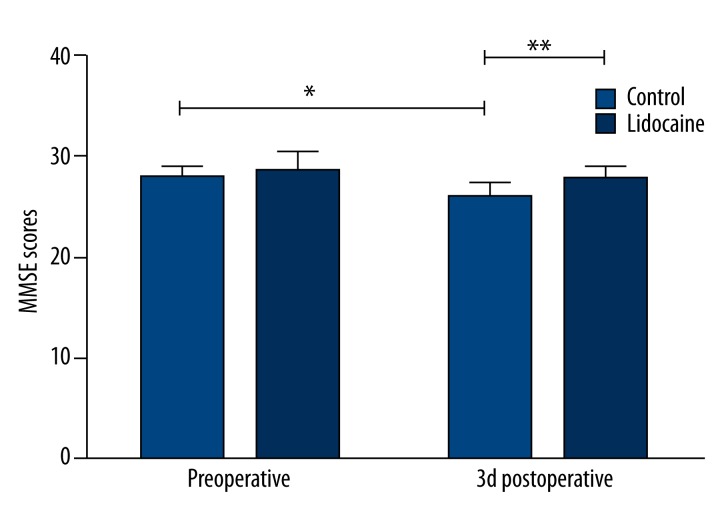
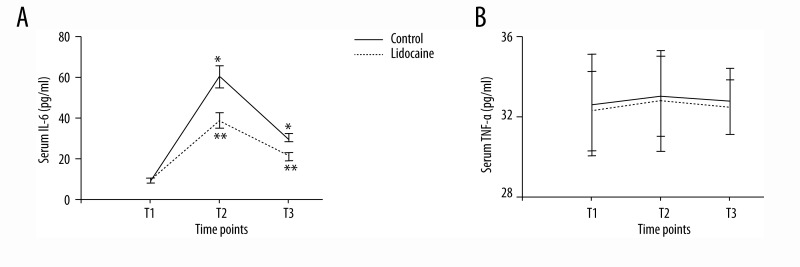
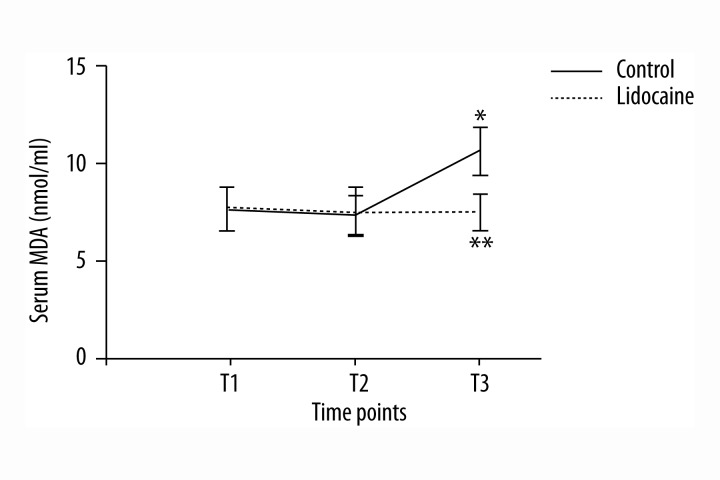
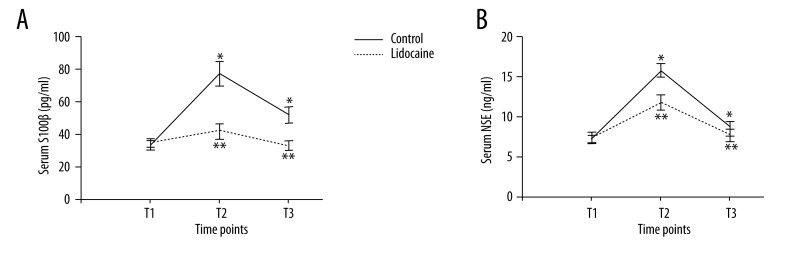
Material/methods: Patients were randomly divided into 2 treatment groups: (1) saline (control) and (2) lidocaine. After induction of anesthesia, the lidocaine group received lidocaine as a bolus of 1 mg/kg over 5 minutes, followed by a continuous infusion at 1.5 mg/kg/h until the end of the surgery. We examined the effects of lidocaine treatment on the improvement of cognitive function using the Mini-Mental State Examination (MMSE) at preoperation and 3 days postoperation. Serum samples were collected to assess the levels of IL-6, TNF-α, MDA, S100β, and NSE before inducing anesthesia, at the end of surgery, and 3 days after the end of surgery.
Results: We found that the MMSE scores in the lidocaine group were markedly higher than those in the control group at 3 days after surgery. Moreover, lidocaine treatment markedly suppressed the release of IL-6, S100β, and NSE into the serum at the end of surgery and 3 days after the end of surgery. In the control group, serum MDA levels increased by 3 days after the end of surgery. The lidocaine group had lower serum MDA levels than those in the control group.
Conclusions: Lidocaine may be an effective neuroprotective agent in treating early postoperative cognitive dysfunction in elderly patients undergoing spine surgery.
Figures
References
-
- Evered L, Scott DA, Silbert B, Maruff P. Postoperative cognitive dysfunction is independent of type of surgery and anesthetic. Anesth Analg. 2011;112:1179–85. - PubMed
-
- Moller JT, Cluitmans P, Rasmussen LS, et al. Long-term postoperative cognitive dysfunction in the elderly ISPOCD1 study. ISPOCD investigators. International Study of Post-Operative Cognitive Dysfunction. Lancet. 1998;351:857–61. - PubMed
Publication types
MeSH terms
Substances
LinkOut - more resources
Full Text Sources
Medical
Miscellaneous