


Impact of a U.S. antismoking national media campaign on beliefs, cognitions and quit intentions
- PMID: 25976009
- PMCID: PMC4514523
- DOI: 10.1093/her/cyv017
Impact of a U.S. antismoking national media campaign on beliefs, cognitions and quit intentions
Abstract
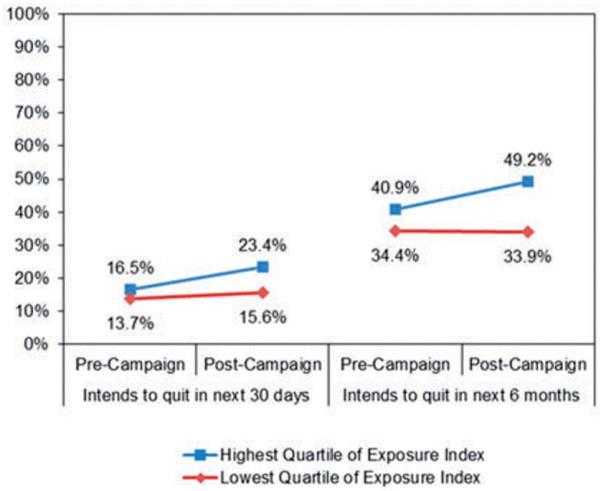
In 2012, the Centers for Disease Control and Prevention launched a national tobacco education campaign, Tips From Former Smokers, that consisted of graphic, emotionally evocative, testimonial-style advertisements. This longitudinal study examines changes in beliefs, tobacco-related cognitions and intentions to quit smoking among U.S. adult smokers after a 12-week airing of the campaign (n = 4040 adult smokers pre- and post-campaign). Exposure to the campaign was associated with greater odds of intending to quit within the next 30 days [odds ratio (OR) = 1.28, P < 0.01] and within the next 6 months (OR = 1.12, P < 0.05), and quit intentions were stronger among respondents with greater campaign exposure (OR = 1.12, P < 0.01). Campaign exposure was also associated with significant changes in beliefs about smoking-related risks (ORs = 1.15-2.40) and increased worries about health (b = 0.30, P < 0.001). Based on study change rates applied to U.S. census data, an estimated 566 000 additional U.S. smokers reported their intention to quit smoking within the next 6 months as a result of viewing campaign advertisements. Campaign effects were consistent with the theory of reasoned action and an expanding body of research demonstrating that graphic, emotional advertisements are highly effective for prompting positive cessation-related cognitions and behavioral intentions.
© The Author 2015. Published by Oxford University Press. All rights reserved. For permissions, please email: journals.permissions@oup.com.
Figures
References
-
- Centers for Disease Control and Prevention Cigarette smoking among adults—United States, 2002. MMWR Morb Mortal Wkly Rep. 2004;53:427–31. - PubMed
-
- U.S. Department of Health and Human Services (USDHHS) The Health Consequences of Smoking—50 Years of Progress: A Report of the Surgeon General. U.S. Department of Health and Human Services, Centers for Disease Control and Prevention, National Center for Chronic Disease Prevention and Health Promotion, Office on Smoking and Health; Atlanta, GA: 2014. - PubMed
-
- Centers for Disease Control and Prevention [Accessed: 29 April 2015];Figure 8.1. Prevalence of Current Smoking among Adults Aged 18 and over: United States, 1997–2012. http://www.cdc.gov/nchs/data/nhis/earlyrelease/earlyrelease201306_08.pdf.
-
- U.S. Department of Health and Human Services [Accessed: 29 April 2015]; HealthyPeople.gov. 2013 HealthyPeople.gov http://www.healthypeople.gov/2020/topicsobjectives2020/objectiveslist.as.... - PubMed
-
- Guide to Community Preventive Services [Accessed: 29 April 2015];Reducing Tobacco Use and Secondhand Smoke Exposure: Mass-Reach Health Communication Interventions. 2013 http://www.healthypeople.gov/2020/topics-objectives/topic/tobacco-use.
Publication types
MeSH terms
Grants and funding
LinkOut - more resources
Full Text Sources
Other Literature Sources
Medical
