


Factor XI and contact activation as targets for antithrombotic therapy
- PMID: 25976012
- PMCID: PMC4516614
- DOI: 10.1111/jth.13005
Factor XI and contact activation as targets for antithrombotic therapy
Abstract
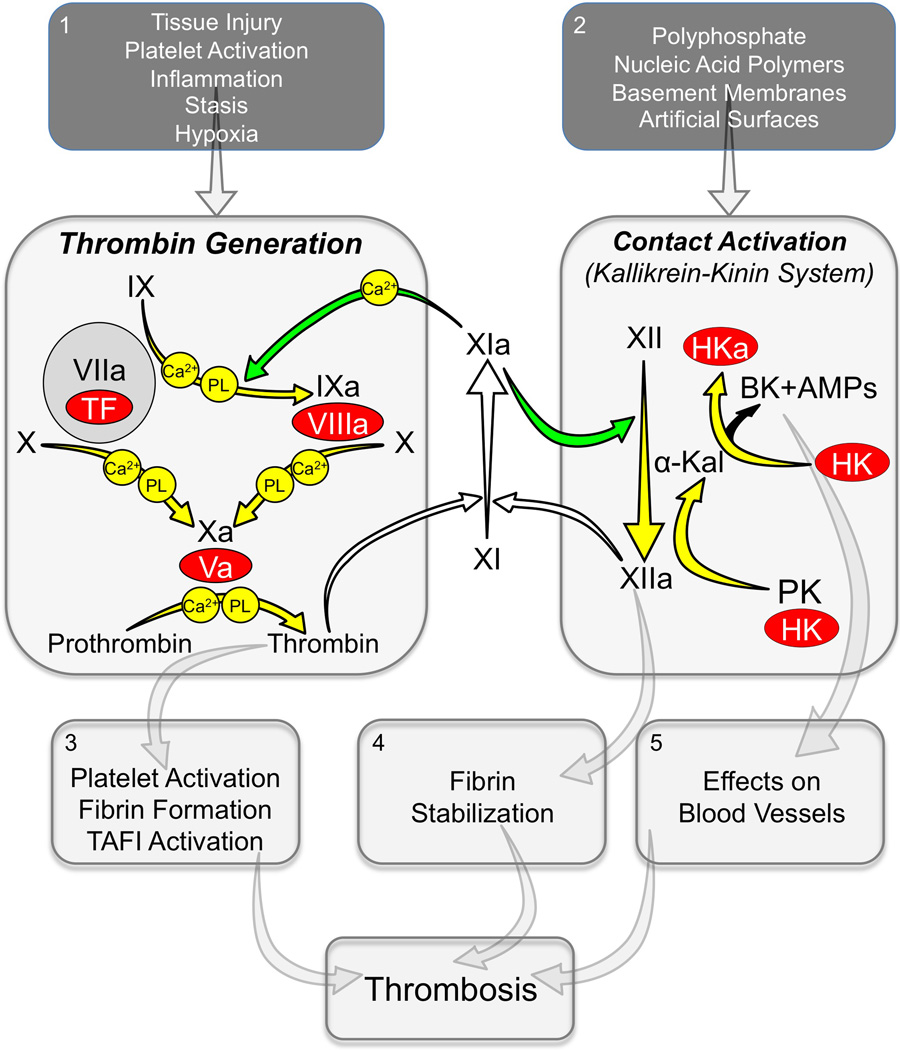
The most commonly used anticoagulants produce therapeutic antithrombotic effects either by inhibiting thrombin or factor Xa (FXa) or by lowering the plasma levels of the precursors of these key enzymes, prothrombin and FX. These drugs do not distinguish between thrombin generation contributing to thrombosis from thrombin generation required for hemostasis. Thus, anticoagulants increase bleeding risk, and many patients who would benefit from therapy go untreated because of comorbidities that place them at unacceptable risk for hemorrhage. Studies in animals demonstrate that components of the plasma contact activation system contribute to experimentally induced thrombosis, despite playing little or no role in hemostasis. Attention has focused on FXII, the zymogen of a protease (FXIIa) that initiates contact activation when blood is exposed to foreign surfaces, and FXI, the zymogen of the protease FXIa, which links contact activation to the thrombin generation mechanism. In the case of FXI, epidemiologic data indicate this protein contributes to stroke and venous thromboembolism, and perhaps myocardial infarction, in humans. A phase 2 trial showing that reduction of FXI may be more effective than low molecular weight heparin at preventing venous thrombosis during knee replacement surgery provides proof of concept for the premise that an antithrombotic effect can be uncoupled from an anticoagulant effect in humans by targeting components of contact activation. Here, we review data on the role of FXI and FXII in thrombosis and results of preclinical and human trials for therapies targeting these proteins.
Keywords: anticoagulant; factor XI; factor XII; thrombosis; venous thrombosis.
© 2015 International Society on Thrombosis and Haemostasis.
Conflict of interest statement
C. E. Bane states that he has no conflict of interest.
Figures
References
-
- Renné T. The procoagulant and proinflammatory contact system. Semin Immunopathol. 2012;3:31–41. - PubMed
-
- Gailani D, Renné T. J Emsley: Factor XI and the Plasma contact system. In: Scriver CR, Beaudet AL, Sly WS, Valle D, Childs B, Kinzler KW, Vogelstein B, editors. Metabolic and Molecular Bases of Inherited Disease. NY, NY: McGraw-Hill; 2010.
-
- Gailani D, Neff AT. Rare coagulation factor deficiencies. In: Hoffman R, Nenz EJ, Silberstein LE, Heslop HE, Weitz JI, Anastasi J, editors. Hematology: basic principles and practice. 6th ed. Saunders-Elsevier; 2010. pp. 1939–1952.
-
- Rosenthal R, Dreskin O, Rosenthal N. Plasma thromboplastin antecedent (PTA) deficiency: Clinical, coagulation, therapeutic and hereditary aspects of a new hemophilia-like disease. Blood. 1955;10:120–131. - PubMed
Publication types
MeSH terms
Substances
Grants and funding
- HL58837/HL/NHLBI NIH HHS/United States
- HL101972/HL/NHLBI NIH HHS/United States
- UL1TR000128/TR/NCATS NIH HHS/United States
- K01 RR000163/RR/NCRR NIH HHS/United States
- RR000163/RR/NCRR NIH HHS/United States
- AI088937/AI/NIAID NIH HHS/United States
- R01 HL081326/HL/NHLBI NIH HHS/United States
- UL1 TR000128/TR/NCATS NIH HHS/United States
- P51 RR000163/RR/NCRR NIH HHS/United States
- R44 AI088937/AI/NIAID NIH HHS/United States
- R43 AI088937/AI/NIAID NIH HHS/United States
- HL81326/HL/NHLBI NIH HHS/United States
- R01 HL058837/HL/NHLBI NIH HHS/United States
- R01 HL101972/HL/NHLBI NIH HHS/United States
LinkOut - more resources
Full Text Sources
Other Literature Sources
Medical
