. 2015 May 15:5:10095.
doi: 10.1038/srep10095.

Functional Characterization of Novel Sesquiterpene Synthases from Indian Sandalwood, Santalum album

Affiliations

Functional Characterization of Novel Sesquiterpene Synthases from Indian Sandalwood, Santalum album

Prabhakar Lal Srivastava et al. Sci Rep. .

Abstract

Indian Sandalwood, Santalum album L. is highly valued for its fragrant heartwood oil and is dominated by a blend of sesquiterpenes. Sesquiterpenes are formed through cyclization of farnesyl diphosphate (FPP), catalyzed by metal dependent terpene cyclases. This report describes the cloning and functional characterization of five genes, which encode two sesquisabinene synthases (SaSQS1, SaSQS2), bisabolene synthase (SaBS), santalene synthase (SaSS) and farnesyl diphosphate synthase (SaFDS) using the transcriptome sequencing of S. album. Using Illumina next generation sequencing, 33.32 million high quality raw reads were generated, which were assembled into 84,094 unigenes with an average length of 494.17 bp. Based on the transcriptome sequencing, five sesquiterpene synthases SaFDS, SaSQS1, SaSQS2, SaBS and SaSS involved in the biosynthesis of FPP, sesquisabinene, β-bisabolene and santalenes, respectively, were cloned and functionally characterized. Novel sesquiterpene synthases (SaSQS1 and SaSQS2) were characterized as isoforms of sesquisabinene synthase with varying kinetic parameters and expression levels. Furthermore, the feasibility of microbial production of sesquisabinene from both the unigenes, SaSQS1 and SaSQS2 in non-optimized bacterial cell for the preparative scale production of sesquisabinene has been demonstrated. These results may pave the way for in vivo production of sandalwood sesquiterpenes in genetically tractable heterologous systems.


Figures
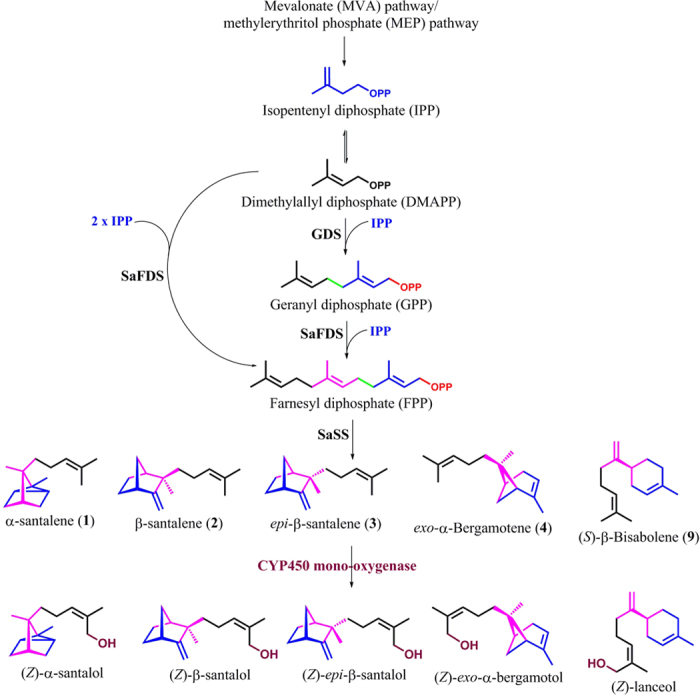
Figure 1
Figure 1
Schematic representation of proposed biosynthetic pathway for santalenes and santalols in Indian Sandalwood S. album; GDS: Geranyl diphosphate synthase, SaFDS: Farnesyl diphosphate synthase, SaSS: Santalene synthase, CYP450: Cytochrome P450.
Figure 2
Figure 2
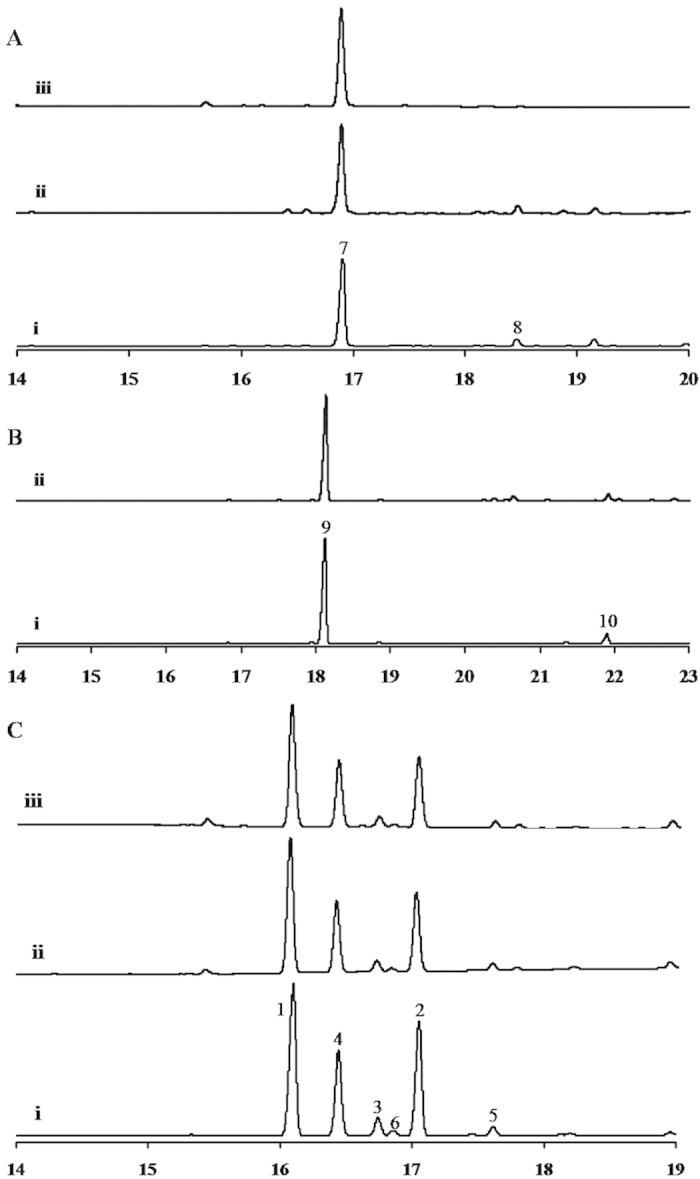
GC-FID chromatogram for the assay extracts using HP-5 capillary column (30m × 0.32 mm × 0.25 μm) (Supplemental Table S5 program 1): A) (i) Sesquisabinene synthase1 (SaSQS1) with (E,E)-FPP, (ii) Sesquisabinene synthase (SaSQS2) with (E,E)-FPP, (iii) Purified enzymatic product sesquisabinene (7). B) (i) Bisabolene synthase (SaBS) with FPP producing (S)-β-bisabolene (9), α-bisabolol (10), (ii) co-injection of (S)-β-bisabolene and assay product of SaBS with FPP. C) Santalene synthase (SaSS) with (i) FPP, (ii) GPP + IPP and farnesyl diphosphate synthase SaFDS, (iii) DMAPP + (2 × IPP) and SaFDS, α-santalene (1), β-santalene (2), epi-β-santalene (3), exo-α-bergamotene (4), exo-β-bergamotene (5), (E)-β-farnesene (6).
Figure 3
Figure 3
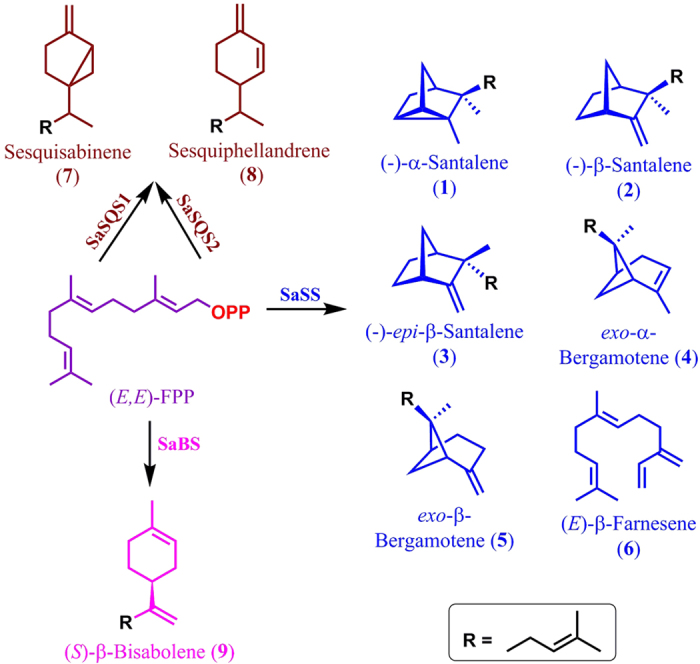
Products of sesquiterpene synthases, Santalene synthase (SaSS), Sesquisabinene synthase (SaSQS1 and SaSQS2) and bisabolene synthase (SaBS) with (E,E)-FPP as a substrate.
Figure 4
Figure 4
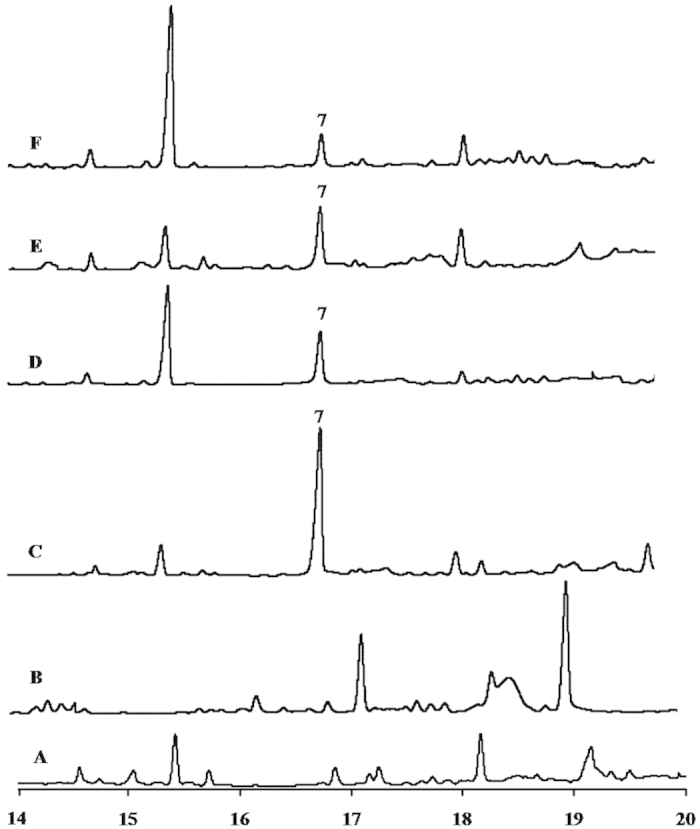
Total ion chromatograms of in vivo productions of SaSQS1 and SaSQS2, A) n-hexane extract of supernatant of empty vector control, B) n-hexane extract of pellet of empty vector, C) n-hexane extract of supernatant of SaSQS1, D) n-hexane extract of pellet of SaSQS1, E) n-hexane extract of supernatant of SaSQS2, F) n-hexane extract of pellet of SaSQS2.
Figure 5
Figure 5
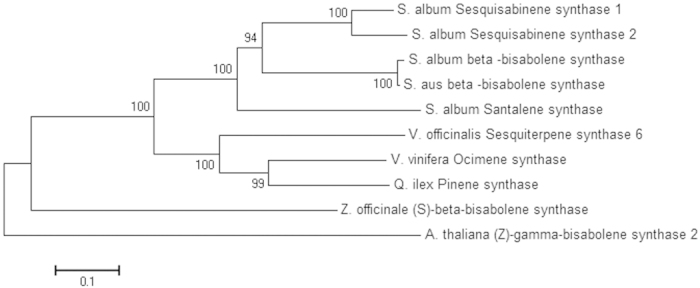
Phylogenetic analysis of terpene synthases isolated from S. album, Sequence used for phylogenetic tree construction are: S. album Sesquisabinene synthase 1 (SaSQS1, KJ665776), S. album Sesquisabinene synthase 2 (SaSQS2, KJ665777), S. album beta-bisabolene synthase (KJ665778), S. aus beta -bisabolene synthase (ADO87003), S. album, Santalene synthase (KF011938), V. officinalis Sesquiterpene synthase 6(AGB05615), V. vinifera, Ocimene synthase (ADR74206), Q. ilex Pinene synthase (CAK55186), Z. officinale (S)-beta-bisabolene synthase (BAI67934), A. thaliana (Z)-gamma-bisabolene synthase 2 (NP_193066).
Figure 6
Figure 6
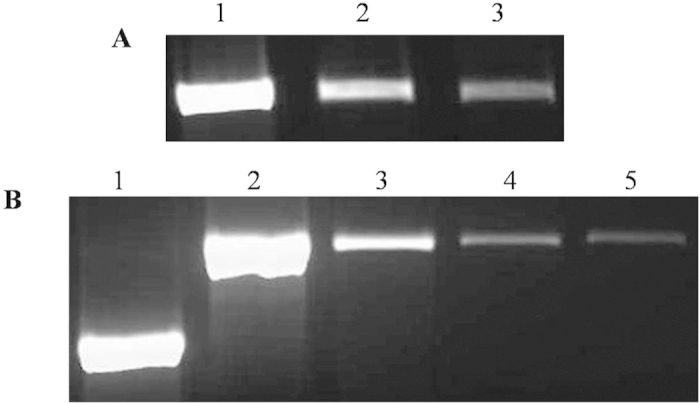
Semi-quantitative real time PCR gel image representing relative transcript level of sesquiterpene synthases present at interface of heartwood and sapwood, A) 18S rRNA semi-qPCR for 30 cycle, Lane 1: undiluted cDNA, Lane 2: 1:5 diluted cDNA (20 ng), Lane 3: 1:10 diluted cDNA (10 ng), B) SaFDS, SaSS, SaSQS1, SaSQS2, and SaBS semi- qPCR with 1:5 diluted cDNA (20 ng) for 32 cycle, Lane 1: semi-qPCR of SaFDS, Lane 2: semi-qPCR of SaSS, Lane 3: semi-qPCR of SaSQS1, Lane 4: semi-qPCR of SaSQS2, Lane 5: semi-qPCR of SaBS.

References

    1. Chen M. et al. Mechanistic Insights from the Binding of Substrate and Carbocation Intermediate Analogues to Aristolochene Synthase. Biochemistry 52, 5441–5453 (2013). - PMC - PubMed
    1. Rock C. D. & Zeevaart J. A. D. The aba mutant of Arabidopsis thaliana is impaired in epoxy-carotenoid biosynthesis. Proc. Natl. Acad. Sci. USA 88, 7496–7499 (1991). - PMC - PubMed
    1. Beyer P., Mayer M. & Kleinig H. Molecular oxygen and the state of geometric isomerism of intermediates are essential in the carotene desaturation and cyclization reactions in daffodil chromoplasts. Eur. J. Biochem. 184, 141–150 (1989). - PubMed
    1. Trumpower Bl, Houser R. M. & Olson R. E. Studies on ubiquinone. Demonstration of the total biosynthesis of ubiquinone-9 in rat liver mitochondria. J. Biol. Chem. 249, 3041–3048 (1974). - PubMed
    1. Anderson M. S., Yarger J. G., Burck C. L. & Poulter C. D. Farnesyl diphosphate synthetase. Molecular cloning, sequence, and expression of an essential gene from Saccharomyces cerevisiae. J. Biol. Chem. 264, 19176–19184 (1989). - PubMed

Publication types