


Musculoskeletal pain in schoolchildren across puberty: a 3-year follow-up study
- PMID: 25976338
- PMCID: PMC4438455
- DOI: 10.1186/s12969-015-0014-z
Musculoskeletal pain in schoolchildren across puberty: a 3-year follow-up study
Abstract
Background: Chronic Musculoskeletal Pain (MSP) in children can be due to non-inflammatory conditions, such as the benign joint hypermobility syndrome (BJHS) or idiopathic MSP (IMSP). Aim of the study was to evaluate type and persistence of MSP in a cohort of schoolchildren with MSP followed for 3 years, in order to identify the main risk factors.
Methods: Healthy schoolchildren, aged 8-13 years, underwent a general and rheumatologic examination, focusing on presence of chronic MSP, defined as continuous or recurrent pain lasting more than 3 months and heavily interfering with daily life activities, presence of generalized joint hypermobility, the body mass index and the pubertal stage. All symptomatic subjects were re-evaluated 3 years later with the same methods.
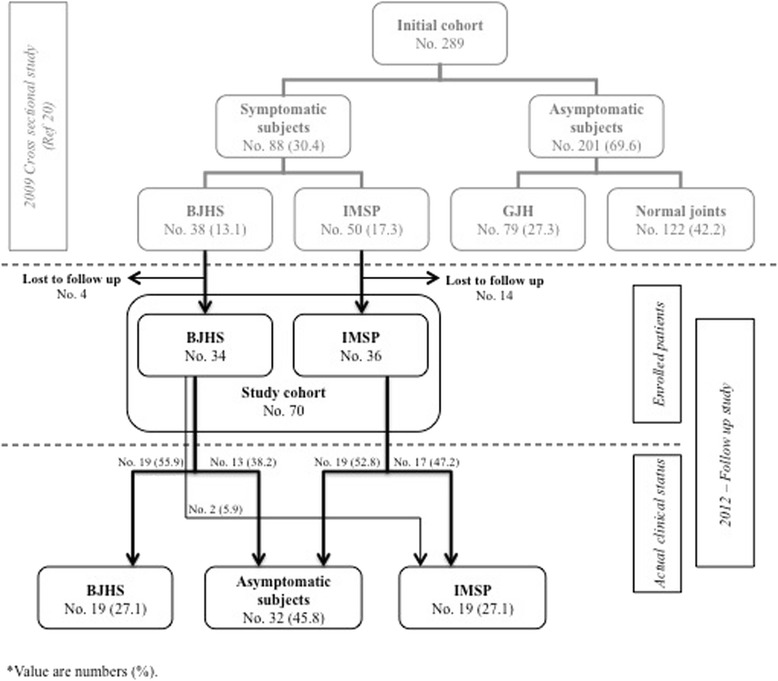
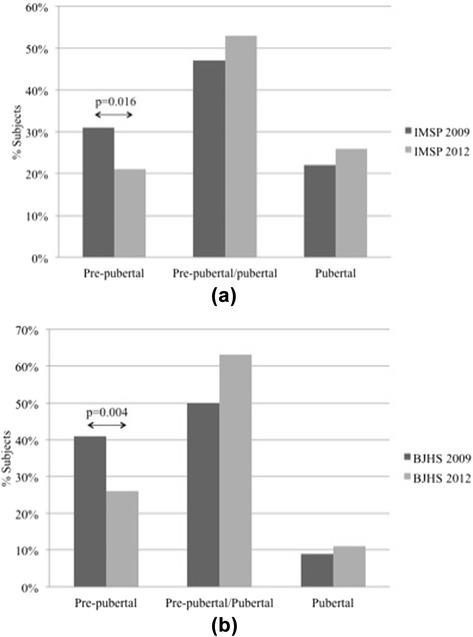
Results: Seventy of the 88 symptomatic subjects of the initial cohort of 289 were re-evaluated 3 years later. Of these, 38 (54.3 %) still presented MSP, including 19 with BJHS and 19 with IMSP. Main symptoms were lower limbs arthralgia and myalgia. MSP persisted more in females than in males (p = 0.038) and in pubertal rather than pre-pubertal subjects (p = 0.022); these subjects recovered significantly more both from BJHS (p = 0.004) and IMSP (p = 0.016). Gender did not influence the distribution of MSP according to pubertal stage.
Conclusions: Female gender, BJHS and pubertal stage are important risk factors for persistence of MSP. Further studies are needed to evaluate the natural history of MSP towards adulthood and the role of the pubertal age.
Figures
References
Publication types
MeSH terms
LinkOut - more resources
Full Text Sources
Other Literature Sources
Medical
Research Materials
