. 2015 May 16:15:121.
doi: 10.1186/s12870-015-0479-4.

Enhanced somatic embryogenesis in Theobroma cacao using the homologous BABY BOOM transcription factor

Affiliations

Enhanced somatic embryogenesis in Theobroma cacao using the homologous BABY BOOM transcription factor

Sergio L Florez et al. BMC Plant Biol. .

Abstract

Background: Theobroma cacao, the chocolate tree, is an important economic crop in East Africa, South East Asia, and South and Central America. Propagation of elite varieties has been achieved through somatic embryogenesis (SE) but low efficiencies and genotype dependence still presents a significant limitation for its propagation at commercial scales. Manipulation of transcription factors has been used to enhance the formation of SEs in several other plant species. This work describes the use of the transcription factor Baby Boom (BBM) to promote the transition of somatic cacao cells from the vegetative to embryonic state.

Results: An ortholog of the Arabidopsis thaliana BBM gene (AtBBM) was characterized in T. cacao (TcBBM). TcBBM expression was observed throughout embryo development and was expressed at higher levels during SE as compared to zygotic embryogenesis (ZE). TcBBM overexpression in A. thaliana and T. cacao led to phenotypes associated with SE that did not require exogenous hormones. While transient ectopic expression of TcBBM provided only moderate enhancements in embryogenic potential, constitutive overexpression dramatically increased SE proliferation but also appeared to inhibit subsequent development.

Conclusion: Our work provides validation that TcBBM is an ortholog to AtBBM and has a specific role in both somatic and zygotic embryogenesis. Furthermore, our studies revealed that TcBBM transcript levels could serve as a biomarker for embryogenesis in cacao tissue. Results from transient expression of TcBBM provide confirmation that transcription factors can be used to enhance SE without compromising plant development and avoiding GMO plant production. This strategy could compliment a hormone-based method of reprogramming somatic cells and lead to more precise manipulation of SE at the regulatory level of transcription factors. The technology would benefit the propagation of elite varieties with low regeneration potential as well as the production of transgenic plants, which similarly requires somatic cell reprogramming.


Figures
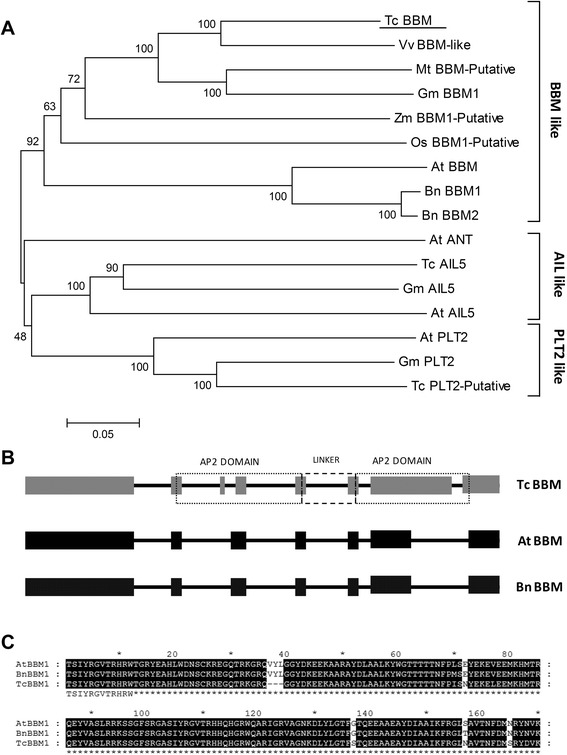
Figure 1
Figure 1
Phylogenetic analysis and gene structure of TcBBM. A. Phylogenetic analysis of AP2 gene family. The neighbor-joining consensus tree was constructed based on the full-length amino acid sequences of AP2 gene family [13,33]. The scale bar represents 0.1 substitutions per site and the values next to the nodes are the bootstrap values from 2000 replicates. B. Gene models of BBM genes of Theobroma cacao (Tc), Arabidopsis thaliana (At) and Brassica napus (Bn) are depicted by their exons (blocks) and introns (lines). The exons highlighted by the dotted lines represent the two AP2 domains, connected by the linker highlighted by the dashed lines. C. Alignment of the two AP2 domain repeats connected by a linker characteristic of AP2-ERF BBM genes from Theobroma cacao (Tc), Arabidopsis thaliana (At) and Brassica napus (Bn). At = Arabidopsis thaliana, Bn = Brassica napus, Gm = Glycine max, Mt = Medicago truncatula, Os = Oryza sativa, Vv = Vitis vinifera, Zm = Zea mays. BBM = BABY BOOM, AIL = AINTEGUMENTA-LIKE, ANT = AINTEGUMENTA, PLT2 = PLETHORA.
Figure 2
Figure 2
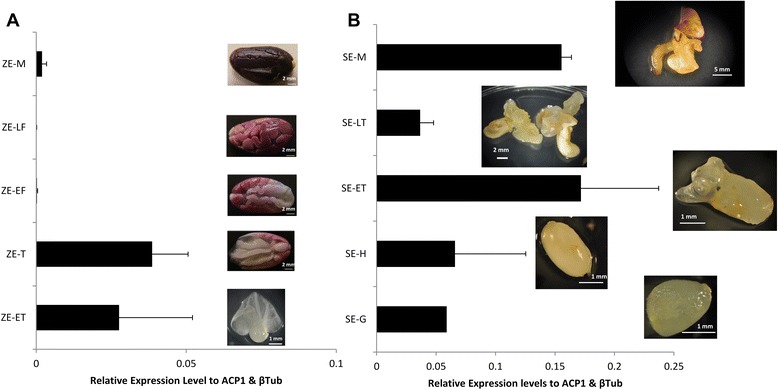
TcBBM expression throughout embryo development. Relative transcript expression of TcBBM throughout different development stages A. Zygotic embryogenesis and B. Somatic embryogenesis. Expression levels were analyzed by RT-qPCR and the TcBBM gene normalized relative to that of TcACP1 and TcβTub genes. G = globular, H = Heart, ET = Early Torpedo, LT = Late torpedo, EF = Early Full, LF = Late Full. Images for ZE-M, ZE-LF, ZE-EF and ZE-T were adapted from Maximova et al. [26].
Figure 3
Figure 3
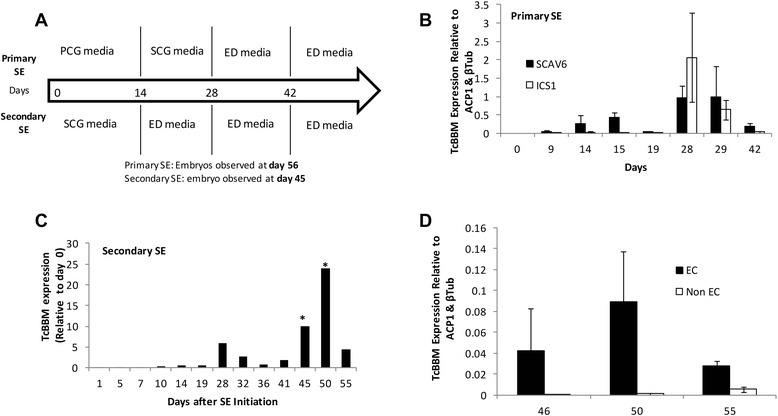
TcBBM expression throughout the process of primary and secondary embryogenesis. A. Schematic of the process of either primary (top) or secondary somatic (bottom) embryogenesis. PCG = Primary Callus Growth media, SCG = Secondary Callus Growth media, ED = Embryo Development media. B. TcBBM expression throughout primary somatic embryogenesis. C. TcBBM expression throughout secondary somatic embryogenesis (* represents a p-value < 0.05 for the Student’s t-test). D. TcBBM expression in embryonic (EC) and non-embryonic calli (Non-EC) obtained from secondary SE calli. Non-embryonic calli were classified as undifferentiated calli tissue that had not produced visible embryos up to the date the tissue was harvested. Embryogenic calli is also undifferentiated tissue; however, it is harvested from explants that had produced visible embryos. Expression levels for panels B, C and D were analyzed by RT-qPCR and the TcBBM gene normalized relative to that of TcACP1 and TcβTub genes.
Figure 4
Figure 4
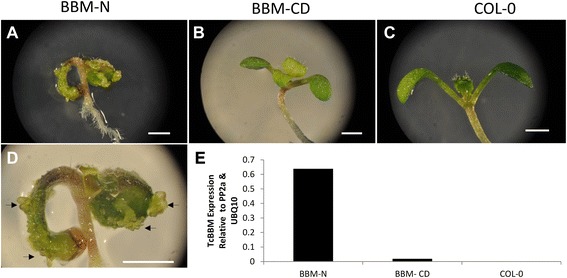
Arabidopsis overexpressing TcBBM leads to spontaneous regeneration from the cotyledon A, D. E12-Ω-CaMV-35S::TcBBM (BBM-N) Arabidopsis line showing spontaneous regeneration of cotyledon like structures from the seedling cotyledons (black arrows). B. E12-Ω-CaMV-35S::TcBBM (BBM-CD) Arabidopsis line showing no phenotype. C. Arabidopsis Col 0 wild type. E. The corresponding TcBBM levels of the three E12-Ω-CaMV-35S::TcBBM lines shown in images A, B and C. Expression levels were analyzed by RT-qPCR and the TcBBM gene normalized relative to AtPP2a and AtUBQ10. Image scale bars = 1 mm.
Figure 5
Figure 5
TcBBM overexpression in cacao leads to spontaneous direct somatic embryogenesis. A. 35S::TcBBM cacao embryo over-expressing TcBBM going through the process of spontaneous direct somatic embryogenesis. B. Further development of same E12-Ω-CaMV-35S::TcBBM cacao embryo (14 days after image on A). C. E12-Ω-CaMV-35S::TcBBM explant after 14 days of being subjected to hormone induced somatic embryogenesis. D. SCA6 wild-type cacao embryo showing normal cotyledon development and no spontaneous embryo regeneration. Image scale bars = 1 mm.
Figure 6
Figure 6
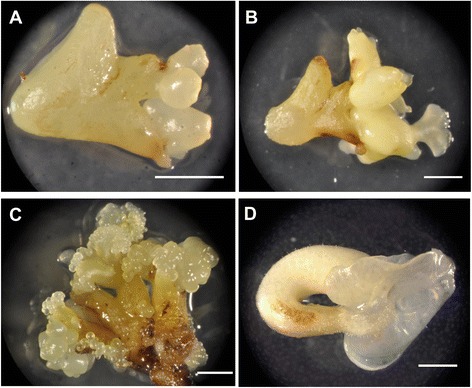
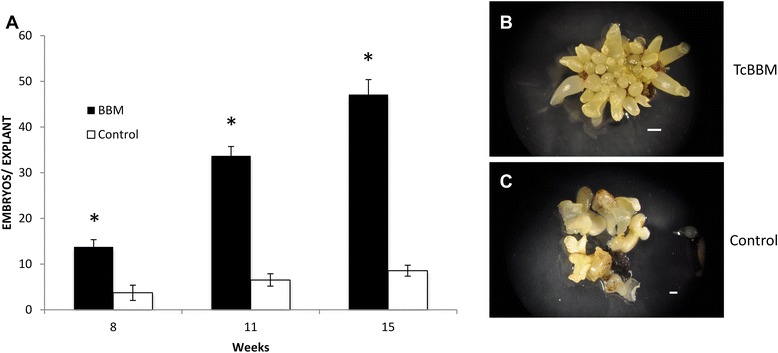
TcBBM constitutive overexpression in cacao leads to an increase in embryonic potential. A. Number of embryos produced per explant generated from E12-Ω-CaMV-35S::TcBBM or SCA6 wild-type tissue. Error bars represent one standard deviation. Image of embryos produced from B. E12-Ω-CaMV-35S::TcBBM or C. SCA6 Wt explants. Image scale bars = 1 mm. (* represents a p-value < 0.05 for the Student’s t-test).
Figure 7
Figure 7
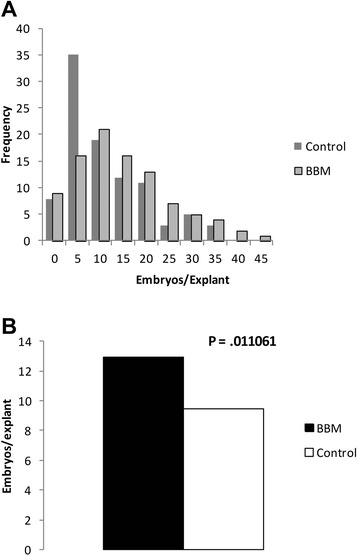
Transient expression of TcBBM in cacao leads to an increase of embryo produced per explant. A. Frequency distribution of embryos produced per explant when exposed to transient expression of TcBBM or control (empty vector). B. Average embryos/explants produced per explant in the transient TcBBM embryos and in the control. Data does not include the outliers identified by the Tukey test.

References

    1. Guiltinan MJ. Cacao. In: Pau EC, Michael RD, editors. Biotechnol agric for transgenic crop V. Volume 60. Berlin, Heidelberg: Berlin Heidelbelg: Springer; 2007. pp. 497–518.
    1. Li Z, Traore A, Maximova S, Guiltinan MJ. Somatic embryogenesis and plant regeneration from floral explants of cacao (Theobroma cacao L.) using thidiazuron. Vitr Cell Dev Biol Plant. 1998;34:293–9. doi: 10.1007/BF02822737. - DOI
    1. Maximova SN, Alemanno L, Young A, Ferriere N, Traore A, Guiltinan MJ. Efficiency, genotypic variability, and cellular origin of primary and secondary somatic embryogenesis of Theobroma cacao L. Vitr Cell Dev Biol Plant. 2002;38:252–9. doi: 10.1079/IVP2001257. - DOI
    1. Maximova SN, Young A, Pishak S, Guiltinan MJ. Field performance of Theobroma cacao L. plants propagated via somatic embryogenesis. Vitr Cell Dev Biol Plant. 2008;44:487–93. doi: 10.1007/s11627-008-9130-5. - DOI
    1. Steward F, Mapes M, Mears K. Growth and organized development of cultured cells. II. Organization in cultures grown from freely suspended cells. Am J Bot. 1958;45:705–8. doi: 10.2307/2439728. - DOI

Publication types

MeSH terms