


Evaluation of a tobacco prevention programme among teenagers in Sweden
- PMID: 25976765
- PMCID: PMC4442209
- DOI: 10.1136/bmjopen-2015-007673
Evaluation of a tobacco prevention programme among teenagers in Sweden
Abstract
Objective: To study the prevalence of tobacco use among teenagers, to evaluate a tobacco prevention programme and to study factors related to participation in the prevention programme.
Design and setting: Population-based prospective cohort study.
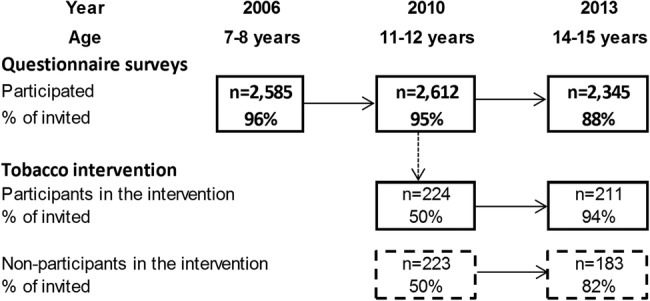
Method: Within the Obstructive Lung disease in Northern Sweden (OLIN) studies, a cohort study about asthma in schoolchildren started in 2006. All children aged 7-8 years in three municipalities were invited to a questionnaire survey and 2585 (96%) participated. The cohort was followed up at age 11-12 years (n=2612, 95% of invited) and 14-15 years (n=2345, 88% of invited). In 2010, some of the children in the OLIN cohort (n=447) were invited to a local tobacco prevention programme and 224 (50%) chose to participate.
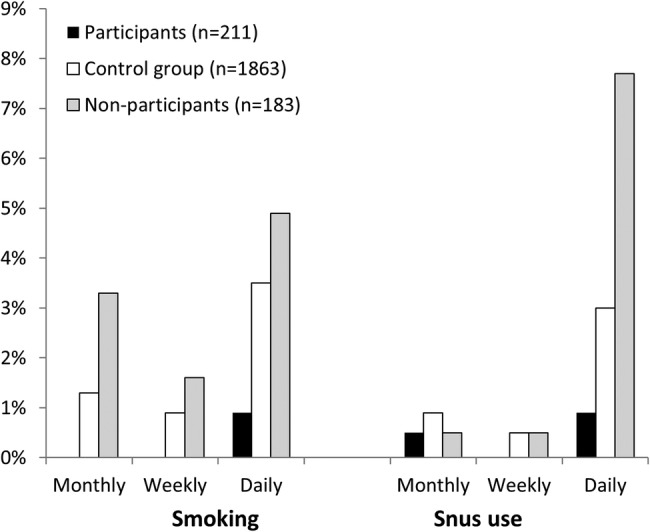
Results: At the age of 14-15 years, the prevalence of daily smoking was 3.5%. Factors related to smoking were female sex, having a smoking mother, participation in sports and lower parental socioeconomic status (SES). The prevalence of using snus was 3.3% and risk factors were male sex, having a smoking mother, having a snus-using father and non-participation in the prevention programme. In the prevention programme, the prevalence of tobacco use was significantly lower among the participants compared with the controls in the cohort. Factors related to non-participation were male sex, having a smoking mother, lower parental SES and participation in sports.
Conclusions: The prevalence of tobacco use was lower among the participants in the tobacco prevention programme compared with the non-participants as well as with the controls in the cohort. However, the observed benefit of the intervention may be overestimated as participation was biased by selection.
Keywords: EPIDEMIOLOGY; PREVENTIVE MEDICINE; PUBLIC HEALTH.
Published by the BMJ Publishing Group Limited. For permission to use (where not already granted under a licence) please go to http://group.bmj.com/group/rights-licensing/permissions.
Figures
References
-
- World Health Organization. WHO report on the global tobacco epidemic. 2013.
-
- Gripe I. Skolelevers drogvanor. 2013;139. The Swedish Council for Information on Alcohol and Other Drugs.
Publication types
MeSH terms
LinkOut - more resources
Full Text Sources
Other Literature Sources
Medical
