


Deployment of rapid response teams by 31 hospitals in a statewide collaborative
- PMID: 25977203
- PMCID: PMC4445360
- DOI: 10.1016/s1553-7250(15)41024-4
Deployment of rapid response teams by 31 hospitals in a statewide collaborative
Abstract
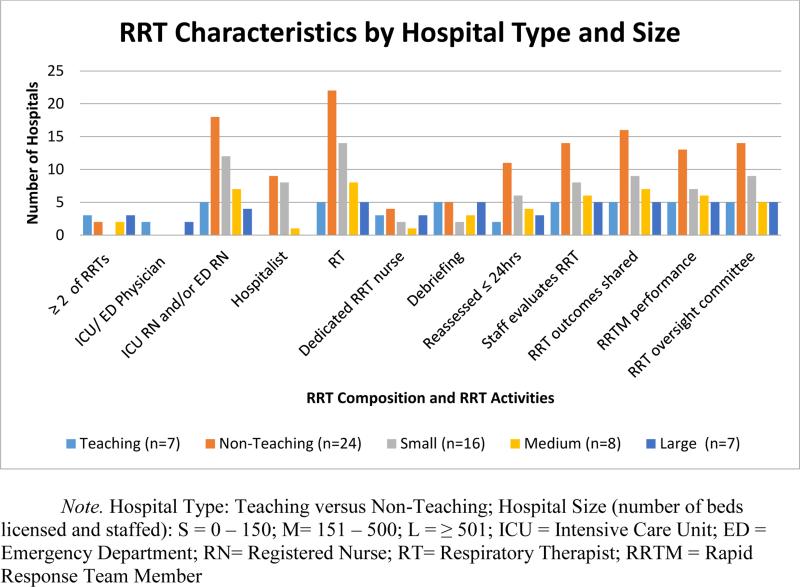
The Institute of Medicine (IOM) report, To Err is Human: Building a Safer Health system (1999), highlighted the need for improvements in the quality of health care, advocating for improvements in patient safety, preventing avoidable harm, and providing the necessary care to patients who could benefit from it. Rapid Response Teams (RRTs) are one crucial aspect of a hospital's RRS, providing hospitals with a mechanism to respond and care for patients experiencing an avoidable medical crisis. RRTs became imbedded in US hospitals following the launch of the 100 000 Lives Campaign in 2004 by the Institute for Healthcare Improvement and the introduction of RRTs as one of six initiatives to improve the quality of patient care. RRT adoption also provides hospitals the opportunity to meet a Joint Commission requirement for hospitals to implement a mechanism that enabled staff members to obtain help from experts when their patient's condition is worsening. Despite the proliferation of RRTs in hospitals, descriptive reports of these teams across groups of hospitals have been relatively few and provided limited descriptive information on RRTs. Therefore, using data we collected as part of a larger mixed-methods study of RRTs to examine their sustainability, we describe RRTs in a group of hospitals that were part of a collaborative to facilitate RRT adoption and implementation.
Figures
References
-
- Institute of Medicine . To err is human: building a safer health system. National Academy Press; Washington, DC: 1999.
-
- Institute of Medicine . Crossing the Quality Chasm: A New Health System for the 21st Century. National Academy Press; Washington, DC: 2001.
-
- DeVita MA, et al. Findings of the first consensus conference on Medical Emergency Teams. Crit Care Med. 2006;34(9):2463–78. - PubMed
-
- Trinkle RM, Flabouris A. Documenting rapid response system afferent limb failure and associated patient outcomes. Resuscitation. 2011;82(7):810–4. - PubMed
Publication types
MeSH terms
Grants and funding
LinkOut - more resources
Full Text Sources
