. 2015:2015:329418.
doi: 10.1155/2015/329418. Epub 2015 Apr 22.

Anti-inflammatory properties of low and high doxycycline doses: an in vitro study

Affiliations

Anti-inflammatory properties of low and high doxycycline doses: an in vitro study

Roberta Di Caprio et al. Mediators Inflamm. 2015.

Abstract

Doxycycline is used to treat infective diseases because of its broadspectrum efficacy. High dose administration (100 or 200 mg/day) is often responsible for development of bacterial resistances and endogenous flora alterations, whereas low doses (20-40 mg/day) do not alter bacteria susceptibility to antibiotics and exert anti-inflammatory activities. In this study, we wanted to assess the efficacy of both low and high doxycycline doses in modulating IL-8, TNF-α, and IL-6 gene expression in HaCaT cells stimulated with LPS. Three experimental settings were used, differing in the timing of doxycycline treatment in respect to the insult induced by LPS: pretreatment, concomitant, and posttreatment. Low doses were more effective than high doses in modulating gene expression of LPS-induced proinflammatory cytokines (IL-8, TNF-α, and IL-6), when added before (pretreatment) or after (posttreatment) LPS stimulation. This effect was not appreciated when LPS and doxycycline were simultaneously added to cell cultures: in this case high doses were more effective. In conclusion, our in vitro study suggests that low doxycycline doses could be safely used in chronic or acute skin diseases in which the inflammatory process, either constantly in progress or periodically recurring, has to be prevented or controlled.


Figures
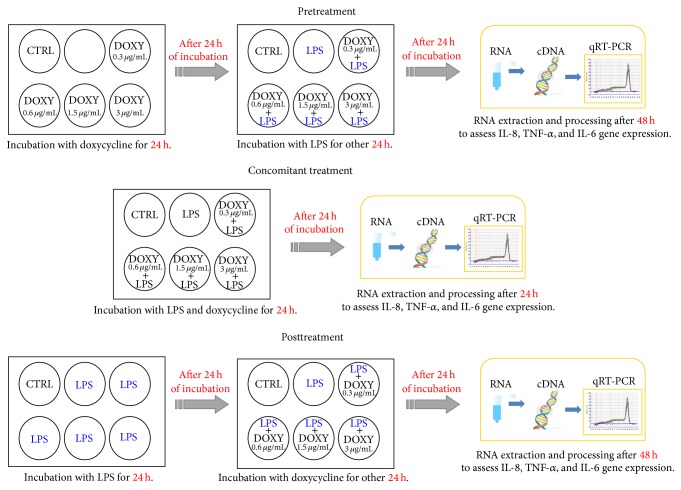
Figure 1
Figure 1
Study design. Schematic representation of the experimental settings with lipopolysaccharide (LPS) (25 μg/mL) stimulation and doxycycline (DOXY) (0.3, 0.6, 1.5, and 3 mg/μL) incubation. Times of stimulation with substances are described in detail in Section 2.3.
Figure 2
Figure 2
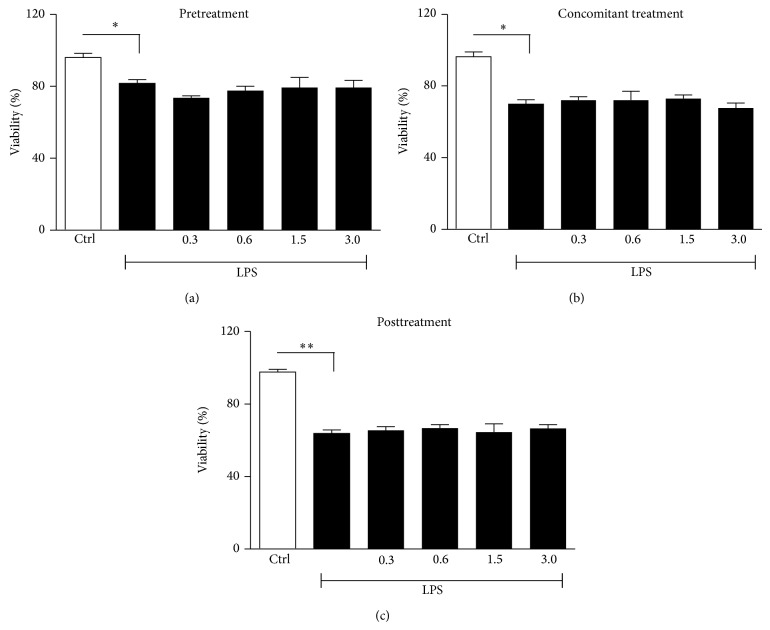
Evaluation of cell viability in HaCaT cells stimulated with LPS (25 μg/mL) and incubated in pretreatment, concomitant, and posttreatment settings with low (0.3 mg/μL; 0.6 mg/μL) and high (1.5 mg/μL; 3 mg/μL) doxycycline doses. (a, c) Cell viability was measured at 48 h in pre- and posttreatment and (b) at 24 h in concomitant treatment. Statistical significance was determined with respect to the viability of nonstimulated cells ( P < 0.05, ∗∗ P < 0.01).
Figure 3
Figure 3
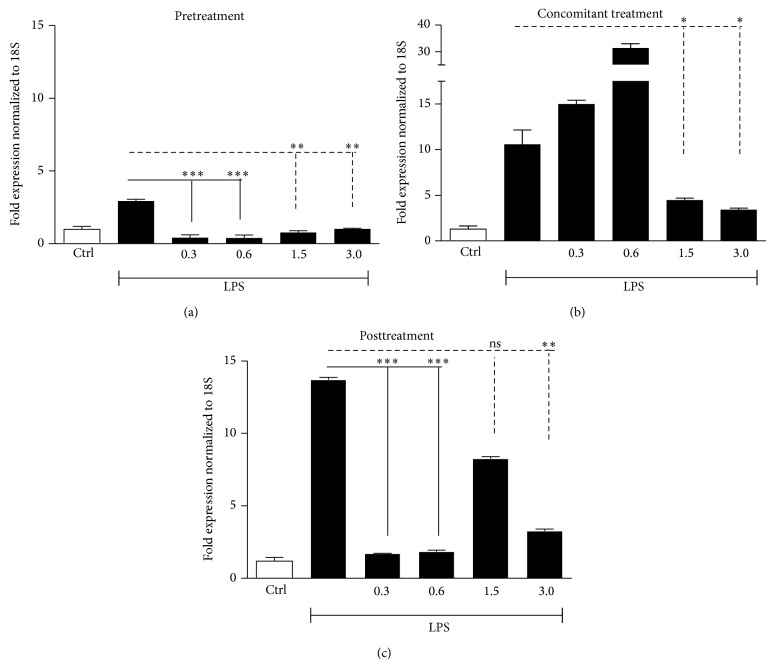
IL-8 gene expression, analyzed through qRT-PCR, in HaCaT cells stimulated with LPS (25 μg/mL) and incubated in pretreatment, concomitant, and posttreatment settings with low (0.3 mg/μL; 0.6 mg/μL) and high (1.5 mg/μL; 3 mg/μL) doxycycline doses. IL-8 gene expression in (a) cells stimulated with LPS for 24 h and successively incubated with doxycycline for further 24 h, mRNA extraction performed at 48 h; (b) cells incubated with doxycycline immediately after LPS, mRNA extraction performed at 24 h; (c) cells pretreated with doxycycline for 24 h and successively stimulated with LPS; mRNA extraction at 48 h ( P < 0.05, ∗∗ P < 0.01, and ∗∗∗ P < 0.001; ns: not statistically significant).
Figure 4
Figure 4
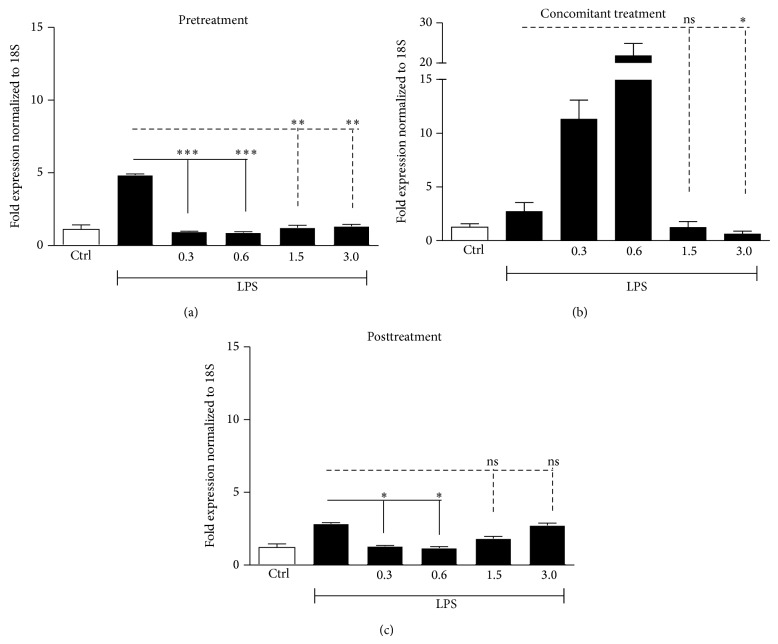
TNF-α gene expression, analyzed through qRT-PCR, in HaCaT cells stimulated with LPS (25 μg/mL) and incubated in pretreatment, concomitant, and posttreatment settings with low (0.3 mg/μL; 0.6 mg/μL) and high (1.5 mg/μL; 3 mg/μL) doxycycline doses. TNF-α gene expression in (a) cells stimulated with LPS for 24 h and successively incubated with doxycycline for further 24 h, mRNA extraction performed at 48 h; (b) cells incubated with doxycycline immediately after LPS, mRNA extraction performed at 24 h; (c) cells pretreated with doxycycline for 24 h and successively stimulated with LPS, mRNA extraction at 48 h ( P < 0.05, ∗∗ P < 0.01, and ∗∗∗ P < 0.001; ns: not statistically significant).
Figure 5
Figure 5
IL-6 gene expression, analyzed through qRT-PCR, in HaCaT cells stimulated with LPS (25 μg/mL) and incubated in pretreatment, concomitant, and posttreatment settings with low (0.3 mg/μL; 0.6 mg/μL) and high (1.5 mg/μL; 3 mg/μL) doxycycline doses. IL-6 gene expression in (a) cells stimulated with LPS for 24 h and successively incubated with doxycycline for further 24 h, mRNA extraction performed at 48 h; (b) cells incubated with doxycycline immediately after LPS, mRNA extraction performed at 24 h; (c) cells pretreated with doxycycline for 24 h and successively stimulated with LPS, mRNA extraction at 48 h ( P < 0.05, ∗∗ P < 0.01, and ∗∗∗ P < 0.001; ns: not statistically significant).
Figure 6
Figure 6
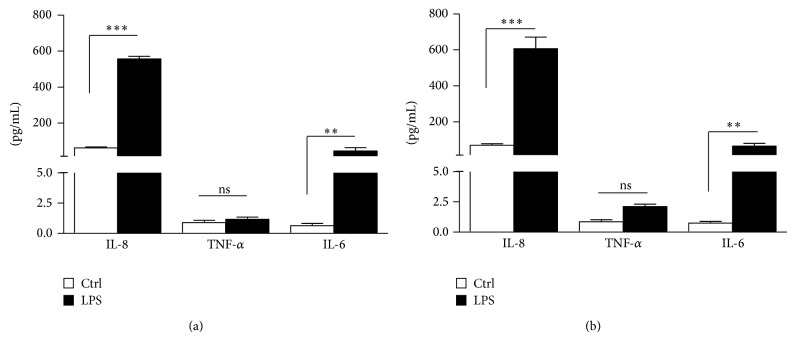
IL-8, TNF-α, and IL-6 protein levels in supernatants from HaCaT cells stimulated or not with LPS (25 μg/mL) at (a) 24 and (b) 48 h ( P < 0.05, ∗∗ P < 0.01, and ∗∗∗ P < 0.001; ns: not statistically significant).

References

    1. Griffin M. O., Fricovsky E., Ceballos G., Villarreal F. Tetracyclines: a pleitropic family of compounds with promising therapeutic properties. Review of the literature. The American Journal of Physiology—Cell Physiology. 2010;299(3):C539–C548. doi: 10.1152/ajpcell.00047.2010. - DOI - PMC - PubMed
    1. Stein G. E., Babinchak T. Tigecycline: an update. Diagnostic Microbiology and Infectious Disease. 2013;75(4):331–336. doi: 10.1016/j.diagmicrobio.2012.12.004. - DOI - PubMed
    1. Duggar B. M. Aureomycin: a product of the continuing search for new antibiotics. Annals of the New York Academy of Sciences. 1948;51(2):177–181. doi: 10.1111/j.1749-6632.1948.tb27262.x. - DOI - PubMed
    1. Kramer P. A., Chapron D. J., Benson J., Mercik S. A. Tetracycline absorption in elderly patients with achlorhydria. Clinical Pharmacology and Therapeutics. 1978;23(4):467–472. - PubMed
    1. Klein N. C., Cunha B. A. Tetracyclines. Medical Clinics of North America. 1995;79(4):789–801. - PubMed

MeSH terms