


Mortality of Hospitalized Patients with Pleural Effusions
- PMID: 25977841
- PMCID: PMC4428160
- DOI: 10.4172/2161-105X.1000184
Mortality of Hospitalized Patients with Pleural Effusions
Abstract
Background: Each year in the United States an estimated 1.5 million people develop pleural effusions and approximately 178,000 thoracenteses (12%) are performed. While it has been established that malignant effusions are associated with increased mortality, the association between mortality and all-cause pleural effusions in a medical population has not been previously evaluated. Our objective was to evaluate associations between 30-day and 12-month all-cause mortality among patients with a pleural effusion.
Methods: All patients admitted to the medical service at Yale-New Haven Hospital during March 2011 were screened for pleural effusion. Pleural effusions were documented by the attending radiologist and the medical record was reviewed for admitting diagnosis, severity of illness and whether a thoracenteses was performed. The outcomes were 30-day and 12-month mortality after identification of the pleural effusion.
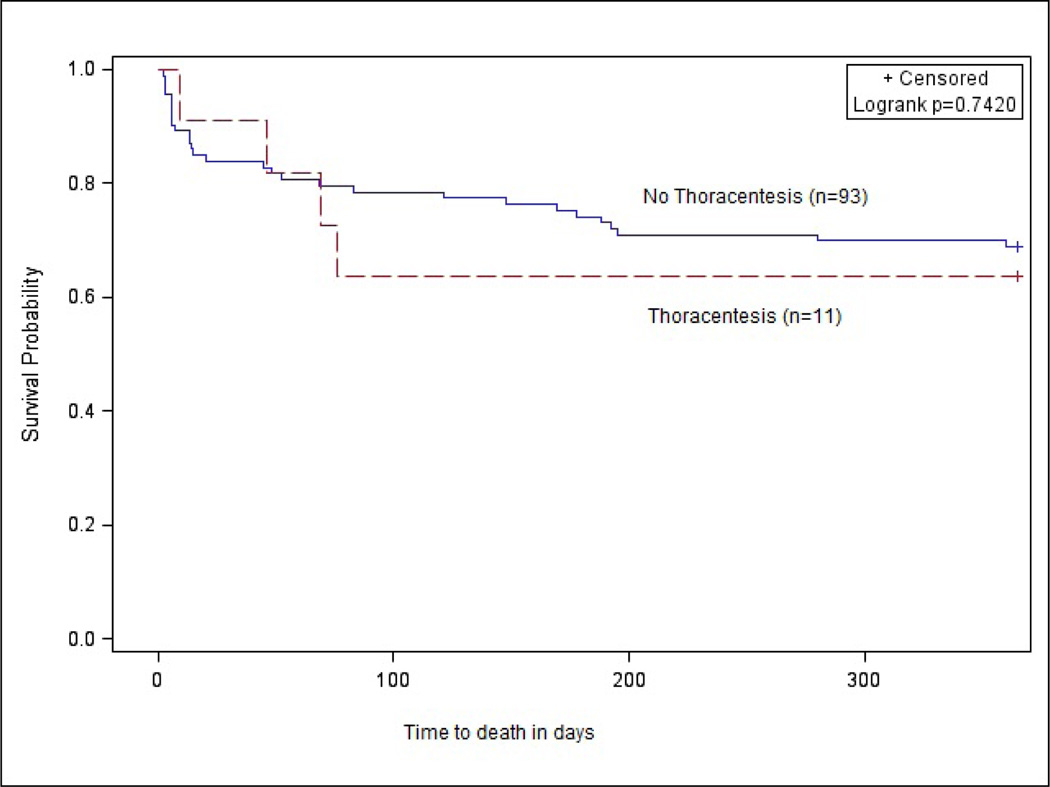
Results: One-hundred and four patients admitted to the medical service had pleural effusions documented by the attending radiologist. At 30-days, 15% of these patients had died and by 12-months mortality had increased to 32%. Eleven (10.6%) of the 104 patients underwent a thoracenteses. Severity of illness and malignancy were associated with 30-day mortality. For 12-month mortality, associations were found with age, severity of illness, malignancy, and diagnosis of pulmonary disease. Although sample size precluded statistical significance with mortality, the hazard ratio for thoracenteses and 30-day mortality was protective, suggesting a possible short term survival benefit.
Conclusions: In hospitalized medical patients with a pleural effusion, age, severity of illness and malignancy or pulmonary disease were associated with higher 12-month mortality. Thoracenteses may provide a protective effect in the first 30 days, but larger studies are needed to detect a short-term survival benefit. The presence of a pleural effusion indicates a high risk of death, with 15% of patients dying within 30 days and 32% dead within one-year of hospital admission.
Keywords: Mortality; Pleural effusion; Thoracenteses.
Figures

References
-
- Light RW. Pleural effusions. Med Clin North Am. 2011;95:1055–1070. - PubMed
-
- Owings MF, Kozak LJ. Ambulatory and inpatient procedures in the United States, 1996. Vital Health Stat. 1998;13:1–119. - PubMed
-
- Collins JD, Furmanski S, Steckel RJ, Snow HD. Minimum calcification demonstrable in pulmonary nodules. A roentgen pathology model. Radiology. 1972;105:49–50. - PubMed
-
- Hasley PB, Albaum MN, Li YH, Fuhrman CR, Britton CA, et al. Do pulmonary radiographic findings at presentation predict mortality in patients with community-acquired pneumonia? Arch Intern Med. 1996;156:2206–2212. - PubMed
-
- Shaw PH, Agarwal R. Pleurodesis for malignant pleural effusions. Cochrane Database of Systematic Reviews. 2004 - PubMed
Grants and funding
LinkOut - more resources
Full Text Sources
Other Literature Sources