Review
. 2015:2015:479354.
doi: 10.1155/2015/479354. Epub 2015 Apr 21.

Insulin resistance and skin diseases

Affiliations
Review

Insulin resistance and skin diseases

Maddalena Napolitano et al. ScientificWorldJournal. 2015.

Abstract

In medical practice, almost every clinician may encounter patients with skin disease. However, it is not always easy for physicians of all specialties to face the daily task of determining the nature and clinical implication of dermatologic manifestations. Are they confined to the skin, representing a pure dermatologic event? Or are they also markers of internal conditions relating to the patient's overall health? In this review, we will discuss the principal cutaneous conditions which have been linked to metabolic alterations. Particularly, since insulin has an important role in homeostasis and physiology of the skin, we will focus on the relationships between insulin resistance (IR) and skin diseases, analyzing strongly IR-associated conditions such as acanthosis nigricans, acne, and psoriasis, without neglecting emerging and potential scenarios as the ones represented by hidradenitis suppurativa, androgenetic alopecia, and hirsutism.


Figures
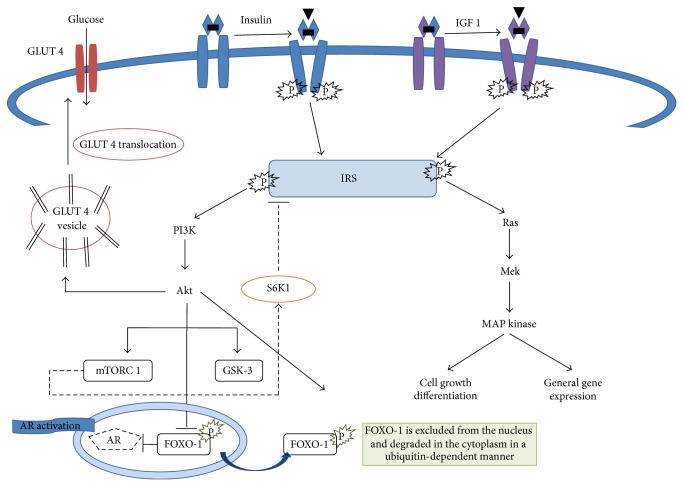
Figure 1
Figure 1
Insulin signalling pathway: insulin binds to the insulin receptor leading to its autophosphorylation and recruitment of adaptor molecules such as insulin receptor substrates (IRS 1–6) to engage multiple downstream signalling pathways. IRS activation can be also triggered by IGF-1 signalling. Phosphoinositide 3-kinase (PI3-K)/Akt, mammalian target of rapamycin (mTOR), and the Ras/mitogen-activated protein kinase (MAPK) pathways represent the major cellular signalling pathways activated. Particularly, AKT controls the assembly of glucose transporter- (GLUT-) 4 at the cell membrane and thus controls glucose influx into the cell. mTOR complex 1 (mTORC1) activates the kinase S6K1, which phosphorylates and inhibits IRS and thus reduces AKT-GLUT-dependent glucose uptake, the principal mechanism of peripheral insulin resistance. AKT phosphorylation pathway inhibits FOXO-1 mediated gene expression by its extrusion from the nucleus to the cytoplasm, preventing FOXO-1 mediated repression of androgen receptors. GSK-3 = glycogen synthase kinase 3 and FOXO-1 = forkhead box protein O-1.
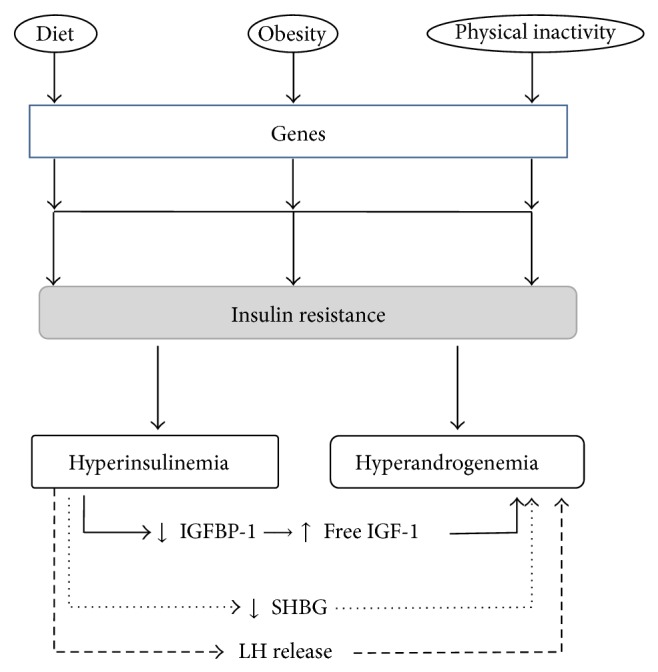
Figure 2
Figure 2
Connections between insulin resistance, hyperinsulinemia, and hyperandrogenism. FSH = follicle stimulating hormone, IGF = insulin-like growth factor, IGFBP = insulin-like growth factor binding protein, LH = luteinizing hormone, and SHBG = sex hormone binding globulin.

References

    1. Franks A. G., Jr. Skin manifestations of internal disease. Medical Clinics of North America. 2009;93(6):1265–1282. doi: 10.1016/j.mcna.2009.08.010. - DOI - PubMed
    1. Rigopoulos D., Larios G., Katsambas A. Skin signs of systemic diseases. Clinics in Dermatology. 2011;29(5):531–540. doi: 10.1016/j.clindermatol.2010.09.021. - DOI - PubMed
    1. Buerger C., Richter B., Woth K., et al. Interleukin-1Β interferes with epidermal homeostasis through induction of insulin resistance: implications for psoriasis pathogenesis. Journal of Investigative Dermatology. 2012;132(9):2206–2214. doi: 10.1038/jid.2012.123. - DOI - PubMed
    1. Taniguchi C. M., Emanuelli B., Kahn C. R. Critical nodes in signalling pathways: insights into insulin action. Nature Reviews Molecular Cell Biology. 2006;7(2):85–96. doi: 10.1038/nrm1837. - DOI - PubMed
    1. Karadag A. S., Ertugrul D. T., Gunes Bilgili S., Takci Z., Tutal E., Yilmaz H. Insulin resistance is increased in alopecia areata patients. Cutaneous and Ocular Toxicology. 2013;32(2):102–106. doi: 10.3109/15569527.2012.713418. - DOI - PubMed

LinkOut - more resources