


Developmental Effects Determine Submaximal Arterial Oxygen Saturation in Peruvian Quechua
- PMID: 25977978
- PMCID: PMC4490701
- DOI: 10.1089/ham.2014.1126
Developmental Effects Determine Submaximal Arterial Oxygen Saturation in Peruvian Quechua
Abstract
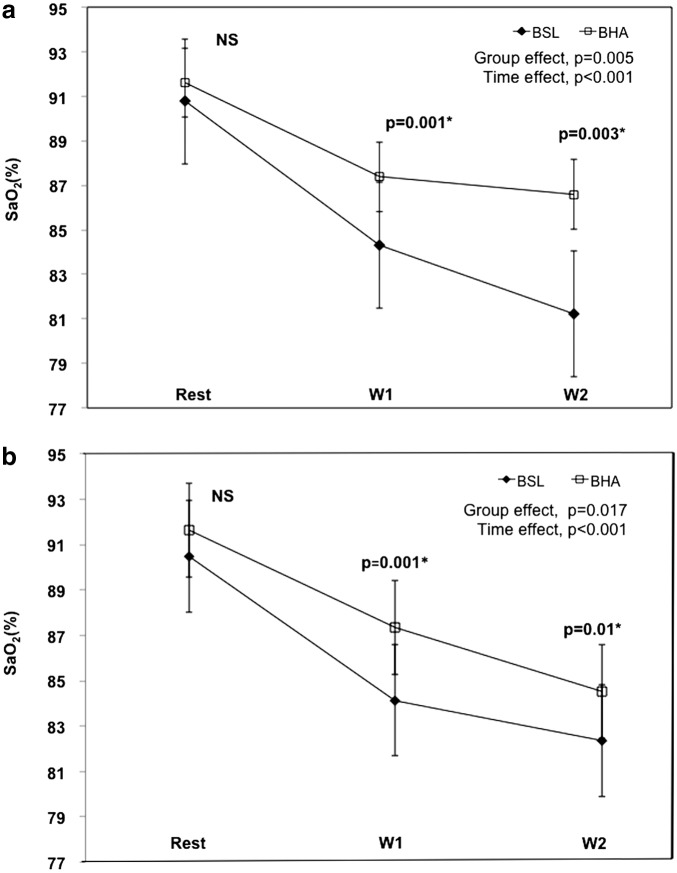
Kiyamu, Melisa, Fabiola León-Velarde, María Rivera-Chira, Gianpietro Elías, and Tom D. Brutsaert. Developmental effects determine submaximal arterial oxygen saturation in Peruvian Quechua. High Alt Med Biol 16, 138-146, 2015.--Andean high altitude natives show higher arterial oxygen saturation (Sao(2)) during exercise in hypoxia, compared to acclimatized sojourners. In order to evaluate the effects of life-long exposure to high altitude on Sao(2), we studied two groups of well-matched, self-identified Peruvian Quechua natives who differed in their developmental exposure to hypoxia before and after a 2-month training period. Male and female volunteers (18-35 years) were recruited in Lima, Peru (150 m). The two groups were: a) Individuals who were born and raised at sea-level (BSL, n=34) and b) Individuals who were born and raised at high altitude (BHA, n=32), but who migrated to sea-level as adults (>16 years old). Exercise testing was conducted using a submaximal exercise protocol in normobaric hypoxia in Lima (BP=750 mmHg, Fio(2)=0.12), in order to measure Sao(2) (%), ventilation (VE L/min) and oxygen consumption (Vo(2), L/min). Repeated-measures ANOVA, controlling for VE/VO(2) (L/min) and sex during the submaximal protocol showed that BHA maintained higher Sao(2) (%) compared to BSL at all workloads before (p=0.005) and after training (p=0.017). As expected, both groups showed a decrease in Sao(2) (%) (p<0.001), as workload increased. Resting Sao(2) levels were not found to be different between groups. The results suggest that developmental exposure to altitude contributes to the maintenance of higher Sao(2) levels during submaximal exercise at hypoxia.
Keywords: adaptation; development; hypoxia; saturation.
Figures
References
-
- Beall CM, Almasy LA, Blangero J, Williams-Blangero S, Brittenham GM, Strohl KP, Decker MJ, Vargas E, Villena M, Soria R, Alarcon AM, and Gonzales C. (1999). Percent of oxygen saturation of arterial hemoglobin among Bolivian Aymara at 3,900-4,000 m. Am J Phys Anthropol 108:41–51 - PubMed
-
- Beall CM. (2000). Oxygen saturation increases during childhood and decreases during adulthood among high altitude native Tibetans residing at 3,800-4,200m. High Alt Med Biol 1:25–32 - PubMed
-
- Beall CM, Blanguero J, Williams-Blanguero S, and Goldstein M. (1994). Major gene for percent of oxygen saturation of arterial hemoglobin in Tibetan highlanders. Am J Phys Anthropol 95:271–276 - PubMed
-
- Beall CM, Brittenham GM, Strohl KP, Blangero J, Williams-Blangero S, Goldstein MC, Decker MJ, Vargas E, Villena M, Soria R, Alarcon AM, and Gonzales C. (1998). Hemoglobin concentration of high-altitude Tibetans and Bolivian Aymara. Am J Phys Anthropol 106:385–400 - PubMed
Publication types
MeSH terms
LinkOut - more resources
Full Text Sources
Other Literature Sources
Research Materials
