. 2015 May 15;10(5):e0127462.
doi: 10.1371/journal.pone.0127462. eCollection 2015.

Gut Microbiota Dynamics during Dietary Shift in Eastern African Cichlid Fishes

Affiliations

Gut Microbiota Dynamics during Dietary Shift in Eastern African Cichlid Fishes

Laura Baldo et al. PLoS One. .

Abstract

The gut microbiota structure reflects both a host phylogenetic history and a signature of adaptation to the host ecological, mainly trophic niches. African cichlid fishes, with their array of closely related species that underwent a rapid dietary niche radiation, offer a particularly interesting system to explore the relative contribution of these two factors in nature. Here we surveyed the host intra- and interspecific natural variation of the gut microbiota of five cichlid species from the monophyletic tribe Perissodini of lake Tanganyika, whose members transitioned from being zooplanktivorous to feeding primarily on fish scales. The outgroup riverine species Astatotilapia burtoni, largely omnivorous, was also included in the study. Fusobacteria, Firmicutes and Proteobacteria represented the dominant components in the gut microbiota of all 30 specimens analysed according to two distinct 16S rRNA markers. All members of the Perissodini tribe showed a homogenous pattern of microbial alpha and beta diversities, with no significant qualitative differences, despite changes in diet. The recent diet shift between zooplantkon- and scale-eaters simply reflects on a significant enrichment of Clostridium taxa in scale-eaters where they might be involved in the scale metabolism. Comparison with the omnivorous species A. burtoni suggests that, with increased host phylogenetic distance and/or increasing herbivory, the gut microbiota begins differentiating also at qualitative level. The cichlids show presence of a large conserved core of taxa and a small set of core OTUs (average 13-15%), remarkably stable also in captivity, and putatively favoured by both restricted microbial transmission among related hosts (putatively enhanced by mouthbrooding behavior) and common host constraints. This study sets the basis for a future large-scale investigation of the gut microbiota of cichlids and its adaptation in the process of the host adaptive radiation.


Conflict of interest statement

Competing Interests: The authors have declared that no competing interests exist.

Figures

Fig 1
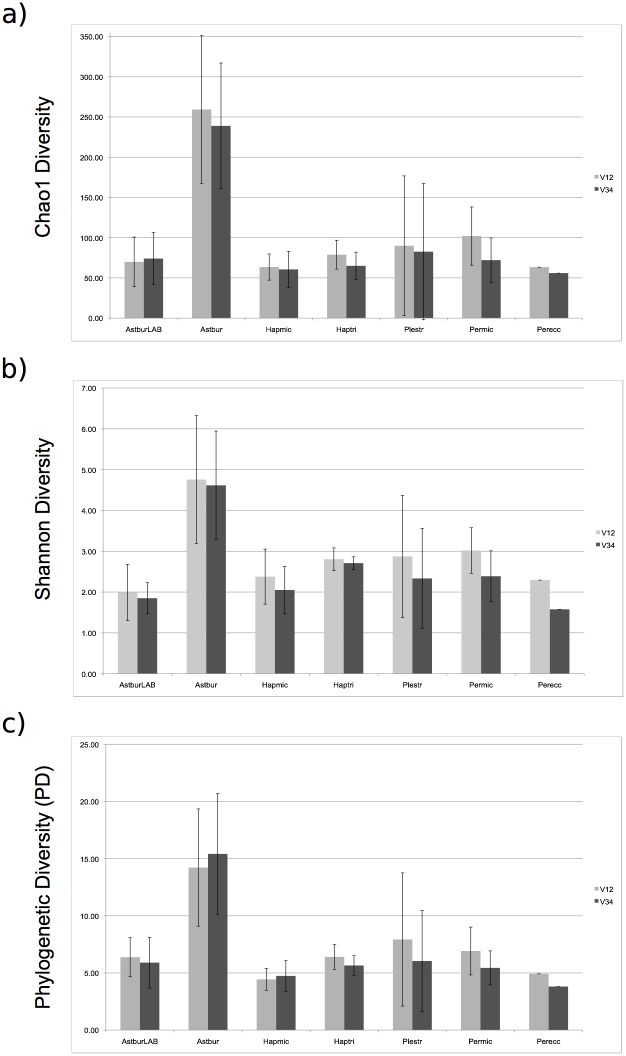
Fig 1. Mean alpha diversity estimates per species (Chao1 (a), Shannon (b) and PD whole metric (c)), and standard deviation across conspecifics (bars).
The two libraries significantly correlated in the pattern of diversity across-species for all three alpha indexes. Astbur carried the most biodiverse microbiota, significantly distinct from all other species and the same species kept in laboratory (i.e. AstburLAB) (p-value<0.05, all indexes, both libraries). Differences among Perissodini species were not statistically relevant (p-value>0.05, all indexes).
Fig 2
Fig 2. Relative abundance of the seven cichlid core phyla in V12 (a) and V34 (b).
Interquartile ranges (25th and 75th percentiles) and whiskers show data dispersion across species averages. Medians are shown as central horizontal lines. The two libraries returned a highly concordant pattern of core phyla abundance: the cichlid gut microbiota is dominated by Fusobacteria, Firmicutes and Proteobacteria, with the first two phyla largely fluctuating in relative abundance across species. Bacteroidetes, Planctomycetes, Actinobacteria and Verrucomicrobia are consistently less represented in all species (overall contributing less than 1% of the total reads).
Fig 3
Fig 3. Observed intraspecific core length (i.e. relative proportion of shared OTUs across 80% of conspecifics, shown as vertical lines), compared to random sampling of the whole dataset (barplots, 1000 permutations, p<0.05) for V12 (a) and V34 (B).
There is a general trend for increase relative core length among conspecifics compared to random individuals, with few species carrying a significantly larger core in one or both libraries (Astbur, Haptri, Hapmic and Permic, p<0.05). Perecc was excluded from the analysis because it contributed with only one individual.
Fig 4
Fig 4. Principal coordinate analysis of beta diversity estimates for whole microbial communities of the 30 specimens analyzed (individual circles) based on binary Jaccard (a, b) and unweighted unifrac distances (c, d) for V12 (a, c) and V34 (b, d).
Lines connect circles with the species centroid; species are colour-coded (see Legend). Despite few discrepancies between libraries, all plots illustrate two main clusters: the member of the tribe Tropheini, Astbur (in red), and the Perissodini species (Haptri, Hapmic, Permic, Perecc and Plestr), which largely superimpose in their microbiota space. The laboratory species AstburLAB carries a remarkably distinct microbiota from its wild conspecifics (Astbur).

References

    1. Maynard CL, Elson CO, Hatton RD, Weaver CT. Reciprocal interactions of the intestinal microbiota and immune system. Nature. 2012;489(7415):231–41. 10.1038/nature11551 . - DOI - PMC - PubMed
    1. Diaz Heijtz R, Wang S, Anuar F, Qian Y, Bjorkholm B, Samuelsson A, et al. Normal gut microbiota modulates brain development and behavior. Proceedings of the National Academy of Sciences of the United States of America. 2011;108(7):3047–52. 10.1073/pnas.1010529108 - DOI - PMC - PubMed
    1. Yeoman CJ, Chia N, Yildirim S, Berg Miller ME, Kent A, Stumpf R, et al. Towards an Evolutionary Model of Animal-Associated Microbiomes. Entropy 2011; 13(3):570–94.
    1. Xing M, Hou Z, Yuan J, Liu Y, Qu Y, Liu B. Taxonomic and functional metagenomic profiling of gastrointestinal tract microbiome of the farmed adult turbot (Scophthalmus maximus). FEMS Microbiol Ecol. 2013;86(3):432–43. 10.1111/1574-6941.12174 . - DOI - PubMed
    1. Shin SC, Kim SH, You H, Kim B, Kim AC, Lee KA, et al. Drosophila microbiome modulates host developmental and metabolic homeostasis via insulin signaling. Science. 2011;334(6056):670–4. 10.1126/science.1212782 . - DOI - PubMed

Publication types

Substances