


Inter-plant communication through mycorrhizal networks mediates complex adaptive behaviour in plant communities
- PMID: 25979966
- PMCID: PMC4497361
- DOI: 10.1093/aobpla/plv050
Inter-plant communication through mycorrhizal networks mediates complex adaptive behaviour in plant communities
Abstract
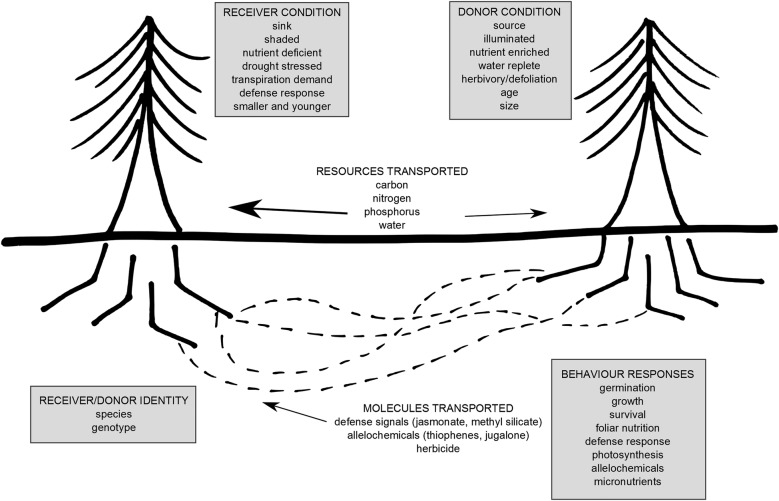
Adaptive behaviour of plants, including rapid changes in physiology, gene regulation and defence response, can be altered when linked to neighbouring plants by a mycorrhizal network (MN). Mechanisms underlying the behavioural changes include mycorrhizal fungal colonization by the MN or interplant communication via transfer of nutrients, defence signals or allelochemicals. We focus this review on our new findings in ectomycorrhizal ecosystems, and also review recent advances in arbuscular mycorrhizal systems. We have found that the behavioural changes in ectomycorrhizal plants depend on environmental cues, the identity of the plant neighbour and the characteristics of the MN. The hierarchical integration of this phenomenon with other biological networks at broader scales in forest ecosystems, and the consequences we have observed when it is interrupted, indicate that underground 'tree talk' is a foundational process in the complex adaptive nature of forest ecosystems.
Keywords: Complex adaptive systems; ectomycorrhiza; forests; mycorrhizal networks; plant behaviour; plant communication.
Published by Oxford University Press on behalf of the Annals of Botany Company.
Figures
References
-
- Achatz M, Morris EK, Müller F, Hilker M, Rillig MC. 2014. Soil hypha-mediated movement of allelochemicals: arbuscular mycorrhizae extend the bioactive zone of juglone (K Field, Ed.). Functional Ecology 28:1020–1029. 10.1111/1365-2435.12208 - DOI
-
- Asay A. 2013. Mycorrhizal facilitation of kin recognition in interior Douglas-fir (Pseudotsuga menziesii var. glauca). UBC Masters Thesis. http://hdl.handle.net/2429/45400.
-
- Baleshta KE, Simard SW, Guy RD, Chanway CP. 2005. Reducing paper birch density increases Douglas-fir growth rate and Armillaria root disease incidence in southern interior British Columbia. Forest Ecology and Management 208:1–13. 10.1016/j.foreco.2004.07.076 - DOI
LinkOut - more resources
Full Text Sources
Other Literature Sources
