


Identification of a Variety of Mutations in Cancer Predisposition Genes in Patients With Suspected Lynch Syndrome
- PMID: 25980754
- PMCID: PMC4550537
- DOI: 10.1053/j.gastro.2015.05.006
Identification of a Variety of Mutations in Cancer Predisposition Genes in Patients With Suspected Lynch Syndrome
Abstract
Background & aims: Multigene panels are commercially available tools for hereditary cancer risk assessment that allow for next-generation sequencing of numerous genes in parallel. However, it is not clear if these panels offer advantages over traditional genetic testing. We investigated the number of cancer predisposition gene mutations identified by parallel sequencing in individuals with suspected Lynch syndrome.
Methods: We performed germline analysis with a 25-gene, next-generation sequencing panel using DNA from 1260 individuals who underwent clinical genetic testing for Lynch syndrome from 2012 through 2013. All patients had a history of Lynch syndrome-associated cancer and/or polyps. We classified all identified germline alterations for pathogenicity and calculated the frequencies of pathogenic mutations and variants of uncertain clinical significance (VUS). We also analyzed data on patients' personal and family history of cancer, including fulfillment of clinical guidelines for genetic testing.
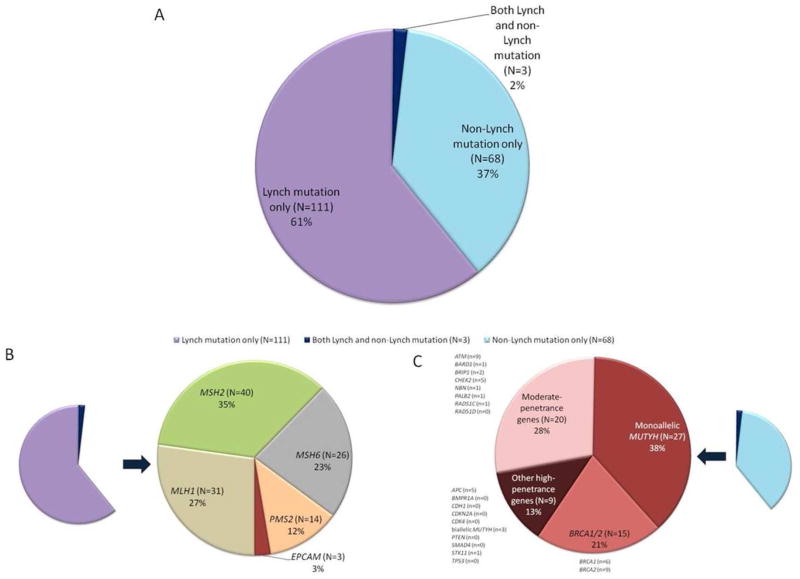
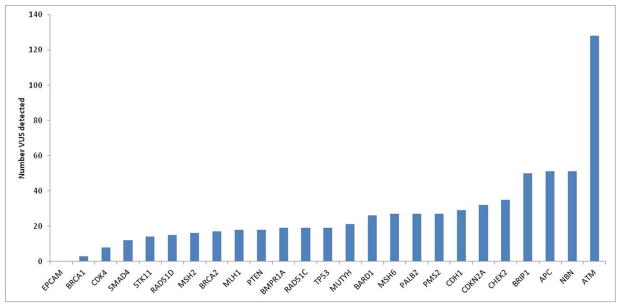
Results: Of the 1260 patients, 1112 met National Comprehensive Cancer Network (NCCN) criteria for Lynch syndrome testing (88%; 95% confidence interval [CI], 86%-90%). Multigene panel testing identified 114 probands with Lynch syndrome mutations (9.0%; 95% CI, 7.6%-10.8%) and 71 with mutations in other cancer predisposition genes (5.6%; 95% CI, 4.4%-7.1%). Fifteen individuals had mutations in BRCA1 or BRCA2; 93% of these met the NCCN criteria for Lynch syndrome testing and 33% met NCCN criteria for BRCA1 and BRCA2 analysis (P = .0017). An additional 9 individuals carried mutations in other genes linked to high lifetime risks of cancer (5 had mutations in APC, 3 had bi-allelic mutations in MUTYH, and 1 had a mutation in STK11); all of these patients met NCCN criteria for Lynch syndrome testing. A total of 479 individuals had 1 or more VUS (38%; 95% CI, 35%-41%).
Conclusions: In individuals with suspected Lynch syndrome, multigene panel testing identified high-penetrance mutations in cancer predisposition genes, many of which were unexpected based on patients' histories. Parallel sequencing also detected a high number of potentially uninformative germline findings, including VUS.
Keywords: Colon Cancer Genetics; HNPCC; Hereditary Nonpolyposis Colorectal Cancer; Inherited Cancer.
Copyright © 2015 AGA Institute. Published by Elsevier Inc. All rights reserved.
Figures
Comment in
-
Next Generation Multigene Panel Testing: The Next Step for Identification of Hereditary Colorectal Cancer Syndromes?Gastroenterology. 2015 Sep;149(3):526-8. doi: 10.1053/j.gastro.2015.07.025. Epub 2015 Jul 27. Gastroenterology. 2015. PMID: 26226575 No abstract available.
References
-
- Nelson HD, Pappas M, Zakher B, et al. Risk assessment, genetic counseling, and genetic testing for BRCA-related cancer in women: a systematic review to update the U.S. Preventive Services Task Force recommendation. Ann Intern Med. 2014;160:255–66. - PubMed
-
- Jarvinen HJ, Aarnio M, Mustonen H, et al. Controlled 15-year trial on screening for colorectal cancer in families with hereditary nonpolyposis colorectal cancer. Gastroenterology. 2000;118:829–34. - PubMed
Publication types
MeSH terms
Substances
Grants and funding
LinkOut - more resources
Full Text Sources
Other Literature Sources
Medical
Research Materials
Miscellaneous
