


Acceptance of drinking and driving and alcohol-involved driving crashes in California
- PMID: 25980918
- PMCID: PMC4801781
- DOI: 10.1016/j.aap.2015.04.035
Acceptance of drinking and driving and alcohol-involved driving crashes in California
Abstract
Background: Alcohol-impaired driving accounts for substantial proportion of traffic-related fatalities in the U.S. Risk perceptions for drinking and driving have been associated with various measures of drinking and driving behavior. In an effort to understand how to intervene and to better understand how risk perceptions may be shaped, this study explored whether an objective environmental-level measure (proportion of alcohol-involved driving crashes in one's residential city) were related to individual-level perceptions and behavior.
Methods: Using data from a 2012 cross-sectional roadside survey of 1147 weekend nighttime drivers in California, individual-level self-reported acceptance of drinking and driving and past-year drinking and driving were merged with traffic crash data using respondent ZIP codes. Population average logistic regression modeling was conducted for the odds of acceptance of drinking and driving and self-reported, past-year drinking and driving.
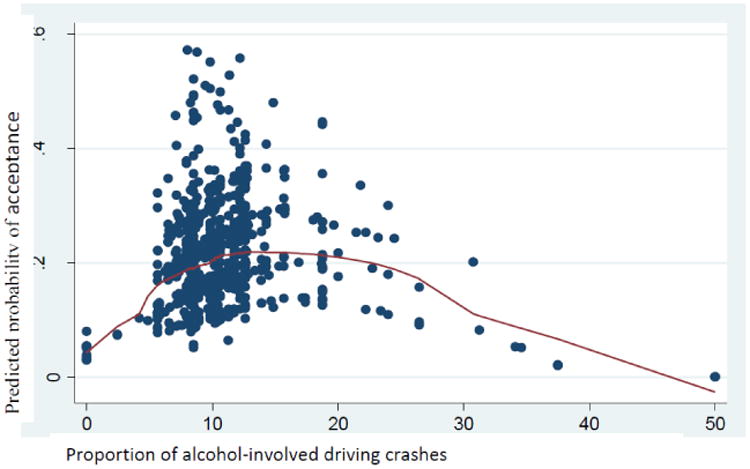
Results: A non-linear relationship between city-level alcohol-involved traffic crashes and individual-level acceptance of drinking and driving was found. Acceptance of drinking and driving did not mediate the relationship between the proportion of alcohol-involved traffic crashes and self-reported drinking and driving behavior. However, it was directly related to behavior among those most likely to drink outside the home.
Discussion: The present study surveys a particularly relevant population and is one of few drinking and driving studies to evaluate the relationship between an objective environmental-level crash risk measure and individual-level risk perceptions. In communities with both low and high proportions of alcohol-involved traffic crashes there was low acceptance of drinking and driving. This may mean that in communities with low proportions of crashes, citizens have less permissive norms around drinking and driving, whereas in communities with a high proportion of crashes, the incidence of these crashes may serve as an environmental cue which informs drinking and driving perceptions. Perceptual information on traffic safety can be used to identify places where people may be at greater risk for drinking and driving. Community-level traffic fatalities may be a salient cue for tailoring risk communication.
Keywords: Alcohol; Drinking and driving; Risk perception; Traffic crashes.
Copyright © 2015 Elsevier Ltd. All rights reserved.
Figures
References
-
- Beck KH, Yan AF, Wang MQ, Kerns TJ, Burch CA. The relationship between impaired driving crashes and beliefs about impaired driving: Do residents in high crash rate counties have greater concerns about impaired driving? Traffic Injury Prevention. 2009;10:127–133. - PubMed
-
- Bergen G, Shults RA, Beck LF, Qayad M. Self-reported alcohol-impaired driving in the U.S., 2006 and 2008. Am J Prev Med. 2012;42(2):142–149. - PubMed
-
- Berkowitz A. The Social Norms Approach: Theory, research, and annotated bibliography. 2004 Retrieved from http://www.alanberkowitz.com/articles/social_norms.pdf.
-
- Bertelli AM, Richardson LE. The behavioral impact of drinking and driving laws. The Policy Studies Journal. 2008;36(4):545–569.
Publication types
MeSH terms
Grants and funding
LinkOut - more resources
Full Text Sources
Other Literature Sources
Medical
Miscellaneous
