


Striking individual differences in color perception uncovered by 'the dress' photograph
- PMID: 25981795
- PMCID: PMC4921196
- DOI: 10.1016/j.cub.2015.04.053
Striking individual differences in color perception uncovered by 'the dress' photograph
Abstract
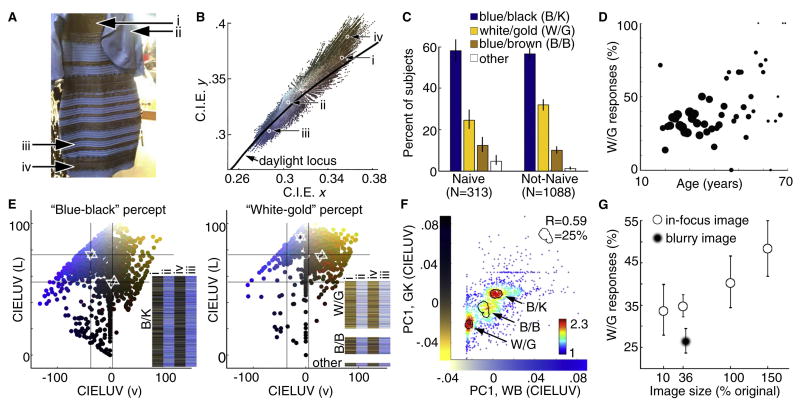
'The dress' is a peculiar photograph: by themselves the dress' pixels are brown and blue, colors associated with natural illuminants, but popular accounts (#TheDress) suggest the dress appears either white/gold or blue/black. Could the purported categorical perception arise because the original social-media question was an alternative-forced-choice? In a free-response survey (N = 1401), we found that most people, including those naïve to the image, reported white/gold or blue/black, but some said blue/brown. Reports of white/gold over blue/black were higher among older people and women. On re-test, some subjects reported a switch in perception, showing the image can be multistable. In a language-independent measure of perception, we asked subjects to identify the dress' colors from a complete color gamut. The results showed three peaks corresponding to the main descriptive categories, providing additional evidence that the brain resolves the image into one of three stable percepts. We hypothesize that these reflect different internal priors: some people favor a cool illuminant (blue sky), discount shorter wavelengths, and perceive white/gold; others favor a warm illuminant (incandescent light), discount longer wavelengths, and see blue/black. The remaining subjects may assume a neutral illuminant, and see blue/brown. We show that by introducing overt cues to the illumination, we can flip the dress color.
Copyright © 2015 Elsevier Ltd. All rights reserved.
Figures
References
-
- Conway BR. Why do we care about the colour of the dress? The Guardian. 2015 http://www.theguardian.com/commentisfree/2015/feb/27/colour-dress-optica....
-
- Rogers A. The Science of Why No One Agrees on the Color of This Dress. Wired. 2015 http://www.wired.com/2015/02/science-one-agrees-color-dress/
-
- Bloj MG, Kersten D, Hurlbert AC. Perception of three-dimensional shape influences colour perception through mutual illumination. Nature. 1999;402:877–879. - PubMed
Publication types
MeSH terms
Grants and funding
LinkOut - more resources
Full Text Sources
Other Literature Sources
