


Kidney Disease Improving Global Outcomes guidelines and parathyroidectomy for renal hyperparathyroidism
- PMID: 25982045
- PMCID: PMC4604005
- DOI: 10.1016/j.jss.2015.04.046
Kidney Disease Improving Global Outcomes guidelines and parathyroidectomy for renal hyperparathyroidism
Abstract
Background: Patients with end-stage renal disease develop hypocalcemia, resulting in secondary hyperparathyroidism (SHPT). No clear criterions exist to aid in surgical decision making for SHPT. The 2009 Kidney Disease Improving Global Outcomes (KDIGO) guidelines provide target ranges for serum calcium, phosphate, and parathyroid hormone (PTH) levels in patients with end-stage renal disease. Parathyroidectomy can help achieve these targets. The study purpose was to examine how parathyroidectomy for SHPT impacts KDIGO targets during immediate and long-term follow-up and to evaluate KDIGO categorization with receipt of additional surgical intervention.
Methods: A retrospective review of a prospective parathyroidectomy database was performed. Included patients had SHPT, were on dialysis, and underwent parathyroidectomy. Calcium, phosphate, and PTH values were classified as below, within, or above KDIGO targets.
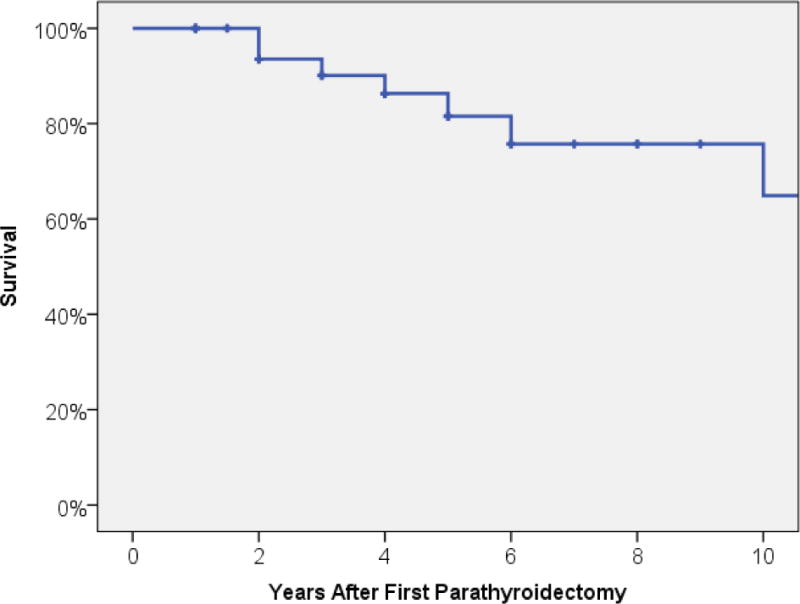
Results: Between 2000 and 2013, 36 patients with SHPT met criteria. Subtotal parathyroidectomy was performed in 89%, total parathyroidectomy in 11%. Follow-up time was 54 ± 7 mo. Eight patients (22%) required additional surgery. Twenty-eight patients (76%) were alive at the last follow-up. At the last-follow up, patients had phosphate (46%), and PTH (17%) above KDIGO ranges. Factors associated with reoperation were assessed. Patient PTH within or above target immediately postoperative had a higher rate of reoperation (P < 0.01). At the last follow-up, higher phosphate (P = 0.054) and PTH (P < 0.001) were associated with higher reoperation rates, but calcium (P = 0.33) was not.
Conclusions: PTH and phosphate levels above KDIGO indices were associated with additional surgical intervention. Many patients had laboratory indices above range at the last follow up, suggesting more patients had persistent or recurrent disease than those who underwent reoperation. Patients may benefit from more aggressive medical and/or surgical management.
Keywords: KDIGO; Mineral and bone disorder; Parathyroidectomy; Renal hyperparathyroidism; Secondary hyperparathyroidism.
Copyright © 2015 Elsevier Inc. All rights reserved.
Conflict of interest statement
The authors report no proprietary or commercial interest in any product mentioned or concept discussed in this article.
Figures
References
-
- Adler JT, Sippel RS, Chen H. New trends in parathyroid surgery. Current problems in surgery. 2010;47:958–1017. - PubMed
-
- Riss P, Asari R, Scheuba C, Niederle B. Current trends in surgery for renal hyperparathyroidism (RHPT)–an international survey. Langenbeck’s archives of surgery / Deutsche Gesellschaft fur Chirurgie. 2013;398:121–130. - PubMed
-
- Tentori F, Wang M, Bieber BA, Karaboyas A, Li Y, et al. Recent Changes in Therapeutic Approaches and Association with Outcomes among Patients with Secondary Hyperparathyroidism on Chronic Hemodialysis: The DOPPS Study. Clinical journal of the American Society of Nephrology : CJASN. 2014 - PMC - PubMed
-
- Alkhalili E, Tasci Y, Aksoy E, Aliyev S, Soundararajan S, et al. The Utility of Neck Ultrasound and Sestamibi Scans in Patients with Secondary and Tertiary Hyperparathyroidism. World journal of surgery. 2014 - PubMed
-
- KDIGO clinical practice guideline for the diagnosis, evaluation, prevention, and treatment of Chronic Kidney Disease-Mineral and Bone Disorder (CKD-MBD) Kidney international Supplement. 2009:S1–130. - PubMed
Publication types
MeSH terms
Substances
Grants and funding
LinkOut - more resources
Full Text Sources
Other Literature Sources
Medical
Miscellaneous
