


Manganese homeostasis in the nervous system
- PMID: 25982296
- PMCID: PMC4516557
- DOI: 10.1111/jnc.13170
Manganese homeostasis in the nervous system
Abstract
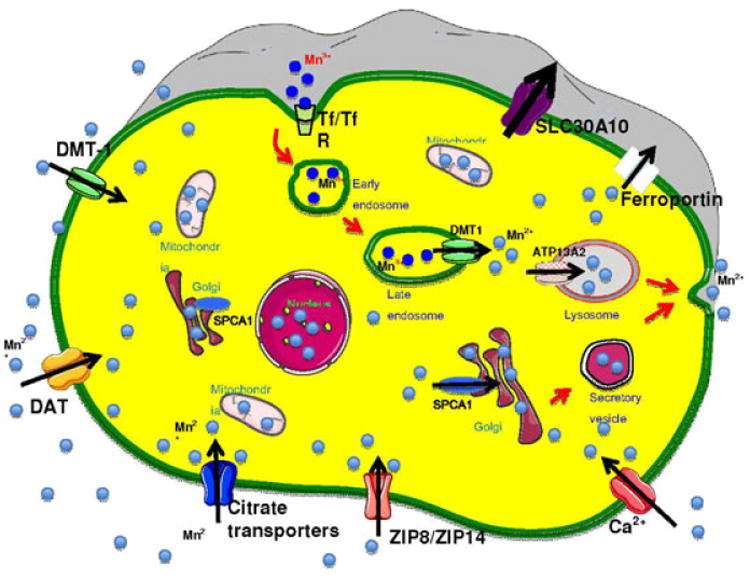
Manganese (Mn) is an essential heavy metal that is naturally found in the environment. Daily intake through dietary sources provides the necessary amount required for several key physiological processes, including antioxidant defense, energy metabolism, immune function and others. However, overexposure from environmental sources can result in a condition known as manganism that features symptomatology similar to Parkinson's disease (PD). This disorder presents with debilitating motor and cognitive deficits that arise from a neurodegenerative process. In order to maintain a balance between its essentiality and neurotoxicity, several mechanisms exist to properly buffer cellular Mn levels. These include transporters involved in Mn uptake, and newly discovered Mn efflux mechanisms. This review will focus on current studies related to mechanisms underlying Mn import and export, primarily the Mn transporters, and their function and roles in Mn-induced neurotoxicity. Though and essential metal, overexposure to manganese may result in neurodegenerative disease analogous to Parkinson's disease. Manganese homeostasis is tightly regulated by transporters, including transmembrane importers (divalent metal transporter 1, transferrin and its receptor, zinc transporters ZIP8 and Zip14, dopamine transporter, calcium channels, choline transporters and citrate transporters) and exporters (ferroportin and SLC30A10), as well as the intracellular trafficking proteins (SPCA1 and ATP12A2). A manganese-specific sensor, GPP130, has been identified, which affords means for monitoring intracellular levels of this metal.
Keywords: Parkinson's disease; manganese; transport.
© 2015 International Society for Neurochemistry.
Conflict of interest statement
The authors have no conflicts of interest to declare.
Figures
References
-
- Aisen P, Leibman A, Zweier J. Stoichiometric and site characteristics of the binding of iron to human transferrin. Journal of Biological Chemistry. 1978;253:1930–1937. - PubMed
-
- ATSDR. Toxicological profile for manganese (Draft for Public Comment) US Department of Health and Human Services, Public Service 2008
Publication types
MeSH terms
Substances
Grants and funding
LinkOut - more resources
Full Text Sources
Other Literature Sources
Medical
