Review
. 2015 Apr 29;7(1):55.
doi: 10.1186/s13148-015-0055-7. eCollection 2015.

Environmental chemicals and DNA methylation in adults: a systematic review of the epidemiologic evidence

Affiliations
Review

Environmental chemicals and DNA methylation in adults: a systematic review of the epidemiologic evidence

Adrian Ruiz-Hernandez et al. Clin Epigenetics. .

Abstract

Current evidence supports the notion that environmental exposures are associated with DNA-methylation and expression changes that can impact human health. Our objective was to conduct a systematic review of epidemiologic studies evaluating the association between environmental chemicals with DNA methylation levels in adults. After excluding arsenic, recently evaluated in a systematic review, we identified a total of 17 articles (6 on cadmium, 4 on lead, 2 on mercury, 1 on nickel, 1 on antimony, 1 on tungsten, 5 on persistent organic pollutants and perfluorinated compounds, 1 on bisphenol A, and 3 on polycyclic aromatic hydrocarbons). The selected articles reported quantitative methods to determine DNA methylation including immunocolorimetric assays for total content of genomic DNA methylation, and microarray technologies, methylation-specific quantitative PCR, Luminometric Methylation Assay (LUMA), and bisulfite pyrosequencing for DNA methylation content of genomic sites such as gene promoters, LINE-1, Alu elements, and others. Considering consistency, temporality, strength, dose-response relationship, and biological plausibility, we concluded that the current evidence is not sufficient to provide inference because differences across studies and limited samples sizes make it difficult to compare across studies and to evaluate sources of heterogeneity. Important questions for future research include the need for larger and longitudinal studies, the validation of findings, and the systematic evaluation of the dose-response relationships. Future studies should also consider the evaluation of epigenetic marks recently in the research spotlight such as DNA hydroxymethylation and the role of underlying genetic variants.

Keywords: Bisphenol A; Cadmium; DNA methylation; Environmental chemicals; Lead; Mercury; Metals; Persistent organic pollutants; Polycyclic aromatic hydrocarbons; Systematic review.


Figures
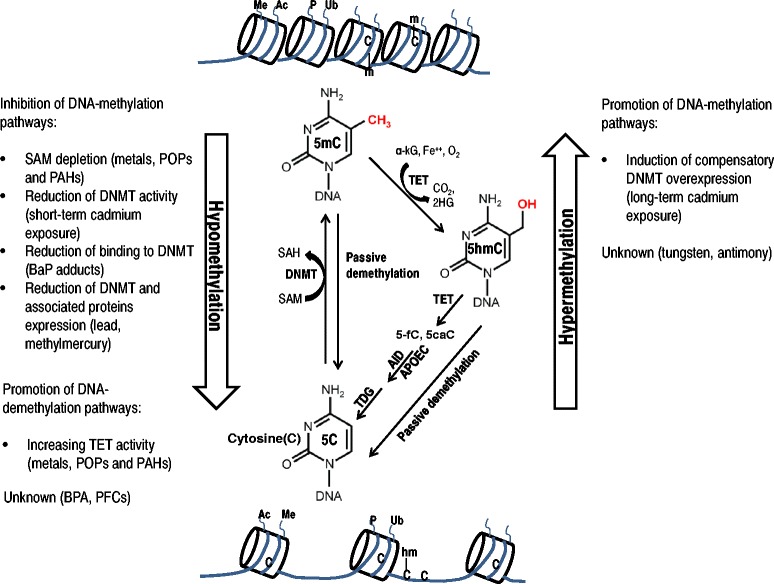
Figure 1
Figure 1
Overview of possible mechanisms of action for environmental chemicals on DNA methylation based on reviews of experimental studies [ 2 , 3 , 5 , 135 , 136 ]. Metals, POPs, and PAH increase reactive oxygen species (ROS) formation. Under chronic consumption of glutathione (GSH) for conjugation with ROS, chemicals, and their metabolites, homocysteine is employed into GSH rather than methionine synthesis pathways, leading to a reduced synthesis of S-adenosylmethionine (SAM, a substrate for DNA methyltransferases (DNMT) which catalyzes the addition of the methyl group onto the 5-carbon cytosine (5C) to become 5-methylcytosine (5mC)). SAM depletion, thus, potentially inhibits DNA methylation and results in subsequent DNA hypomethylation [2]. Exposures to specific environmental chemicals such as short-term cadmium, PAH, lead, and mercury exposures can directly reduce the enzymatic activity and concentrations of DNMT [136]. In addition, oxidative stress is proposed to stimulate the alpha-ketoglutarate (α-KG) production from isocitrate. α-KG activates ten-eleven translocation (TET) proteins that catalyze the oxidation of 5mC to 5-hydroxymethylcytosine (5hmC), 5-formlycytosine (5fC), and 5-carboxycytosine (5caC) in the presence of cofactors, iron and oxygen. 5hmC, 5fC, and 5caC could act as an intermediate in both passive and active DNA demethylation pathways [3,135] involving DNA repair enzymes like AID, APOEC, and TDG. Overall, it facilitates DNA hypomethylation. Conversely, it has been suggested that long-term cadmium exposure induces compensatory DNMT overexpression [4] that could lead to increased DNA methylation. On the other hand, environmental chemicals can modulate the enzymes involved in covalent modifications (acetylation (Ac), methylation (Me)), phosphorylation (P) and ubiquitination (Ub)) at the histone tails that can interact with the DNA methylation or demethylation machinery. Lead has been related with transcription-active histone modifications (associated to DNA hypomethylation), while methylmercury and nickel have been related with transcription-repressive histone modifications (associated to DNA hypermethylation) [5,136]. Finally, while other environmental toxicants have been related to DNA hypomethylation (BPA, PFCs) and hypermethylation (tungsten, antimony) in epidemiologic studies, their mechanism of action in epigenetic regulation of gene transcription is unknown.
Figure 2
Figure 2
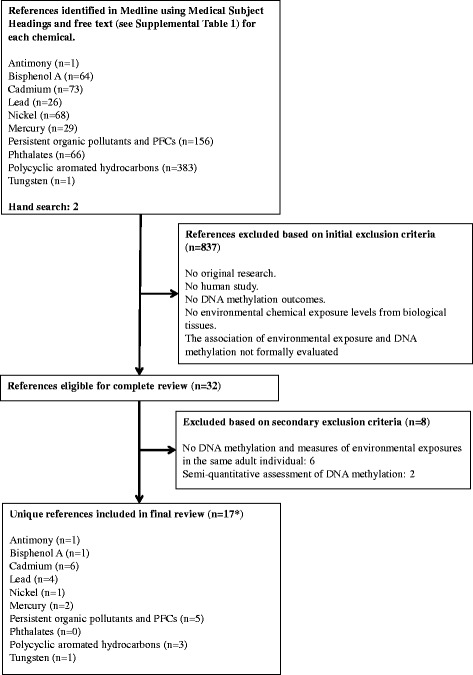
Flow diagram of the study selection process. Summary of inclusion and exclusion criteria used in this systematic review of studies investigating the association between environmental chemicals and DNA methylation levels, 10 April 2014. *17 references include the following studies with multiple environmental toxicants evaluated in unique study populations: Hanna et al. (2012) [29] examined in SMART population urine cadmium, blood lead and mercury, and serum BPA. Tajuddin et al. (2013) [30] examined in EPICURO population toenail cadmium, nickel, and lead. Tellez-Plaza et al. (2014) [19] examined in the SHS populations urine tungsten, antimony, and cadmium. Abbreviations: BPA, bisphenol A; PCF, perfluorinated compounds.

References

    1. Pruss-Ustun A, Vickers C, Haefliger P, Bertollini R. Knowns and unknowns on burden of disease due to chemicals: a systematic review. Environ Health. 2011;10:9. - PMC - PubMed
    1. Lee DH, Jacobs DR, Jr, Porta M. Hypothesis: a unifying mechanism for nutrition and chemicals as lifelong modulators of DNA hypomethylation. Environ Health Perspect. 2009;117:1799–1802. - PMC - PubMed
    1. Chia N, Wang L, Lu X, Senut MC, Brenner C, Ruden DM. Hypothesis: environmental regulation of 5-hydroxymethylcytosine by oxidative stress. Epigenetics. 2011;6:853–856. - PubMed
    1. Takiguchi M, Achanzar WE, Qu W, Li G, Waalkes MP. Effects of cadmium on DNA-(Cytosine-5) methyltransferase activity and DNA methylation status during cadmium-induced cellular transformation. Exp Cell Res. 2003;286:355–365. - PubMed
    1. Chervona Y, Costa M. The control of histone methylation and gene expression by oxidative stress, hypoxia, and metals. Free Radic Biol Med. 2012;53:1041–1047. - PMC - PubMed

LinkOut - more resources