Imaging Correlates of Memory and Concussion History in Retired National Football League Athletes
- PMID: 25985094
- PMCID: PMC6761828
- DOI: 10.1001/jamaneurol.2015.0206
Imaging Correlates of Memory and Concussion History in Retired National Football League Athletes
Abstract
Importance: To our knowledge, this is the first study to show an association between concussion, cognition, and anatomical structural brain changes across the age spectrum in former National Football League athletes.
Objective: To assess the relationship of hippocampal volume, memory performance, and the influence of concussion history in retired National Football League athletes with and without mild cognitive impairment (MCI).
Design, setting, and participants: This retrospective cohort study assessed differences between groups, mean hippocampal volumes, and memory performance by computing age quintiles based on group-specific linear regression models corrected for multiple comparisons for both athletes and control participants. The study was conducted starting in November 2010 and is ongoing at a research center in the northern region of Texas. This current analysis was conducted from October 9, 2013, to August 21, 2014. Participants included 28 retired National Football League athletes, 8 of whom had MCI and a history of concussion, 21 cognitively healthy control participants, and 6 control participants with MCI without concussion.
Main outcomes and measures: Hippocampal volume, age, California Verbal Learning Test scores, and the number of grade 3 (G3) concussions. In addition, the number of games played was examined as an objective variable pertaining to football history.
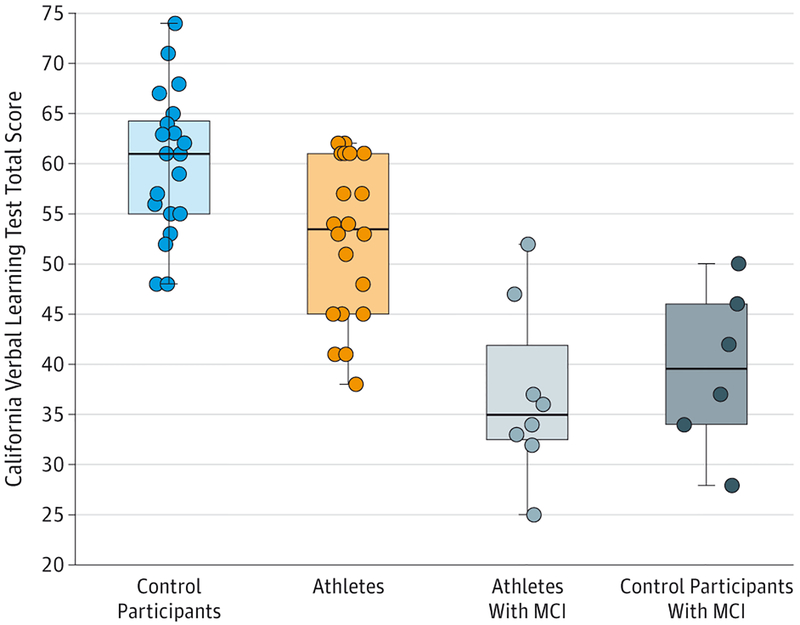
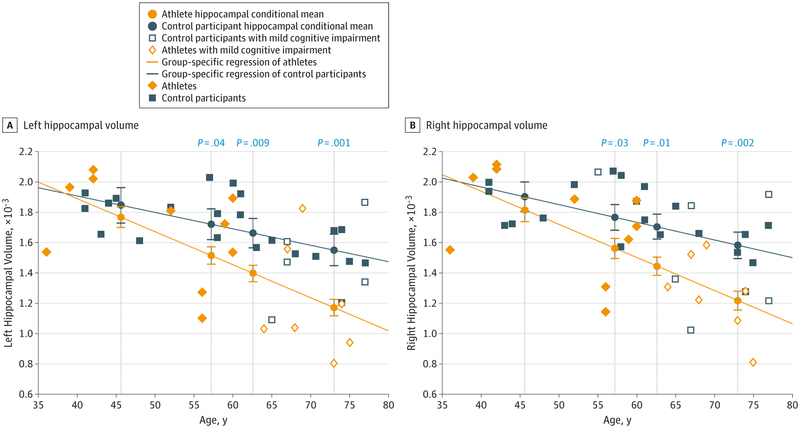
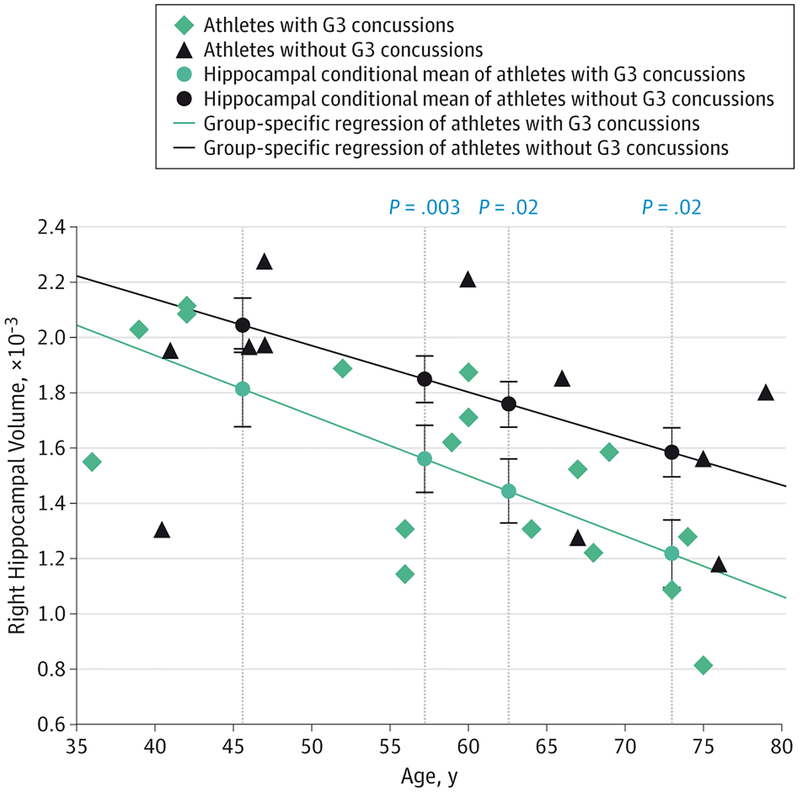
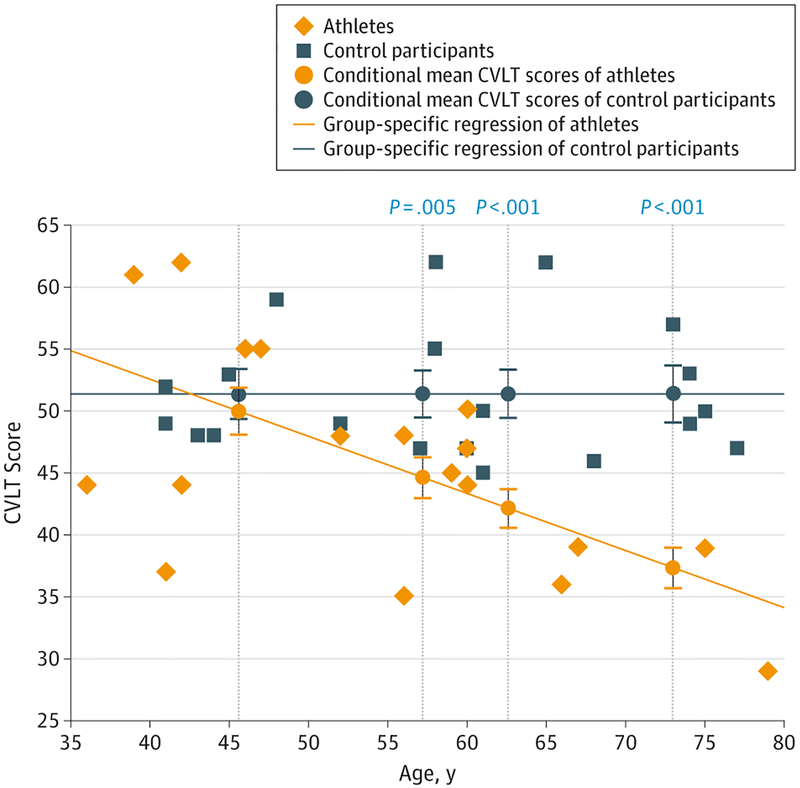
Results: The mean (SD) age was 58.1 (13) years for the 28 former athletes and 59.0 (12) years for the 27 control participants. Retired athletes with concussion history but without cognitive impairment had normal but significantly lower California Verbal Learning Test scores compared with control participants (mean [SD], 52.5 [8] vs 60.24 [7]; P = .002); those with a concussion history and MCI performed worse (mean [SD], 37 [8.62]) compared with both control participants (P < .001) and athletes without memory impairment (P < .001). Among the athletes, 17 had a G3 concussion and 11 did not. Older retired athletes with at least 1 G3 concussion had significantly smaller bilateral hippocampal volumes compared with control participants at the 40th age percentile (left, P = .04; right, P = .03), 60th percentile (left, P = .009; right, P = .01), and 80th percentile (left, P = .001; right, P = .002) and a smaller right hippocampal volume compared with athletes without a G3 concussion at the 40th percentile (P = .03), 60th percentile (P = .02), and 80th percentile (P = .02). Athletes with a history of G3 concussion were more likely to have MCI (7 of 7) compared with retired athletes without a history of G3 concussion (1 of 5) older than 63 years (P = .01). In addition, the left hippocampal volume in retired athletes with MCI and concussion was significantly smaller compared with control participants with MCI (P = .03).
Conclusion and relevance: Prior concussion that results in loss of consciousness is a risk factor for increased hippocampal atrophy and the development of MCI. In individuals with MCI, hippocampal volume loss appears greater among those with a history of concussion.
Conflict of interest statement
Figures
References
-
- Iverson GL, Brooks BL, Collins MW, Lovell MR. Tracking neuropsychological recovery following concussion in sport. Brain Inj. 2006;20(3): 245–252. - PubMed
-
- Klein M, Houx PJ, Jolles J. Long-term persisting cognitive sequelae of traumatic brain injury and the effect of age. J Nerv Ment Dis. 1996;184(8):459–467. - PubMed
-
- Kraus MF, Susmaras T, Caughlin BP, Walker CJ, Sweeney JA, Little DM. White matter integrity and cognition in chronic traumatic brain injury: a diffusion tensor imaging study. Brain. 2007; 130(pt 10):2508–2519. - PubMed
-
- Geary EK, Kraus MF, Pliskin NH, Little DM. Verbal learning differences in chronic mild traumatic brain injury. J Int Neuropsychol Soc. 2010;16(3):506–516. - PubMed
Publication types
MeSH terms
Grants and funding
LinkOut - more resources
Full Text Sources
Other Literature Sources
Medical