Review
. 2015 Jun;38(6):475-81.
doi: 10.14348/molcells.2015.0103. Epub 2015 May 19.

Measuring and Reducing Off-Target Activities of Programmable Nucleases Including CRISPR-Cas9

Affiliations
Review

Measuring and Reducing Off-Target Activities of Programmable Nucleases Including CRISPR-Cas9

Taeyoung Koo et al. Mol Cells. 2015 Jun.

Abstract

Programmable nucleases, which include zinc-finger nucleases (ZFNs), transcription activator-like effector nucleases (TALENs), and RNA-guided engineered nucleases (RGENs) repurposed from the type II clustered, regularly interspaced short palindromic repeats (CRISPR)-CRISPR-associated protein 9 (Cas9) system are now widely used for genome editing in higher eukaryotic cells and whole organisms, revolutionising almost every discipline in biological research, medicine, and biotechnology. All of these nucleases, however, induce off-target mutations at sites homologous in sequence with on-target sites, limiting their utility in many applications including gene or cell therapy. In this review, we compare methods for detecting nuclease off-target mutations. We also review methods for profiling genome-wide off-target effects and discuss how to reduce or avoid off-target mutations.

Keywords: CRISPR; Cas9; TALEN; ZFN; genome editing; off-target.


Figures
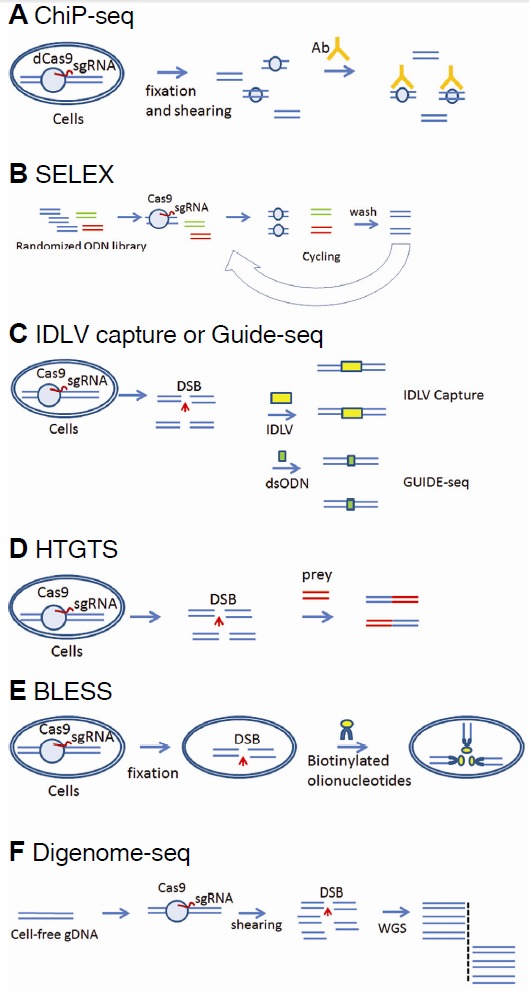
Fig. 1.
Fig. 1.
Overview of methods for measuring off-target effects in the genome. (A) Chromatin immunoprecipitation coupled with deep sequencing (ChIP-Seq). (B) Systemic evolution of ligands by exponential amplification (SELEX). (C) Integrase-deficient lentivirus (IDLV) capture or genome-wide, unbiased identification of DSBs enabled by sequencing (GUIDE-seq). (D) High-throughput genomic translocation sequencing (HTGTS). (E) Breaks labelling, enrichments on streptavidin and next-generation sequencing (BLESS). (F) In vitro nuclease-digested genome sequencing (Digenome-seq). Ab, antibody, dCas9, catalytically-dead Cas9; DSB, double-strand break; ODN, oligodeoxynucleotide; sgRNA, small-guide RNA; WGS, whole-genome sequencing; WT, wild type.
Fig. 2.
Fig. 2.
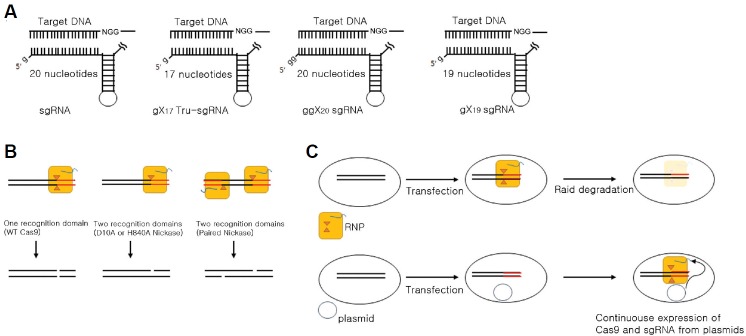
Schematic strategies for reducing off-target mutations. (A) Four different forms of sgRNAs. sgRNAs with two extra guanines (ggX20) or truncated sgRNAs (gX17) enhance the specificity of RNA-guided genome editing, compared to conventional sgRNAs (gX19 or gX20). (B) Use of paired nickases to generate two single-strand breaks or nicks on different DNA strands. (C) Use of Cas9-sgRNA ribonucleoprotein (RNP) complexes, rather than the Cas9 and sgRNA-encoding plasmids to avoid continuous expression of Cas9 and sgRNA from plasmids.

References

    1. Bae S, Park J, Kim JS. Cas-OFFinder: A fast and versatile algorithm that searches for potential off-target sites of Cas9 RNA-guided endonucleases. Bioinformatics. 2014;30:1473–1475. - PMC - PubMed
    1. Bibikova M, Beumer K, Trautman JK, Carroll D. Enhancing gene targeting with designed zinc finger nucleases. Science. 2003;300:764. - PubMed
    1. Bitinaite J, Wah DA, Aggarwal AK, Schildkraut I. FokI dimerization is required for DNA cleavage. Proc. Natl. Acad. Sci. USA. 1998;95:10570–10575. - PMC - PubMed
    1. Boch J, Scholze H, Schornack S, Landgraf A, Hahn S, Kay S, Lahaye T, Nickstadt A, Bonas U. Breaking the code of DNA binding specificity of TAL-type III effectors. Science. 2009;326:1509–1512. - PubMed
    1. Brunet E, Simsek D, Tomishima M, DeKelver R, Choi VM, Gregory P, Urnov F, Weinstock DM, Jasin M. Chromosomal translocations induced at specified loci in human stem cells. Proc. Natl. Acad. Sci. 2009;106:10620–10625. - PMC - PubMed

Publication types

MeSH terms