


Midlife Blood Pressure and Late-Life GFR and Albuminuria: An Elderly General Population Cohort
- PMID: 25987258
- PMCID: PMC4516633
- DOI: 10.1053/j.ajkd.2015.03.030
Midlife Blood Pressure and Late-Life GFR and Albuminuria: An Elderly General Population Cohort
Abstract
Background: Chronic kidney disease (CKD) is common in the elderly, but the cause is often not identifiable. Some posit that age-related reductions in glomerular filtration rate (GFR) and increases in albuminuria are normal, whereas others suggest that they are a consequence of vascular disease.
Study design: Cross-sectional analysis of a substudy of a prospective cohort.
Setting & participants: AGES (Age, Gene/Environment Susceptibility)-Reykjavik Study.
Predictor: Exposure to higher blood pressure in midlife.
Outcomes & measurements: Measured GFR using plasma clearance of iohexol and urine albumin-creatinine ratio.
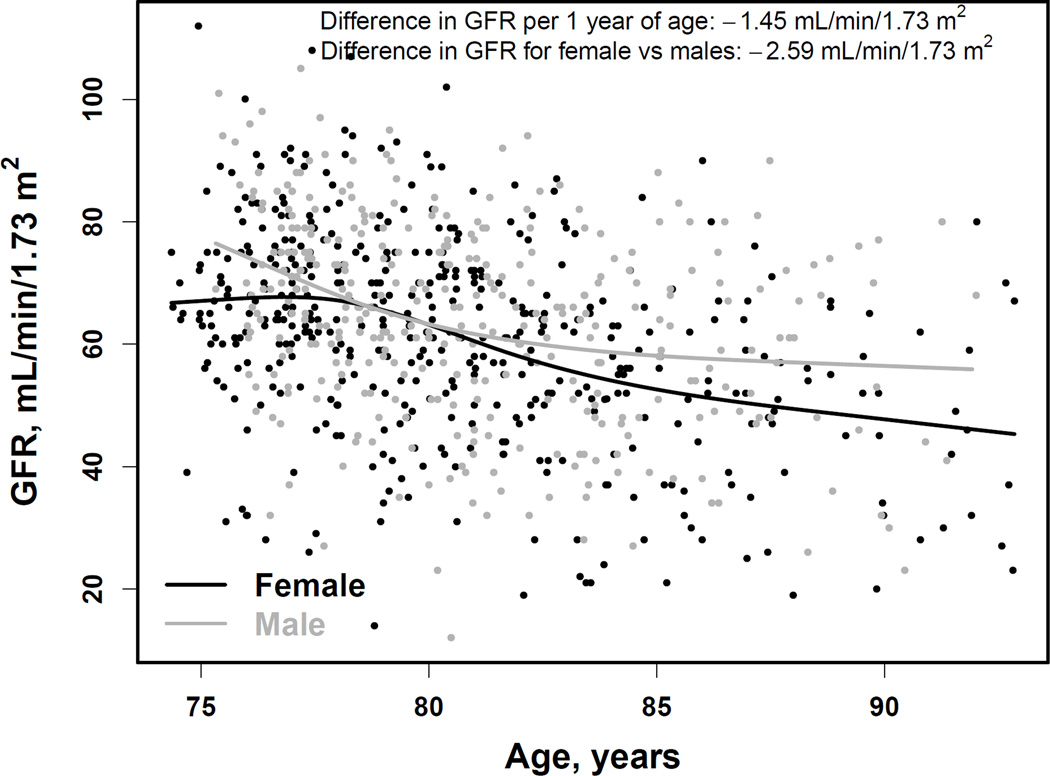
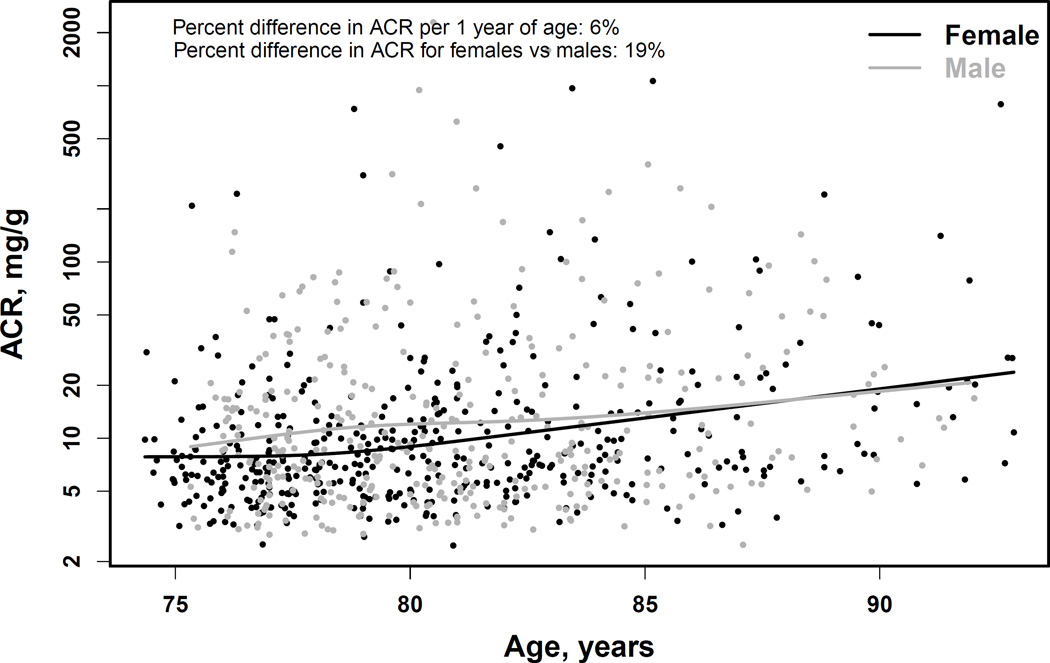
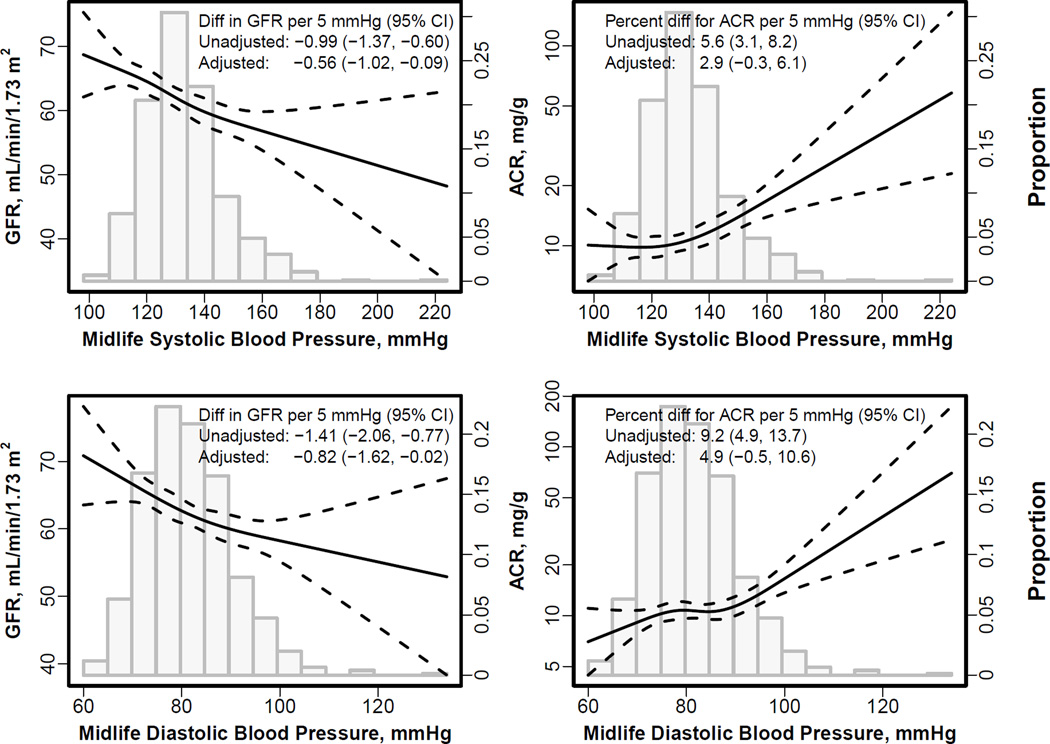
Results: GFR was measured in 805 participants with mean age in midlife and late life of 51.0±5.8 and 80.8±4.0 (SD) years, respectively. Mean measured GFR was 62.4±16.5 mL/min/1.73 m(2) and median albuminuria was 8.0 (IQR, 5.4-16.5) mg/g. Higher midlife systolic and diastolic blood pressures were associated with lower later-life GFRs. Associations persisted after adjustment. Higher midlife systolic and diastolic blood pressures were also associated with higher albumin-creatinine ratios, and associations remained significant even after adjustment.
Limitations: This is a study of survivors, and people who agreed to participate in this study were healthier than those who refused. Blood pressure may encompass effects of the other risk factors. Results may not be generalizable to populations of other races. We were not able to adjust for measured GFR or albuminuria at the midlife visit.
Conclusions: Factors other than advanced age may account for the high prevalence of CKD in the elderly. Midlife factors are potential contributing factors to late-life kidney disease. Further studies are needed to identify and treat midlife modifiable factors to prevent the development of CKD.
Keywords: Chronic kidney disease (CKD); aging; albumin-creatinine ratio (ACR); albuminuria; blood pressure; elderly; hypertension; iohexol clearance; measured glomerular filtration rate (mGFR); mid-life; modifiable risk factor; renal function.
Copyright © 2015 National Kidney Foundation, Inc. All rights reserved.
Figures
Comment in
-
CKD in the Elderly: Kidney Senescence or Blood Pressure-Related Nephropathy?Am J Kidney Dis. 2015 Aug;66(2):184-6. doi: 10.1053/j.ajkd.2015.05.004. Am J Kidney Dis. 2015. PMID: 26210723 No abstract available.
References
-
- Levey AS, Coresh J. Chronic kidney disease. Lancet. 2012;379(9811):165–180. - PubMed
-
- Eckardt KU, Berns JS, Rocco MV, Kasiske BL. Definition and classification of CKD: the debate should be about patient prognosis--a position statement from KDOQI and KDIGO. Am J Kidney Dis. 2009;53(6):915–920. - PubMed
-
- Coresh J, Selvin E, Stevens LA, et al. Prevalence of chronic kidney disease in the United States. JAMA. 2007;298(17):2038–2047. - PubMed
-
- Sarnak MJ, Katz R, Stehman-Breen CO, et al. Cystatin C concentration as a risk factor for heart failure in older adults. Ann Intern Med. 2005;142(7):497–505. - PubMed
Publication types
MeSH terms
Substances
Grants and funding
LinkOut - more resources
Full Text Sources
Other Literature Sources
Medical
