


Prevalence of fatty liver disease and the economy in China: A systematic review
- PMID: 25987797
- PMCID: PMC4427696
- DOI: 10.3748/wjg.v21.i18.5695
Prevalence of fatty liver disease and the economy in China: A systematic review
Abstract
Aim: To investigate the relationship between the economy and the adult prevalence of fatty liver disease (FLD) in mainland China.
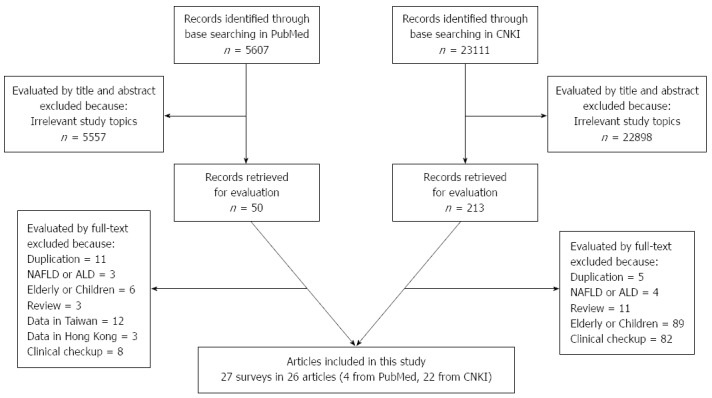
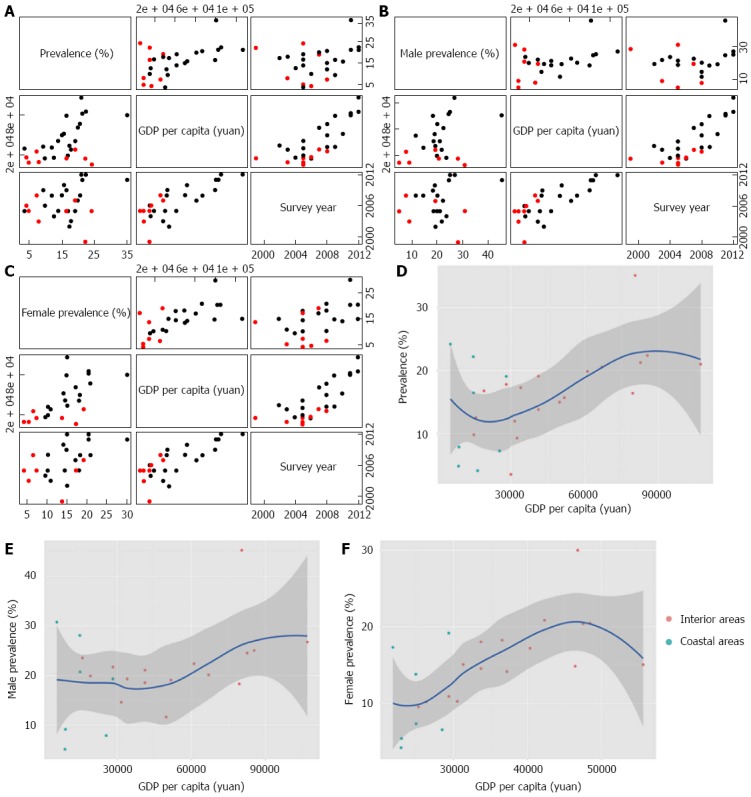
Methods: Literature searches on the PubMed and Chinese National Knowledge Infrastructure databases were performed to identify eligible studies published before July 2014. Records were limited to cross-sectional surveys or baseline surveys of longitudinal studies that reported the adult prevalence of FLD and recruited subjects from the general population or community. The gross domestic product (GDP) per capita was chosen to assess the economic status. Multiple linear regression and Loess regression were chosen to fit the data and calculate the 95%CIs. Fitting and overfitting of the models were considered in choosing the appropriate models.
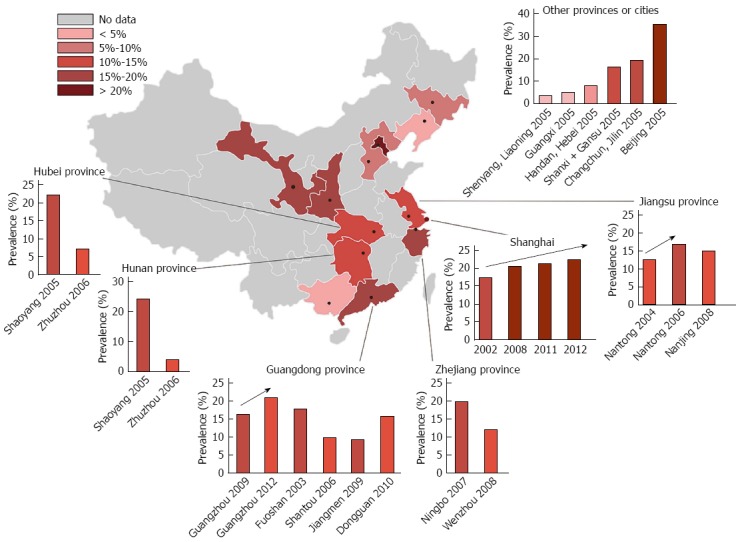
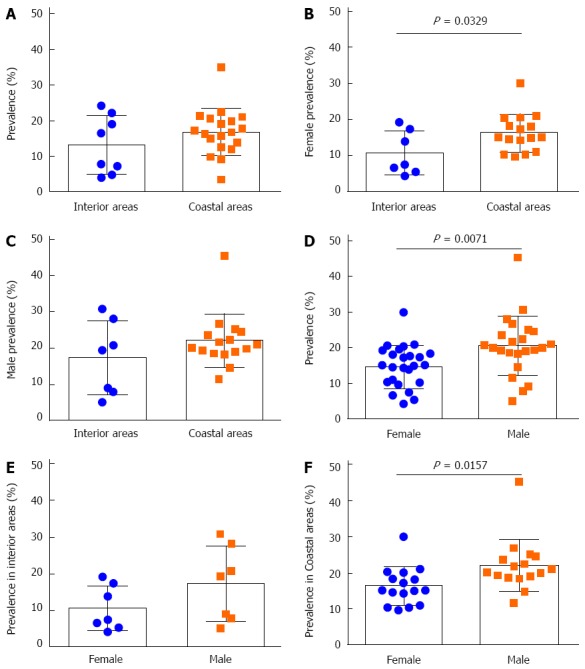
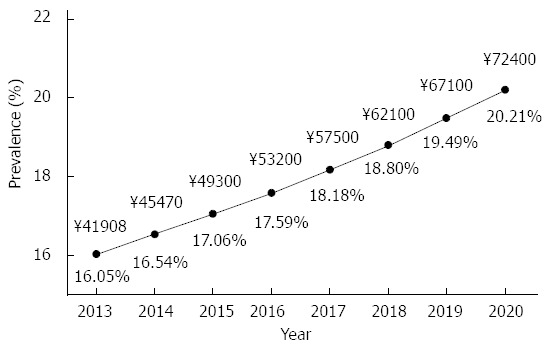
Results: There were 27 population-based surveys from 26 articles included in this study. The pooled mean prevalence of FLD in China was 16.73% (95%CI: 13.92%-19.53%). The prevalence of FLD was correlated with the GDP per capita and survey years in the country (adjusted R (2) = 0.8736, P GDP per capita = 0.00426, P years = 0.0000394), as well as in coastal areas (R (2) = 0.9196, P GDP per capita = 0.00241, P years = 0.00281). Furthermore, males [19.28% (95%CI: 15.68%-22.88%)] presented a higher prevalence than females [14.1% (95%CI: 11.42%-16.61%), P = 0.0071], especially in coastal areas [21.82 (95%CI: 17.94%-25.71%) vs 17.01% (95%CI: 14.30%-19.89%), P = 0.0157]. Finally, the prevalence was predicted to reach 20.21% in 2020, increasing at a rate of 0.594% per year.
Conclusion: This study reveals a correlation between the economy and the prevalence of FLD in mainland China.
Keywords: Economy; Epidemiology; Fatty liver disease; Gross domestic product per capita; Prevalence.
Figures
References
-
- Adams LA, Lymp JF, St Sauver J, Sanderson SO, Lindor KD, Feldstein A, Angulo P. The natural history of nonalcoholic fatty liver disease: a population-based cohort study. Gastroenterology. 2005;129:113–121. - PubMed
-
- Mohapatra S, Patra J, Popova S, Duhig A, Rehm J. Social cost of heavy drinking and alcohol dependence in high-income countries. Int J Public Health. 2010;55:149–157. - PubMed
-
- Nascimbeni F, Pais R, Bellentani S, Day CP, Ratziu V, Loria P, Lonardo A. From NAFLD in clinical practice to answers from guidelines. J Hepatol. 2013;59:859–871. - PubMed
-
- Crabb DW, Galli A, Fischer M, You M. Molecular mechanisms of alcoholic fatty liver: role of peroxisome proliferator-activated receptor alpha. Alcohol. 2004;34:35–38. - PubMed
Publication types
MeSH terms
LinkOut - more resources
Full Text Sources
Other Literature Sources
Medical
