Opioid education and nasal naloxone rescue kits in the emergency department
- PMID: 25987910
- PMCID: PMC4427207
- DOI: 10.5811/westjem.2015.2.24909
Opioid education and nasal naloxone rescue kits in the emergency department
Abstract
Introduction: Emergency departments (EDs) may be high-yield venues to address opioid deaths with education on both overdose prevention and appropriate actions in a witnessed overdose. In addition, the ED has the potential to equip patients with nasal naloxone kits as part of this effort. We evaluated the feasibility of an ED-based overdose prevention program and described the overdose risk knowledge, opioid use, overdoses, and overdose responses among participants who received overdose education and naloxone rescue kits (OEN) and participants who received overdose education only (OE).
Methods: Program participants were surveyed by telephone after their ED visit about their substance use, overdose risk knowledge, history of witnessed and personal overdoses, and actions in a witnessed overdose including use of naloxone.
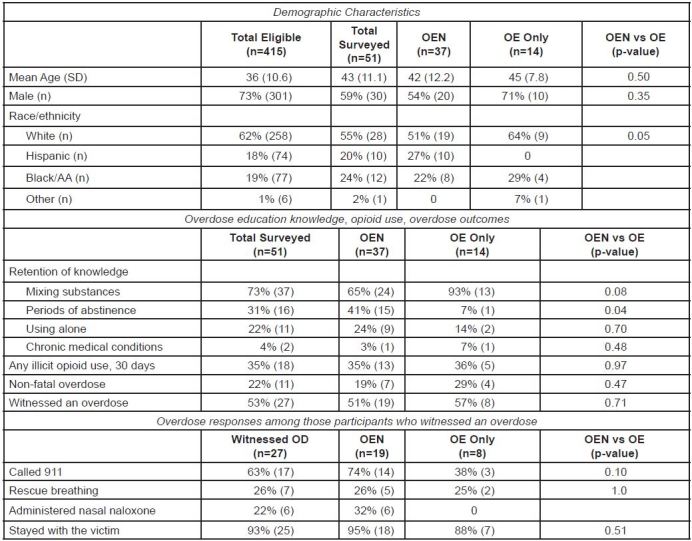
Results: A total of 415 ED patients received OE or OEN between January 1, 2011 and February 28, 2012. Among those, 51 (12%) completed the survey; 37 (73%) of those received a naloxone kit, and 14 (27%) received OE only. Past 30-day opioid use was reported by 35% OEN and 36% OE, and an overdose was reported by 19% OEN and 29% OE. Among 53% (27/51) of participants who witnessed another individual experiencing an overdose, 95% OEN and 88% OE stayed with victim, 74% OEN and 38% OE called 911, 26% OEN and 25% OE performed rescue breathing, and 32% OEN (n=6) used a naloxone kit to reverse the overdose. We did not detect statistically significant differences between OEN and OE-only groups in opioid use, overdose or response to a witnessed overdose.
Conclusion: This is the first study to demonstrate the feasibility of ED-based opioid overdose prevention education and naloxone distribution to trained laypersons, patients and their social network. The program reached a high-risk population that commonly witnessed overdoses and that called for help and used naloxone, when available, to rescue people. While the study was retrospective with a low response rate, it provides preliminary data for larger, prospective studies of ED-based overdose prevention programs.
Figures
References
-
- Jones CM, Mack KA, Paulozzi LJ. Pharmaceutical Overdose Deaths, United States, 2010. JAMA. 2013;309(7):657–659. - PubMed
-
- Substance Abuse and Mental Health Services Administration, Center for Behavioral Health Statistics and Quality. The DAWN Report: Highlights of the 2011 Drug Abuse Warning Network (DAWN) Findings on Drug-Related Emergency Department Visits. Rockville, MD: - PubMed
-
- Office of National Drug Control Policy National Drug Control Strategy. 2013. Available at: http://www.whitehouse.gov/sites/default/files/ondcp/policy-and-research/....
MeSH terms
Substances
LinkOut - more resources
Full Text Sources
Other Literature Sources
Medical
Miscellaneous